

DZone
Thanks for visiting DZone today,
Edit Profile
  • Manage Email Subscriptions
  • How to Post to DZone
  • Article Submission Guidelines
Sign Out View Profile
  • Post an Article
  • Manage My Drafts
Over 2 million developers have joined DZone.
Log In / Join
Refcards Trend Reports
Events Video Library
Refcards
Trend Reports

Events

View Events Video Library

Related

  • MuleSoft MCP and A2A in Production: What 17 Recipes Reveal
  • MuleSoft IDP: Enhancing Efficiency and Accuracy in Data Extraction
  • From AI Chaos to Control: Building Enterprise-Grade LLM Gateways With MuleSoft Anypoint
  • Revolutionizing Scaled Agile Frameworks with AI, MuleSoft, and AWS: An Insider’s Perspective

Trending

  • Lambda-Driven API Design: Building Composable Node.js Endpoints With Functional Primitives
  • How SaaS Architectures Break at Scale — and the Engineering Decisions That Prevent It
  • When Snowflake Lies to You: Understanding False Failures in dbt Pipelines
  • MuleSoft IDP: Enhancing Efficiency and Accuracy in Data Extraction
  1. DZone
  2. Software Design and Architecture
  3. Integration
  4. MuleSoft: Using a Groovy Component

MuleSoft: Using a Groovy Component

Looking for some time to let your code catch its breath? Adding a Groovy component to your Mule can give you the pause you're looking for.

By 
Kumar Gaurav user avatar
Kumar Gaurav
·
Jul. 19, 16 · Tutorial
Likes (4)
Comment
Save
Tweet
Share
11.4K Views

Join the DZone community and get the full member experience.

Join For Free

While working with MuleSoft, we would often like to pause process execution for while and continue later. Normally in Java, we can use the sleep() method to achieve that. But with Mule, the Groovy component has the answer.

Sample Use Case

Let's consider a flow where a file component will poll files from a particular location and will push them to specified target location. We would like to hold the file for a particular interval (say three seconds) and then push it outbound.
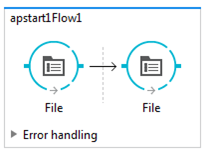
Image title

Implementation

We can achieve that by using the Groovy component, followed by implementating the sleep method within it. 

1. First, create a Mule project followed by a flow-apstartFlow1.

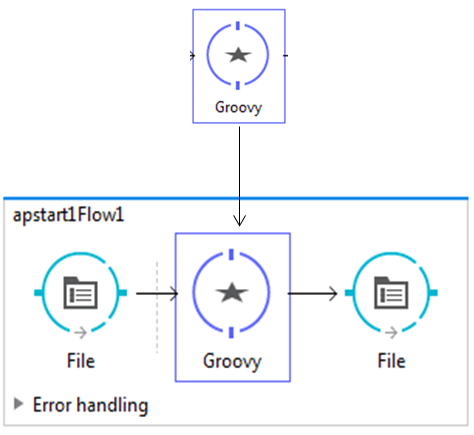
2. Add and configure the file component as inbound and outbound. Add a Groovy component between the two file components:
Using groovy component


3. Add a script in the Groovy configuration:
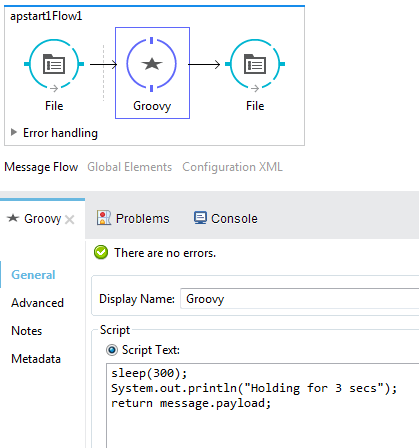
Image title


4. Save and run the application.

5. The console log will contain the message specified in the script:
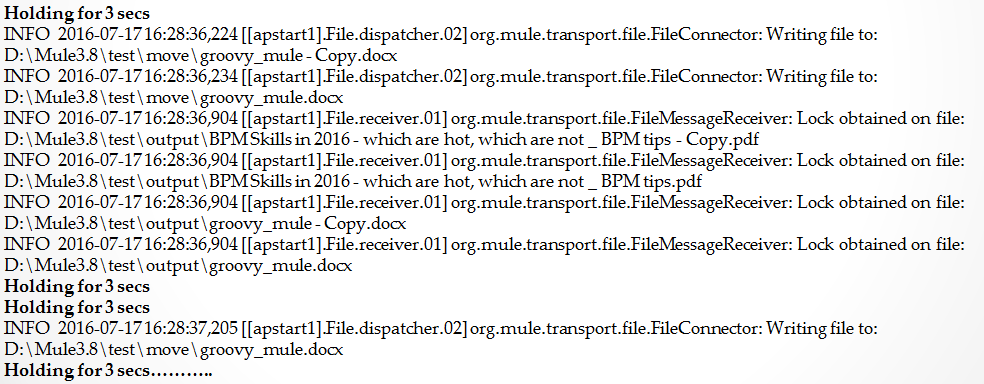
Image title

Note: I have used Mule runtime 3.8 while taking the screenshots.

So, with that, we have seen that the Groovy component is useful for implementing some custom business requirements.

Groovy (programming language) MuleSoft

Published at DZone with permission of Kumar Gaurav. See the original article here.

Opinions expressed by DZone contributors are their own.

Related

  • MuleSoft MCP and A2A in Production: What 17 Recipes Reveal
  • MuleSoft IDP: Enhancing Efficiency and Accuracy in Data Extraction
  • From AI Chaos to Control: Building Enterprise-Grade LLM Gateways With MuleSoft Anypoint
  • Revolutionizing Scaled Agile Frameworks with AI, MuleSoft, and AWS: An Insider’s Perspective

Partner Resources

×

Comments

The likes didn't load as expected. Please refresh the page and try again.

  • RSS
  • X
  • Facebook

ABOUT US

  • About DZone
  • Support and feedback
  • Community research

ADVERTISE

  • Advertise with DZone

CONTRIBUTE ON DZONE

  • Article Submission Guidelines
  • Become a Contributor
  • Core Program
  • Visit the Writers' Zone

LEGAL

  • Terms of Service
  • Privacy Policy

CONTACT US

  • 3343 Perimeter Hill Drive
  • Suite 215
  • Nashville, TN 37211
  • [email protected]

Let's be friends:

  • RSS
  • X
  • Facebook