

Why RAG Alone Isn’t Enough: How MCP Completes the Agentforce Intelligence Stack?
RAG fetches context, but MCP adds reasoning, tool orchestration, and observability, making AI agents reliable and operational at enterprise scale.
Join the DZone community and get the full member experience.
Join For FreeRetrieval-augmented generation (RAG) has emerged as one of the key building blocks for AI-based systems in recent years. RAG takes a language model and mixes it with external knowledge access. In short, it permits a system to extract useful information from big data sources and provide context-aware responses. On the surface, that may seem fantastic for smart agents, AI assistants, and question-answering systems. RAG can produce relevant information at scale and without needing to retrain the underlying model, generalizing across many domains.
But in actual enterprise applications, constraints begin to appear. RAG is strong at fetching documents or data snippets and incorporating them into generated responses, but it has weaknesses in structured reasoning, long-horizon planning, and tool use. For machines that are required to access multiple systems, carry out stepwise operations, or undertake complex workflows, RAG alone is not enough. Models can hallucinate steps, misunderstand instructions, or fail to recognize dependencies between tools.
Limitations of Knowledge Freshness and Reliability
Another issue is the freshness and reliability of the knowledge. RAG is sensitive to the retrieval corpus. If the corpus is old or partial, it can fairly quickly cause erroneous AI output. Companies typically deal with dynamic data, such as financials, inventories, CRM updates, and operational stats. If we do not use the current information, RAG may generate a realistic but incorrect result. In a regulated environment (where compliance and auditability matter), this lack of control can be downright dangerous.
Reasoning Challenges With RAG
RAG points to another aspect of reasoning. Whereas raw information is gained by querying, the generative step relies on probabilistic language modeling. AI may not always make logical sense, particularly in multi-step processes. The system could, for instance, confuse unrelated documents together, lose important steps, or forget to check document generation work against business rules. In practice, that means agents driven purely by RAG may be helpful for simple queries while being brittle to structured, multi-step tasks.
Introducing MCP: The Missing Layer
This is where MCP, Model-Controller-Processor, becomes essential. MCP generalizes RAG by facilitating structured reasoning, controlled tool applications, and explicit workflows. Content is both created and consumed during this process — RAG does the searching for information, while MCP ensures that everything will be processed in an organized manner, validated, and used as intended. MCP is the “conductor” of the intelligence stack, interleaving reasoning steps and tool interactions. RAG is complemented by “making the outputs true/actionable/operational-rules-aligned.”
Separation of Reasoning and Retrieval
One of the major advantages of MCP is decoupling reasoning from retrieval. In RAG alone, the model needs to perform comprehension and generation over twice as much space. This double duty is a frequent source of error. MCP includes a Controller layer that directs reasoning apart from retrieval, allowing multi-step problem-solving, validation checks, and structured output generation. Predictability of outputs is better because now the AI isn’t trying to generate language and process logic at the same time.
Tool-Aware Intelligence
MCP also introduces tool-aware intelligence. Most modern AI agents interface with an API, database, or operational system. RAG can advise actions, but not perform or choose the proper tool. MCP incorporates straightforward mechanisms to choose the tool, format the input, and execute step by step. Also, agents can execute operational procedures with precision, communicate with external systems safely, and produce traceable outputs.
Real-World Impact in Enterprise Applications
MCP makes a significant difference in enterprise scenarios. Imagine an assistant in a finance department pulling old invoices with RAG. Without MCP, the agent may aggregate data correctly but compute totals inaccurately or not filter records accurately. MCP allows processing the returned invoices, validating them, and using them for exact operations. The agent could have higher-order reasoning about totals, rules can be applied, and interaction with downstream processes is possible without any human involvement.
Error Handling and Fallback Management
MCP brings checkpoints and validation steps that RAG does not have. This enables agents to recognize when the information is incomplete, ask for more retrieval, or postpone actions. By lessening hallucinations and inconsistencies, MCP enhances trust in automated systems.
Scalable Reasoning Pipelines
MCP enables scalable reasoning pipelines. Enterprises rarely seek answers to isolated queries; they generally do so through sequences of tasks. MCP organizes these sequences by making each step of the process explicit, checking inputs, caching results, and remembering the chain of dependencies. It also aids in monitoring and debugging since developers can follow retrievals and reasoning steps performed to produce a specific output.
Continuous Improvement and Modularity
Finally, MCP supports continuous improvement. By separating retrieval, reasoning, and execution, we can change one layer without breaking the others. The retrieval corpora, tools, and reasoning rules can be taken from different sources. To prevent errors, AI agents are kept accurate, scalable, and maintainable; a major limitation of RAG-based approaches in changing business contexts.
Agentforce Stack With MCP
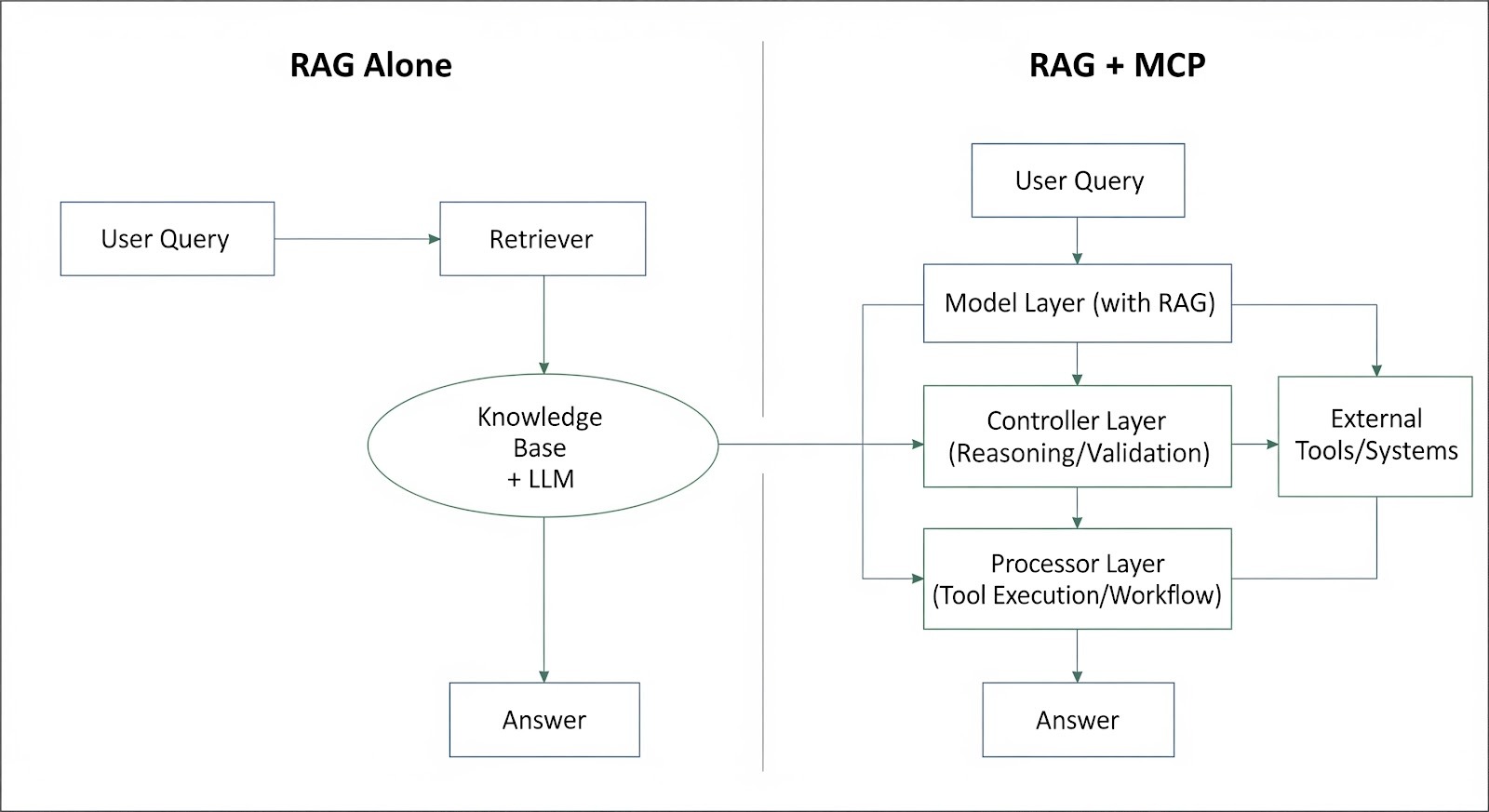
Now that it’s clear why RAG on its own is not enough for enterprise AI, let’s discuss how MCP adds value to RAG. MCP brings structure to reasoning and tool orchestration into the stack. MCP is organized into three main layers:
Model Layer
Creates outputs. The Model layer continues to carry the RAG, offering raw information required by the agent. But it is no longer solely responsible for reasoning or doing tasks.
Controller Layer
Provides reasoning and decision-making. The Controller reads a CMS response back, orders reasoning steps, and validates them against business rules. This level is necessary for multi-step processes, decision trees, or events that require logical continuity among tools or systems.
Processor Layer
Handles tool execution and workflow orchestration. RAG can “recommend” tasks, but the Processor ensures they are performed. It formats inputs, makes API calls that start the transaction, keeps track of the transaction state, and logs each step for auditing. With this separation, MCP prevents agents from hallucinating procedures, skipping validation, or improperly interfacing with systems.
Real-World Example: Multi-System Financial Workflow
Imagine an AI agent automating financial workflows across Salesforce, an ERP system, and a payment gateway. You receive a request to match invoices and payments. RAG can extract the appropriate entries from Salesforce and ERP, but without structured reasoning, it might mismap invoice numbers, ignore payment differences, or produce wrong reconciliation summaries.
With MCP, it’s much more robust. The Controller orders the reconciliation steps: first, check the bill data, then reconcile the payments, and finally, create a summary. The Processor activates API calls to update the ERP and payment gateway, logging every transaction with correlation IDs. This guarantees traceability; everything can be audited. Failures trigger automated retries or routing to a dead-letter queue for human inspection.
This illustrates the distinction between being an information-retrieval system and acting with structured intelligence. MCP allows agents to handle multi-system processes with minimal human intervention while maintaining operational visibility.
Advanced Capabilities Enabled by MCP
MCP enables capabilities beyond RAG.
Multi-Step Reasoning
MCP ensures each step in a sequence is consistent with previous and subsequent steps. Agents can solve complex problems involving intermediate computations, cross-references, or conditional decisions.
Tool Integration
Organizations rely on APIs, databases, SaaS tools, and internal applications. MCP allows AI agents to select the right tool at the right time. For example, a support agent can pull a ticket from Salesforce, search documentation, and update the support system in a single workflow. The Controller guarantees the correct sequence, and the Processor ensures proper execution.
Error Management
When data is missing or flawed, RAG may fail silently or produce incoherent results. MCP adds checkpoints, validators, and fallback plans. Failed steps can retry automatically, route to another processor, or log errors for manual review. This makes AI agents self-healing and robust.
Observability and Logging in MCP
MCP improves observability. Each reasoning step and tool interaction is explicit, allowing the full transaction lifecycle to be logged. Correlation IDs track actions across systems. Latency, throughput, error patterns, and success rates can all be monitored.
Visibility is critical for trust in complex workflows. Without it, stakeholders may hesitate to assign mission-critical tasks to AI agents. MCP ensures all operations are auditable, intermediate states are verifiable, and metrics allow insight into bottlenecks or inefficiencies. Over time, this observability drives continuous improvements to the Agentforce stack.
Scaling AI Agents With MCP
MCP simplifies scaling AI agents. Organizations often have multiple agents across departments with different workflows and tooling. Separating retrieval, reasoning, and processing allows modular agent construction. New tools can be added to the Processor layer without affecting reasoning, and new data sources can integrate into the retrieval layer without workflow changes.
Modularity also supports experimentation. Teams can fine-tune reasoning rules, adjust retrieval strategies, or optimize execution pipelines independently. Agents become more maintainable and resilient to future changes.
MCP in Knowledge-Intensive Domains
Industries like finance, healthcare, and legal services benefit most from MCP. Mistakes or non-compliance can be extremely costly. RAG alone may generate acceptable outputs, but cannot guarantee procedural soundness or regulatory compliance. MCP ensures reasoning follows domain rules, checks outputs for compliance, and logs all activity for auditing.
For example, during a compliance review, an AI agent can fetch policy documents, cross-analyze them with case-specific data, and generate recommendations. The Controller sequences reasoning, checks conflicts, and verifies legal rules. The Processor updates systems and logs every step. RAG alone cannot achieve this level of formality.
Best Practices for MCP Implementation
A deliberate approach is needed to implement MCP successfully. Start by defining workflows clearly. Identify steps requiring reasoning, tools used, and validations needed. Create correlation IDs and logging standards to track the full lifecycle. Instrument the Controller for reasoning rules and exception handling. Integrate the Processor with the required tools to ensure proper input formatting and guarantees.
Testing and monitoring are critical. Simulate failures to verify retries, fallbacks, and dead-letter queues. Dashboards should summarize metrics such as latency, success rates, and tool usage. Logs can then refine reasoning mechanisms and enhance system robustness.
The Strategic Advantage of MCP
MCP does more than improve reliability. It transforms AI agents from reactive information manipulators to proactive problem-solvers. Agents can handle complex processes, interact with multiple tools, and remain robust during failures. This reduces manual work and builds trust in AI systems.
Organizations using RAG with MCP gain a competitive advantage. Agents manage knowledge-heavy workflows, remain compliant, and scale across departments. MCP integrates retrieval, structured reasoning, and tool-aware execution, ensuring AI systems are intelligent, dependable, auditable, and operationally resilient.
Conclusion
RAG is effective, but its limitations become apparent in enterprise environments. Retrieval alone cannot provide structured reasoning, tool orchestration, or operational robustness. MCP completes the Agentforce intelligence stack with Controller and Processor layers to handle reasoning, execution, and observability.
The outcome is AI agents that are accurate, adaptive, and reliable. Multi-step workflows, error handling, and tool-chain integration become dependable while auditability and compliance are preserved. For organizations seeking to scale AI intelligently, MCP is essential; it is the missing link enabling agents to operate autonomously and drive real business outcomes.
Opinions expressed by DZone contributors are their own.
Comments