

The AI Autonomy Spectrum: 7 Architecture Patterns for Intelligent Applications
AI integration is more than agents and prompts. Explore seven architectural patterns to choose the right level of autonomy for enterprise applications.
 CORE
·
CORE
·
Join the DZone community and get the full member experience.
Join For FreeFor decades, the software industry has integrated databases, APIs, messaging systems, and distributed services into enterprise applications. Now, large language models (LLMs) have become a new architectural component. Despite widespread interest in AI and numerous tutorials, many engineering teams are still asking a fundamental question: How should AI be integrated into software systems?
AI integration does not follow a single architectural style. For example, a retrieval-augmented generation (RAG) application operates differently from an autonomous agent that reasons over tools. Similarly, reflection workflows have distinct characteristics, risks, and operational needs compared to multi-agent systems. Without a clear framework, teams may move directly to implementation, resulting in solutions that are overly complex, hard to manage, and misaligned with business goals.
To address this, new integration patterns are emerging, forming an Autonomy Spectrum that ranges from deterministic AI-assisted workflows to fully autonomous intelligent systems. This article explores seven architectural patterns within this spectrum and offers a practical roadmap for architects and engineers building the next generation of intelligent applications.
Understanding the AI Autonomy Spectrum
Artificial intelligence is transforming software engineering in two main ways. First, it enhances the development process through coding assistants, automated testing, documentation generation, and productivity tools. Second, and more significantly, AI is embedded directly into applications to address business challenges. In this approach, AI becomes integral to the solution rather than just supporting development.
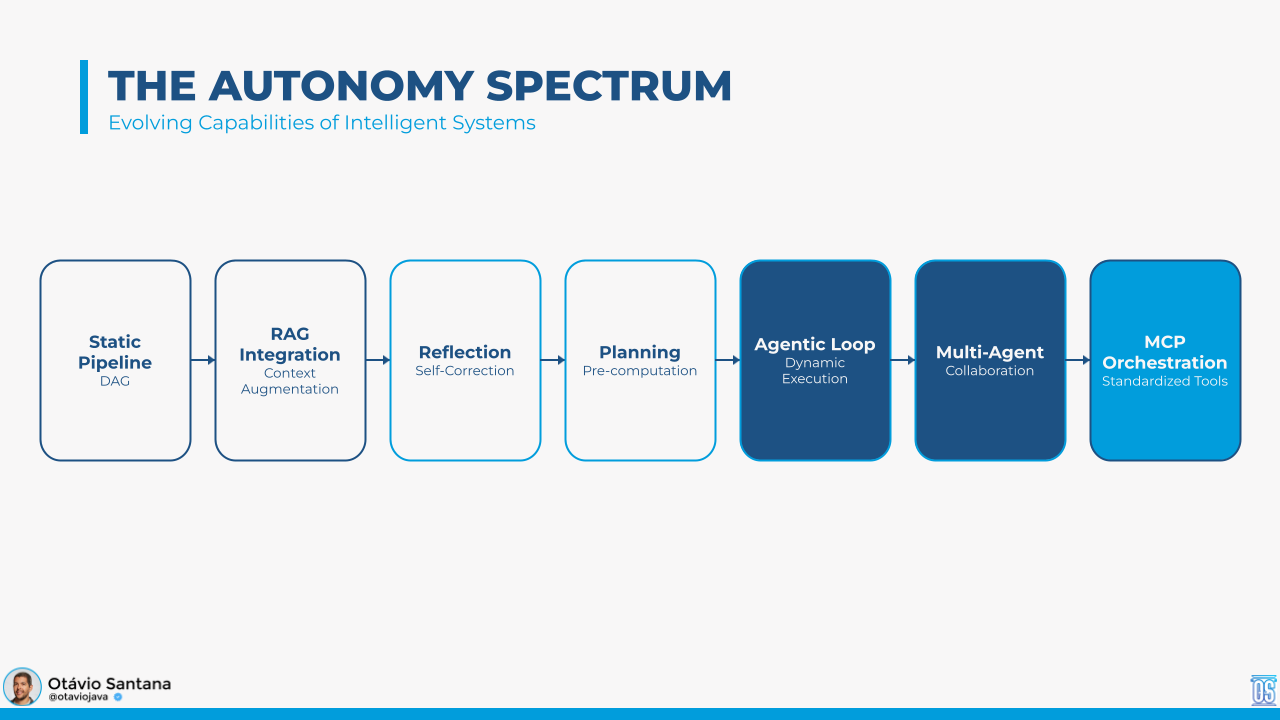
As organizations advance beyond basic chatbot implementations, architects must consider how much autonomy an AI system should have. Not all problems require fully autonomous agents that reason and interact with multiple external systems. Often, a deterministic workflow enhanced by AI is sufficient. In other cases, business value arises only when the system can dynamically plan, adapt, and coordinate actions across various tools and services.
This progression leads to the concept of the AI Autonomy Spectrum. Instead of a binary choice between traditional software and autonomous agents, the spectrum illustrates a gradual evolution of architectural patterns. At one end are deterministic workflows with predefined steps. As systems progress along the spectrum, they gain more reasoning, adaptation, self-correction, planning, and collaboration. At the highest level, AI systems interact with external capabilities through standardized protocols, enabling dynamic orchestration across a wide range of tools and services.
The purpose of this spectrum is not to suggest that higher autonomy is always better. In software architecture, the most effective solution is rarely the most sophisticated one. Each increase in autonomy introduces additional complexity, governance requirements, observability challenges, and operational risks. Understanding where a particular use case falls on the spectrum allows architects to select the simplest architecture that delivers the desired business outcome.
The seven patterns discussed in this article represent key stages in this evolution: static pipelines (DAGs), retrieval-augmented generation (RAG), reflection workflows, planning pipelines, agentic loops, multi-agent collaboration, and MCP orchestration. Together, they offer a practical framework for understanding intelligent system design and the shift in architectural control from deterministic execution to dynamic decision-making.
We begin with the foundation of the spectrum: static pipelines, where AI is integrated into a predefined workflow and execution remains fully deterministic.
Static Pipelines (DAGs)
The first stage of the autonomy spectrum is the static pipeline, typically represented as a directed acyclic graph (DAG). Here, developers define the execution flow in advance, assigning each step a specific responsibility. The AI model functions as one component within the workflow, similar to a database query, API call, or messaging operation.
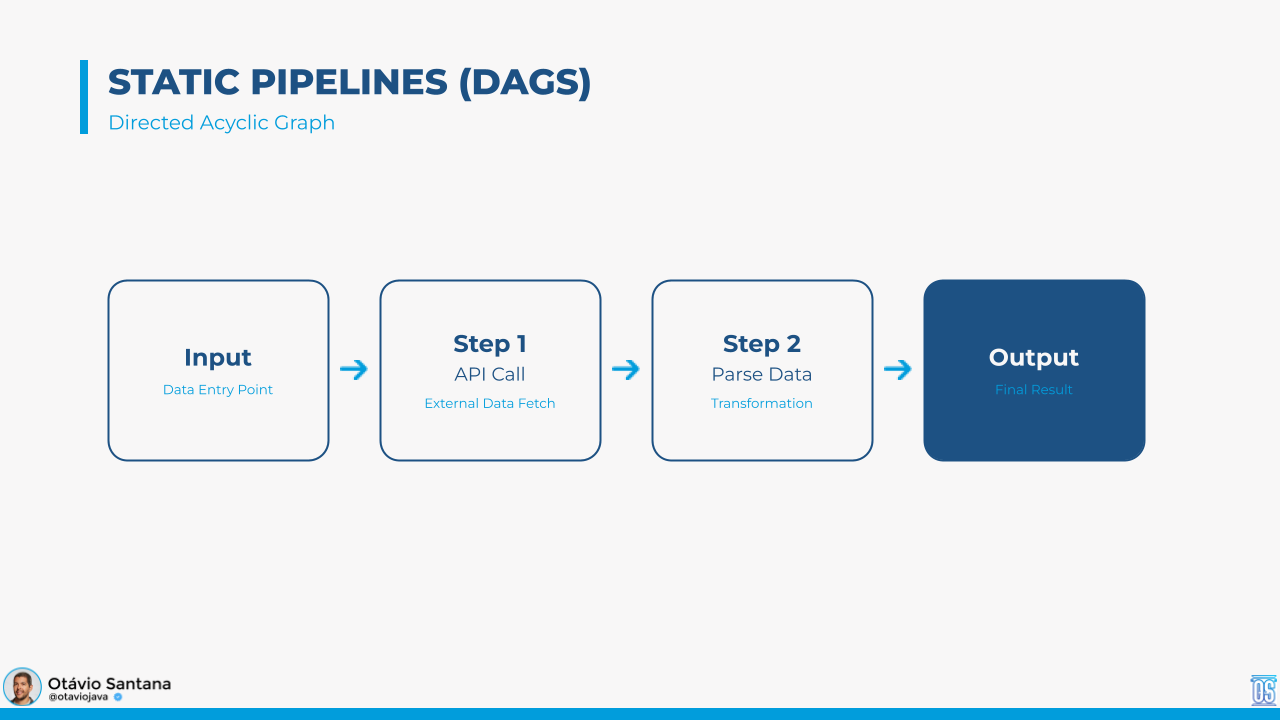
A key characteristic of this pattern is that control remains fully with the development team. The application determines when to invoke the model, what information to provide, and how to use the result. While AI introduces a probabilistic element into an otherwise deterministic process, the overall workflow remains predictable because the execution path does not change.
This pattern is often the simplest and safest way to introduce AI into enterprise systems. It offers predictable behavior, clear observability, and straightforward governance, while leveraging the model’s reasoning and content-generation capabilities.
While static pipelines use only the information provided in the request, many real-world scenarios require access to external knowledge beyond the prompt. This need leads to the next pattern: RAG, where the application dynamically enriches the model with relevant contextual information before generation.
Retrieval-Augmented Generation (RAG)
As AI applications advance, the limitations of static prompts become evident. Large language models can only process information within their context window, so they cannot access private documents, company knowledge bases, or data generated after training. RAG addresses this by adding a retrieval step before generation. Rather than relying only on the prompt, the application searches a knowledge source, retrieves relevant information, and provides that context to the model before generating a response.
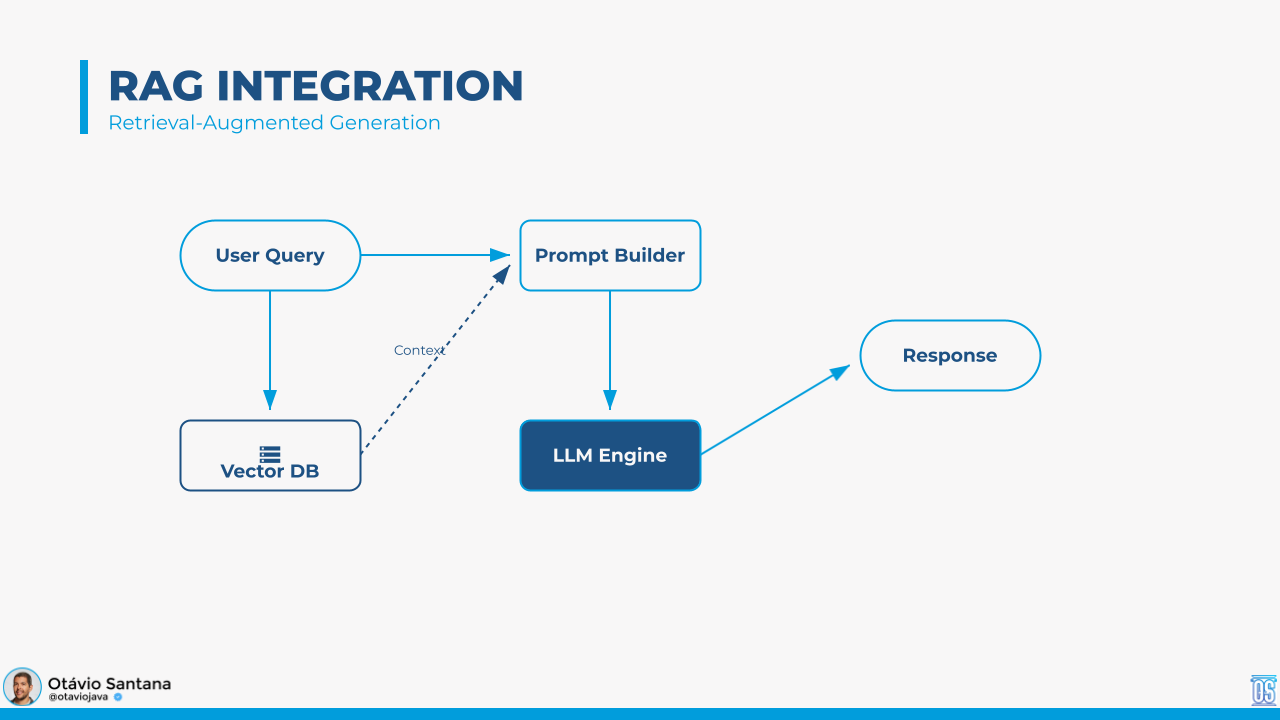
Architecturally, control remains largely deterministic. Developers specify how information is indexed, how retrieval is performed, and how retrieved content is incorporated into the prompt. The model does not choose where to search or how to obtain knowledge; it uses the context provided by the application. This approach improves accuracy, reduces hallucinations, and allows AI systems to reason over domain-specific information without retraining.
RAG is a significant step in the autonomy spectrum, as the system is no longer limited to information explicitly provided by the user. However, the workflow remains a single-pass process: retrieve context, generate a response, and return the result.
What if the initial answer is insufficient? In many enterprise scenarios, accuracy and quality require further validation before a response can be trusted. This leads to the next pattern in the spectrum: Reflection workflows, where AI systems evaluate and improve their outputs through iterative feedback loops.
Reflection Workflows
Traditional software typically executes a task once and returns the result. Reflection workflows add self-evaluation. Rather than accepting the first generated response, the system creates a feedback loop where a model, or a separate evaluation model, reviews the output against predefined criteria such as accuracy, completeness, formatting, or business constraints. If the response does not meet expectations, it can be revised and regenerated before reaching the user.
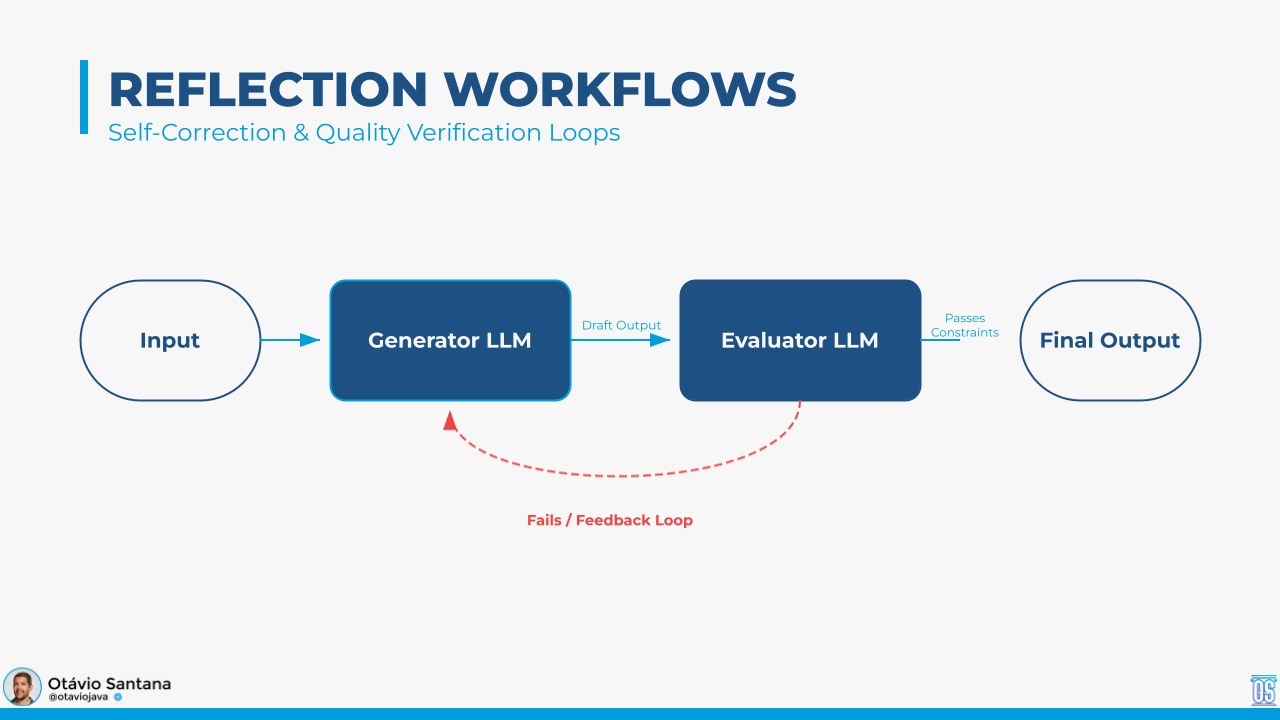
This pattern improves quality without significantly increasing autonomy. The workflow remains predefined by developers, who set evaluation criteria and determine when the process should stop. The AI can critique and refine its work but still operates within a controlled execution path.
Reflection workflows are especially valuable for generating content, reports, code, summaries, or any output where correctness is more important than response speed. Instead of treating the first answer as final, the system adds an explicit quality assurance phase before delivering the result.
While reflection improves response quality, it assumes the system already knows the steps needed to solve the problem. More complex objectives often require breaking a goal into multiple tasks before execution. This need introduces the next stage in the autonomy spectrum: planning pipelines, where AI generates an execution strategy before work begins.
Planning Pipelines
As objectives grow more complex, a single prompt is often inadequate. Before execution, the system must determine how to achieve the goal. Planning pipelines separate reasoning from execution by having the model generate a structured plan outlining required tasks. A deterministic component then executes this plan using predefined tools, APIs, or business services.
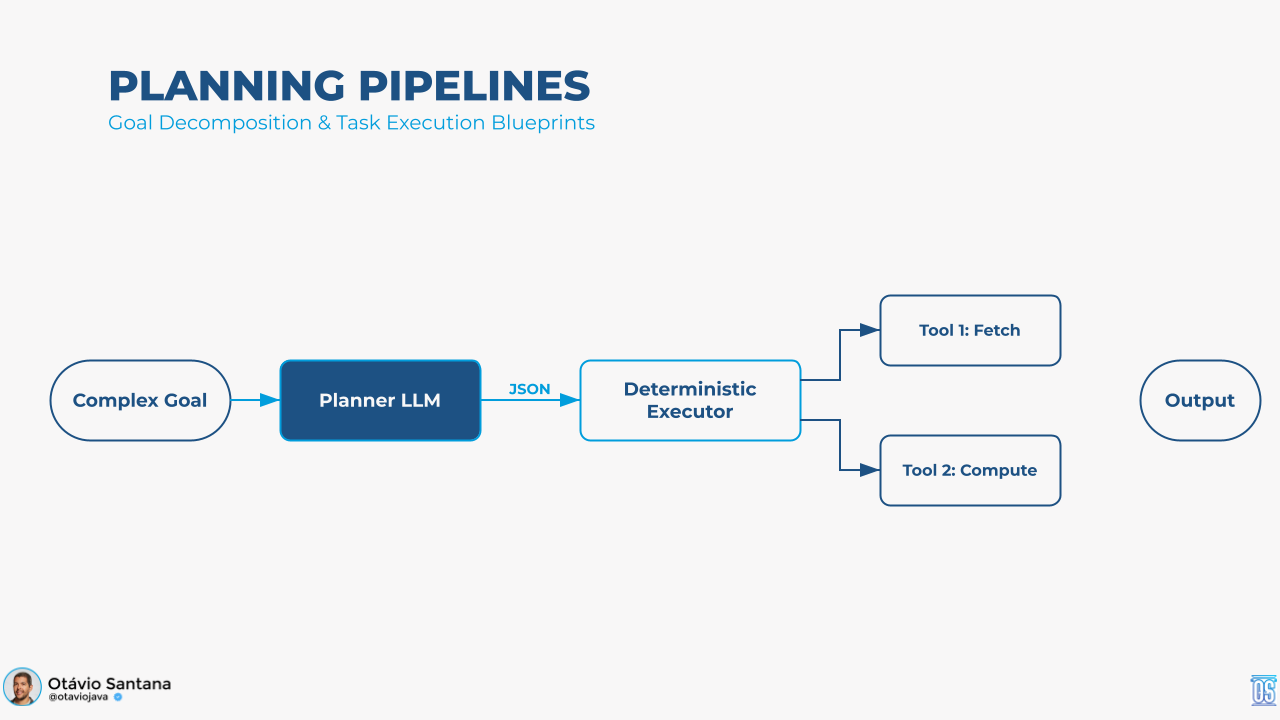
This pattern maintains strong architectural control. Developers define available capabilities and oversee execution, while the model breaks down complex objectives into actionable steps. This approach enables the system to handle sophisticated requests without relinquishing control over execution.
Planning marks a key shift in autonomy, as the model now generates intent and strategy, not just content. Execution remains deterministic and follows the initial plan.
When a plan cannot be fully defined in advance, dynamic environments and emerging information present challenges. This leads to the next pattern: agentic loops, where planning and execution form a continuous reasoning cycle.
Agentic Loops
Agentic loops go beyond predefined plans by enabling the AI to continuously assess its progress as it interacts with external tools and services. Instead of creating a full execution plan up front, the system iteratively observes the current state, decides on the next action, executes it, evaluates the result, and repeats until the objective is met. This approach is known as the Reason and Act pattern.
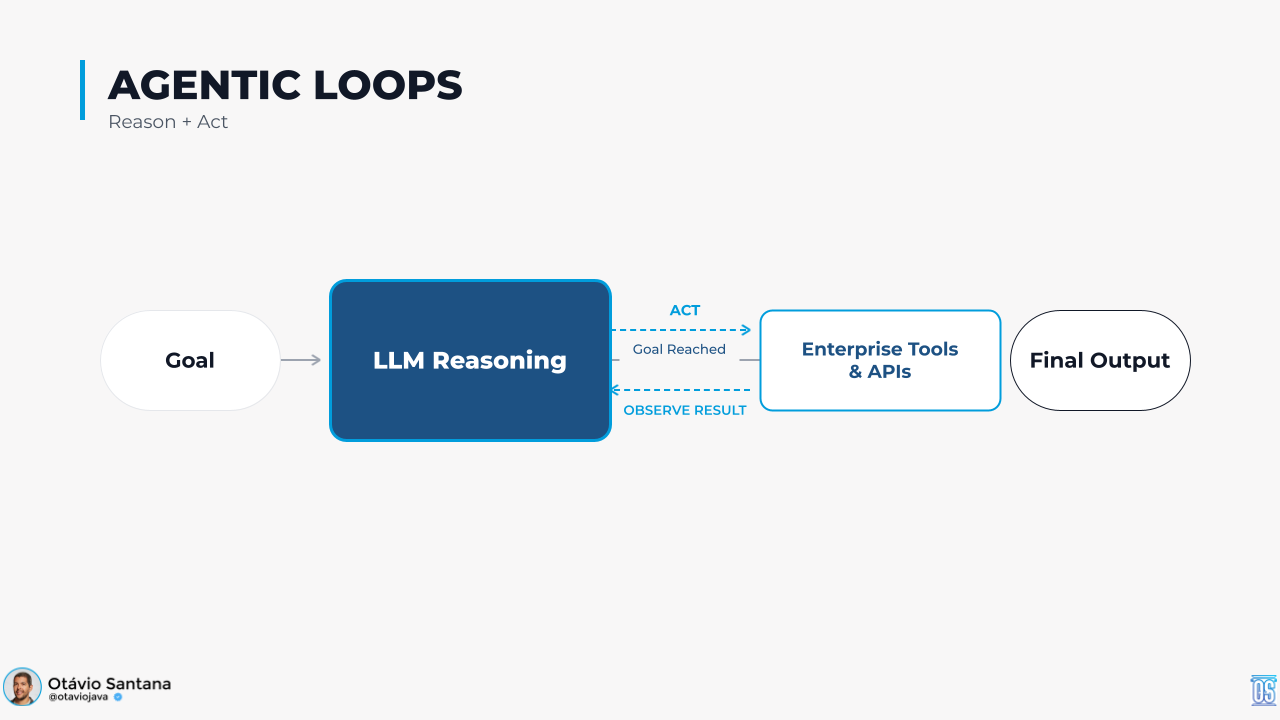
At this stage, much of the control shifts from the application to the model. Developers define tools, boundaries, and safety constraints, while the AI decides which actions to take, their order, and the number of iterations needed to achieve the goal. The workflow becomes less predictable, as execution paths emerge dynamically based on new information.
Agentic loops allow systems to address problems that cannot be solved with a fixed sequence of steps. They are especially effective when interacting with enterprise APIs, searching knowledge sources, or coordinating business capabilities where each action depends on the previous outcome.
As systems advance, a single agent may not suffice. Different tasks require distinct expertise, responsibilities, or reasoning strategies. This progression leads to multi-agent collaboration, where specialized agents work together to achieve a common objective.
Multi-Agent Collaboration
As AI systems address more complex objectives, relying on a single agent can create bottlenecks. Distinct tasks often demand specialized skills or expertise. Multi-agent collaboration resolves this by distributing work among specialized agents that cooperate toward a shared goal. A supervisory component coordinates interactions, delegates tasks, collects results, and assembles the final outcome.
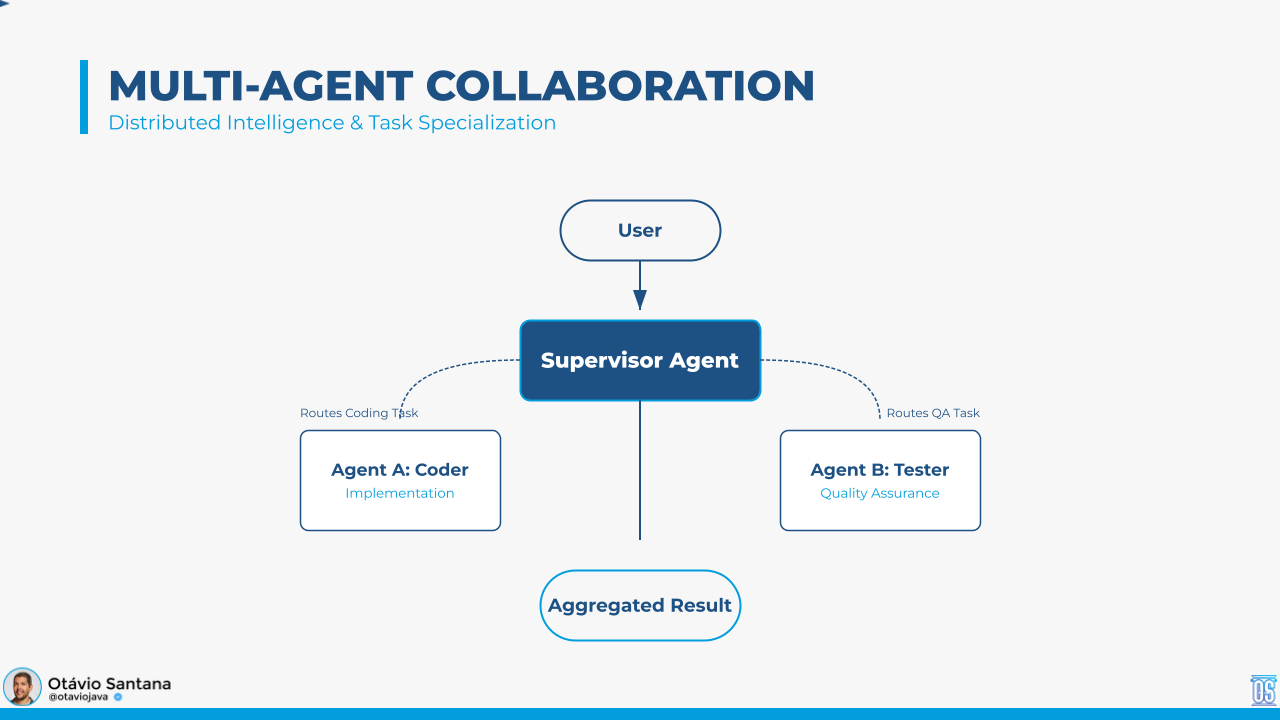
This approach reflects real-world organizational structures, where work is divided among specialists rather than assigned to one individual. For example, one agent may handle coding, another testing, another documentation, and another compliance or security. Each agent contributes within its expertise, while the supervisor ensures coordination and alignment with the overall objective.
Within the autonomy spectrum, this pattern increases both capability and complexity. Coordination, communication, observability, and governance become distinct architectural concerns. The challenge shifts from deciding the next action to determining which agent should perform it and how information is shared across the system.
As the number of agents and external integrations increases, integration efforts multiply, resulting in a complex web of connections. This challenge leads to the final stage of the spectrum: MCP orchestration, which introduces a standardized integration layer between intelligent systems and external capabilities.
MCP Orchestration
The Model Context Protocol (MCP) is the most advanced point on the autonomy spectrum discussed here. Instead of focusing on reasoning strategies or collaboration models, MCP addresses the architectural challenge of standardizing how AI systems interact with external tools and services. Rather than building custom integrations for each application, database, API, or platform, MCP provides a common protocol that allows agents to dynamically discover and invoke capabilities.
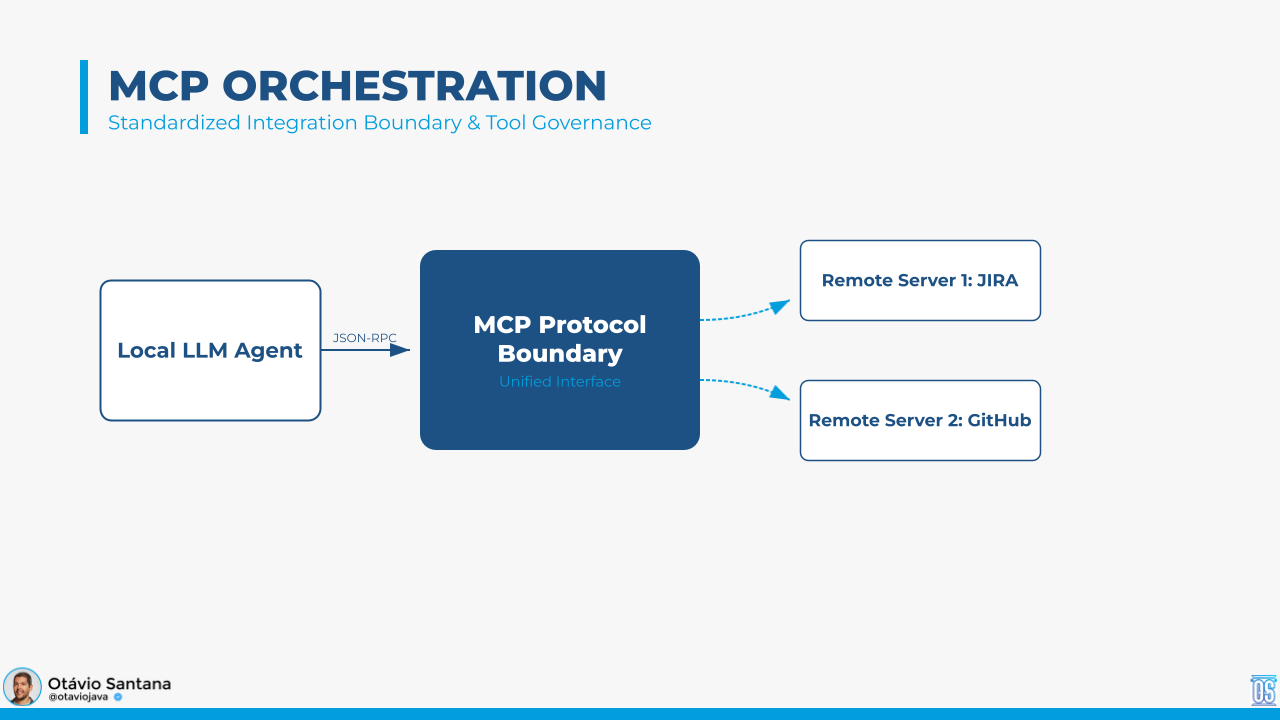
Software architecture has consistently moved toward standardization, as seen in technologies such as SQL, HTTP, JDBC, and REST, which simplify integration across diverse systems. MCP applies this principle to AI-driven applications. By introducing a protocol boundary between agents and tools, organizations can expose capabilities once and make them accessible to multiple intelligent systems without developing custom integrations for each use case.
MCP's value lies in enhancing interoperability, not intelligence. Agents can dynamically discover capabilities, interact with local or remote services, and extend functionality without changing the core application architecture. This shifts the focus from building integrations to governing and managing a reusable ecosystem of capabilities.
The autonomy spectrum described here is not a maturity model that every system must reach. Instead, it offers a framework for selecting the right level of autonomy for each problem. Often, a simple DAG or RAG workflow is sufficient. In other cases, planning, agentic execution, multi-agent collaboration, or MCP-based orchestration may provide greater business value. The main architectural challenge is to choose the simplest pattern that effectively solves the problem.
Opinions expressed by DZone contributors are their own.
Comments