

Why Role-Based Access Control Fails for AI Agents — and How to Fix It With Memory Lineage Engines
Learn how lineage-aware access control prevents cached AI agent results from exposing data derived from restricted database columns.
 ·
Join the DZone community and get the full member experience.
Join For FreeKey Takeaways
- Role-based access control (RBAC) and content-tagging systems check whether a requester's credentials match a label attached to data. That check has nothing to say about a derived, cached result — a plain number with no tag of its own.
- A cached metric like
churn_rate = 0.114can be computed from a query that touches a restricted column (income) and then be served to a department that was never allowed to see that column, without a single existing access control catching it. - The fix is to gate retrieval on the result's derivation graph — the tables, columns, and filters that produced it — rather than on a tag attached after the fact.
- In benchmark testing, this reduced a structural cross-department leak rate of 18.8%–25.5% to zero, at a real, measurable cost: roughly 13 additional query executions per 100 requests, and a gate-check predicate costing 0.09 microseconds.
- The mechanism does not stop inference attacks, a compromised memory store, or collusion — it closes one specific, previously unguarded gap in agent-memory retrieval.
A Clean Integer That Still Leaks a Restricted Column
Take a concrete scenario. A Finance agent runs a query that joins a transactions table against a customer_pii table — which includes an income column — to compute a churn_rate for customers who have gone quiet in the last 90 days. It gets back a single float: 0.114. Nothing about that number looks sensitive. No names, no account numbers, no raw income figures. The agent caches the result in shared memory so the next agent that asks for churn_rate does not have to recompute it.
A week later, a Marketing agent asks the same shared memory for churn_rate and gets 0.114 back instantly, with no query executed. Marketing was never granted access to income. Its role-based access-control (RBAC) entry explicitly blocks that column. But nothing in this transaction touched income directly — Marketing did not query the column, did not see a row containing it, and did not request anything with "income" in the name. It asked for a key performance indicator (KPI) by name and got a float back.
By any access-control system running in production today, that transaction is clean. And it is a policy violation: the number 0.114 was derived from a computation Marketing was never authorized to run.
This is the finding at the center of a paper co-authored with Sudhir Vissa, "Lineage-Aware Memory Governance: A Derivation-Gated Framework for Privacy-Preserving Column-Level Access Control in Enterprise AI Agents," accepted at IEEE Access (DOI: 10.1109/ACCESS.2026.3730363). This article walks through the engineering mechanics of the failure and the fix, using the worked example and architecture diagram from the paper.
The Access Check Every System Runs — and the One It Doesn't
Strip away the vendor language, and every access-control mechanism guarding a piece of data — RBAC, attribute-based access control (ABAC), content tagging, ownership metadata — runs some version of the same predicate at retrieval time:
allow(requester, object) := tag(object) ⊆ permissions(requester)The object carries a label — a sensitivity classification, an owner, a role requirement — and the check asks whether the requester holds a credential matching that label. Apache Ranger and Databricks Unity Catalog enforce this at the column level for raw queries: they intercept a SELECT statement and check whether the requesting principal is allowed to read the specific columns named in it. That works well for exactly the case it was built for: stopping an unauthorized read at the point of query execution.
Shared agent-memory systems — MemGPT, Zep, A-MEM, and the newer governed-memory architectures being built for enterprise deployments — extend the same pattern to cached results. A memory entry gets an owner, maybe a sensitivity tag, maybe a role requirement, and retrieval is gated on whether the requester's credentials match. This is a reasonable design, and it is also where every one of these systems stops.
The problem is that churn_rate = 0.114 has no tag to check. It is a scalar. Nobody attached a sensitivity classification to it, because nothing about the value is sensitive — a churn rate cannot be reverse-engineered into an income figure. The column-level access-control list (ACL) at the database layer did its job perfectly: it verified that Finance was allowed to touch income when it ran the join. But that check fired once, at write time, for the agent that computed the number. It has nothing left to say about the agent that retrieves the cached result afterward. By the time 0.114 sits in shared memory, the access-control moment has already passed, and the object in front of the second access-control check carries no trace of the columns that produced it.
So the predicate every current system checks — does the requester's tag match the object's tag — answers the wrong question for this failure mode. The question that actually determines safety is:
safe(requester, result) := columns_touched(result.derivation) ⊆ permissions(requester)
That is not a check on the object. It is a check on the object's derivation — the tables it joined, the columns it read from each of them, and the filter predicates that shaped it. No system in the current agent-memory landscape records that, which means none of them can evaluate it.
A Worked Example: How Finance's Churn Rate Leaks to Marketing
Here is the derivation graph from the paper — Figure 1 — showing exactly what has to be tracked to make that second check possible.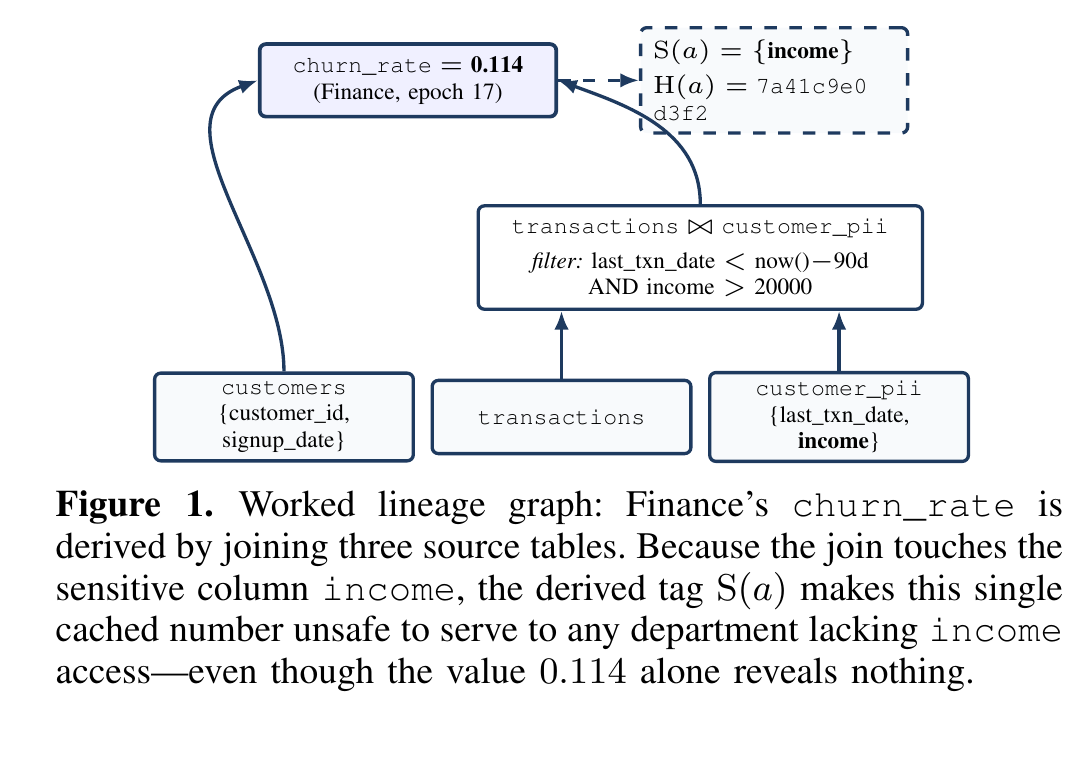
Read it left to right. Three source tables feed a join: transactions, customers (with customer_id and signup_date), and customer_pii (with last_txn_date and income). The join step applies a filter — last_txn_date < now()-90d AND income > 20000 — and produces churn_rate = 0.114, tagged with the producing department and a time-to-live (TTL) epoch for eviction.
The part that matters is the dashed box on the right. Two values are computed once, at the moment the result is cached, and stored alongside it.
The sensitivity tag, S(a), is the union of every column touched across every step of the derivation, intersected with the organization's registry of sensitive columns:
S(a) = (∪ᵢ Cᵢ) ∩ SensitiveColumnRegistryFor this cached entry, S(a) = {income}. It does not matter that income never appears in the output — the tag is computed from what was read, not from what was returned.
The definition hash, H(a), is a fingerprint of exactly how the metric was computed: the sorted table names, the sorted column set, and the filter predicate, hashed and truncated to 12 characters:
H(a) = SHA256(sort(tables) || sort(∪ᵢ Cᵢ) || φ)[0:12]
This second value is not for access control. It catches a different, related failure: two departments computing a metric with the same name through different logic — a 90-day churn window versus a 60-day window, say. If two cached entries share a metric name but their hashes differ, that is a silent definition conflict, and it can be surfaced automatically instead of showing up as a mismatch in a board deck. It comes along for free once derivation is already being recorded for the access-control reason.
Both values are sub-microsecond to compute. The retrieval-time check is then a single set-difference: is S(a) a subset of what this requester is permitted to see? For Marketing, whose permission set explicitly excludes income, the answer is no, regardless of how inert the value 0.114 looks.
The Fix: Gate Retrieval on Derivation, Not on Tags
The mechanism described in the paper is called the Analytical Memory Unit (AMU) — a memory schema that carries the derivation graph as a first-class field, plus a retrieval algorithm that gates on it. Figure 2 shows the full architecture.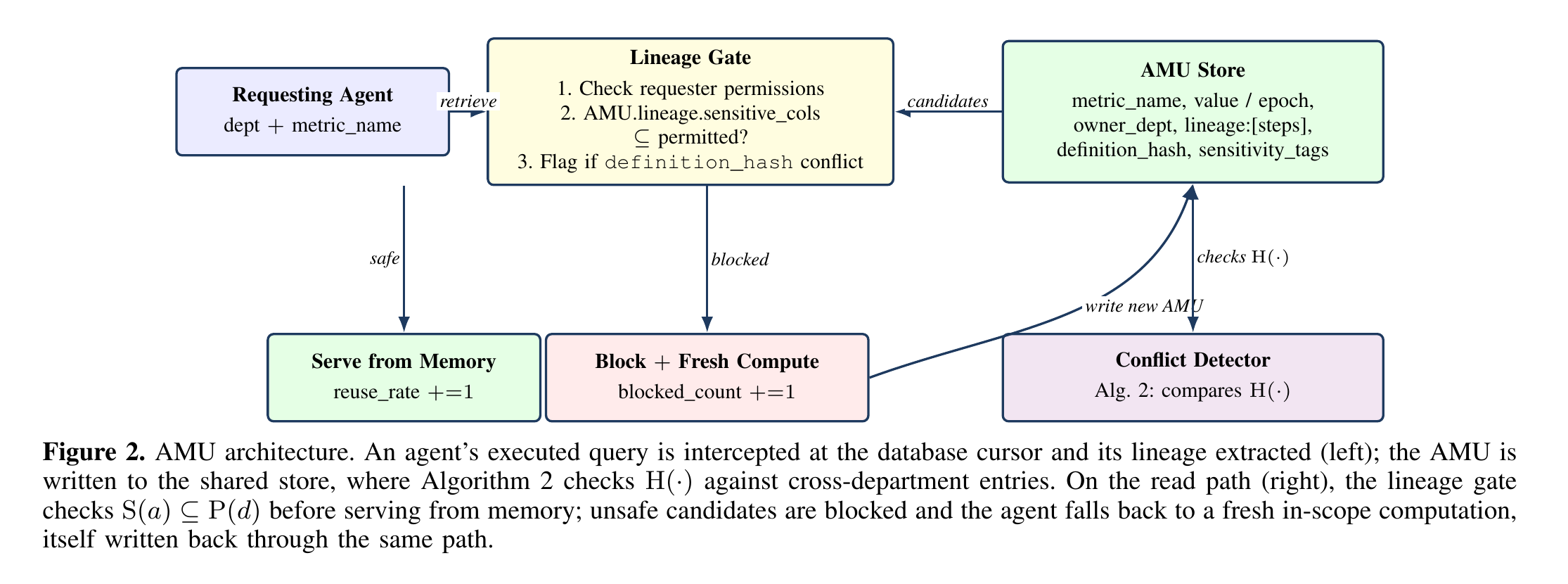
Two paths run through this diagram, and they solve two different problems.
The read path (left and center) is the leak-prevention mechanism. A requesting agent asks for a metric by name. The lineage gate pulls every AMU ever stored under that name, resolves the requester's permission set once, and scans candidates most-recent-first — a deliberate policy choice, so that when a safe candidate exists, the department gets the freshest one rather than an arbitrary historical value. For each candidate, the gate checks a single predicate: is the cached S(a) a subset of P(department)? The first candidate to pass gets served, and a memory-reuse counter increments. If a candidate fails — Marketing hitting the Finance-computed churn_rate — it is skipped, and the loop moves to the next-oldest candidate. If nothing in the store passes, the agent falls back to a fresh, in-scope computation of its own, which is then written back into the store through the same path, available to the next requester who is actually permitted to see it.
The write path (right) is unrelated to access control — it is the definition-conflict detector. Every new AMU is compared against existing entries under the same metric name; if a cross-department pair has matching metric names but different definition hashes, that is flagged for downstream review. It never blocks the write. It simply surfaces a signal that two teams' business logic has silently diverged.
The formal safety guarantee behind the read path is a straightforward case analysis: the retrieval algorithm has exactly two exit points, a memory-served return and a fallback return, and the proof shows neither path can hand a requester a result whose derivation touches a column outside their permission set — provided the lineage record is complete. That qualifier does real work, and it is worth sitting with before treating this as a drop-in fix.
What It Costs, Measured
None of this is useful if it is a paper mechanism that falls apart under load or eats the redundant computation that shared memory exists to avoid in the first place. Six experiments in the paper attempt to break it.
Across a synthetic five-table schema and a denser eight-table TPC-H benchmark schema, naive content-gated memory — the pattern every current system uses — leaked cross-department results at 18.8% and 25.5% of retrievals, respectively (30 seeds each, effect size around d≈7–8, well past the conventional threshold for a large effect). Lineage-gated retrieval brought that to zero in both configurations. To be precise about what that number means: this is the formal safety guarantee holding in the tested setting, not an empirical discovery on its own. The empirical finding is the naive baseline's leak rate; the zero is what the proof predicts.
That protection is not free. Gating out unsafe candidates means more fallbacks to fresh computation: the reuse rate dropped from 95.8% under naive caching to 81.5%–82.6% under lineage gating, roughly 13 additional query executions per 100 requests. That cost shows up as extra compute, not as gating latency — the permission-check predicate itself runs at 0.09 microseconds, and even the worst-case retrieval scan, with every candidate blocked across a store of 50, tops out at 13.82 microseconds. In a realistic production store, where a metric accumulates at most a handful of department-variant entries, that is sub-2-microsecond in practice, not a meaningful line item next to a query that takes milliseconds to seconds.
Two further results matter for anyone deciding whether to trust this in production. First, a completeness-degradation experiment: the safety proof assumes lineage recording is complete, but real instrumentation is not always. Testing with deliberately truncated lineage — simulating buggy instrumentation or agents that under-report what they touched — showed the protection degrading gracefully rather than falling off a cliff, converging back to zero leakage by 75%–90% completeness, and degrading faster specifically on schemas where sensitive columns sit behind more joins. That is a useful operational signal: instrument the deeply nested joins first.
Second, and more important for anyone concerned this only works when the agent cooperates: a real-agent test wired lineage extraction directly into the database driver layer, using a Structured Query Language (SQL) parser to read the actual statements a LangChain agent executed, with no self-reporting from the agent required. Across nine round-trips against a real database, there were zero cross-department leaks, and two genuine definition conflicts were caught automatically. The cleanest integration point turns out to be exactly where you would want it: wrap the cursor, parse every executed statement, and the agent never has to know it is being watched.
What This Doesn't Fix
The credibility of a mechanism like this depends on being precise about its edges, so three limitations are worth stating plainly rather than leaving implicit.
It does not stop inference attacks: a derived feature that encodes sensitive information without ever naming the source column in a way the lineage extractor can see. A hand-crafted risk score computed from income, where that dependency is not captured in the executed query, will slip past the gate, because the gate can only check what the lineage record actually contains. This is the gap the paper's authors flag as the most important one left open.
It assumes lineage recording is honest and complete. Self-reported lineage from a cooperative agent is a weaker foundation than lineage extracted automatically from executed SQL, which is exactly why driver-layer interception matters more than it might first appear: it removes the agent's ability to misreport what it touched, whether deliberately or through a bug.
It does not defend against a compromised memory store or an insider with direct infrastructure access, and it does not, on its own, stop a requester from triangulating a blocked column by combining several individually permitted results that are jointly informative about it. Those need their own controls: encryption, audit logging, differential privacy, and infrastructure trust boundaries. This is one layer in a defense-in-depth stack, not a replacement for the source-layer controls it sits alongside.
The Question Worth Asking About Your Agent-Memory Stack
If you are building or evaluating a shared memory layer for agents, there is one question worth running through concretely: when your retrieval path decides whether to hand a cached result to a requesting agent, what predicate is it actually evaluating? A tag someone attached when the entry was written? A role the requester happens to hold? Or a set-membership check against the actual columns that produced the value?
Most systems on the market today, including every system benchmarked in the referenced paper, are checking the first two. RBAC and content tagging are not wrong; they answer a real question, just not the one that determines whether a specific cached number is safe for a specific requester. That is a derivation question, and it needs a derivation record to answer it. The mechanism described here costs microseconds and a few hundred bytes per cache entry. What it buys is a governance layer that can prove, mechanically, at retrieval time, that a result never crossed a column-permission boundary — rather than discovering the leak in a post-incident audit.
This article is a plain-language, engineering-focused walkthrough of "Lineage-Aware Memory Governance: A Derivation-Gated Framework for Privacy-Preserving Column-Level Access Control in Enterprise AI Agents," co-authored with Sudhir Vissa (SAGE7 AI), accepted at IEEE Access (DOI: 10.1109/ACCESS.2026.3730363). Figures are reproduced from the published paper. The full derivations, threat model, and experimental protocol are available in the paper and its supplementary material.
Published at DZone with permission of Venkata M Sangaraju. See the original article here.
Opinions expressed by DZone contributors are their own.
Comments