

The Role of Data Governance in Data Strategy: Part 4
Explore the critical role of data retention in governance: reduce costs, mitigate legal and cybersecurity risks, and ensure compliance with clear policies.
Join the DZone community and get the full member experience.
Join For FreeIn the previous articles of this series, we explored the importance of data governance in managing enterprise data effectively (Part 1), how BigID supports data governance, particularly for data privacy, security, and classification (Part 2), and the role of Data Subject Access Rights (DSAR) in protecting individual privacy (Part 3). Together, these concepts emphasized the importance of visibility, control, and accountability in modern data governance.
In this fourth installment, we shift focus to another critical pillar of data governance: Data Retention. While organizations often think of retention simply as storing data for later use, the reality is far more complex. Done right, data retention ensures compliance, cost efficiency, and stronger security. Done poorly, it creates unnecessary risks, ranging from legal exposure and privacy violations to spiraling storage costs and an expanded cybersecurity attack surface.
What Is Data Retention?
Data retention refers to the process of keeping data for future usage. A data retention policy is a collection of guidelines for dealing with information that an organization creates and collects. This includes identifying the information, determining how it is saved, how long it remains in existence, and how it is destroyed. When creating a data retention strategy, it’s essential to evaluate the business purpose of the data, the associated storage expenses, and any relevant legal or compliance obligations.
The Dark Side of Data Retention Overload: Addressing the Legal and Cybersecurity Consequences of Overcollection
Keeping too much data in a data governance process poses a number of problems, including increased storage costs, greater security threats, privacy and compliance violations, and significant legal liability. Unnecessary data retention has the potential to reduce productivity and quality.
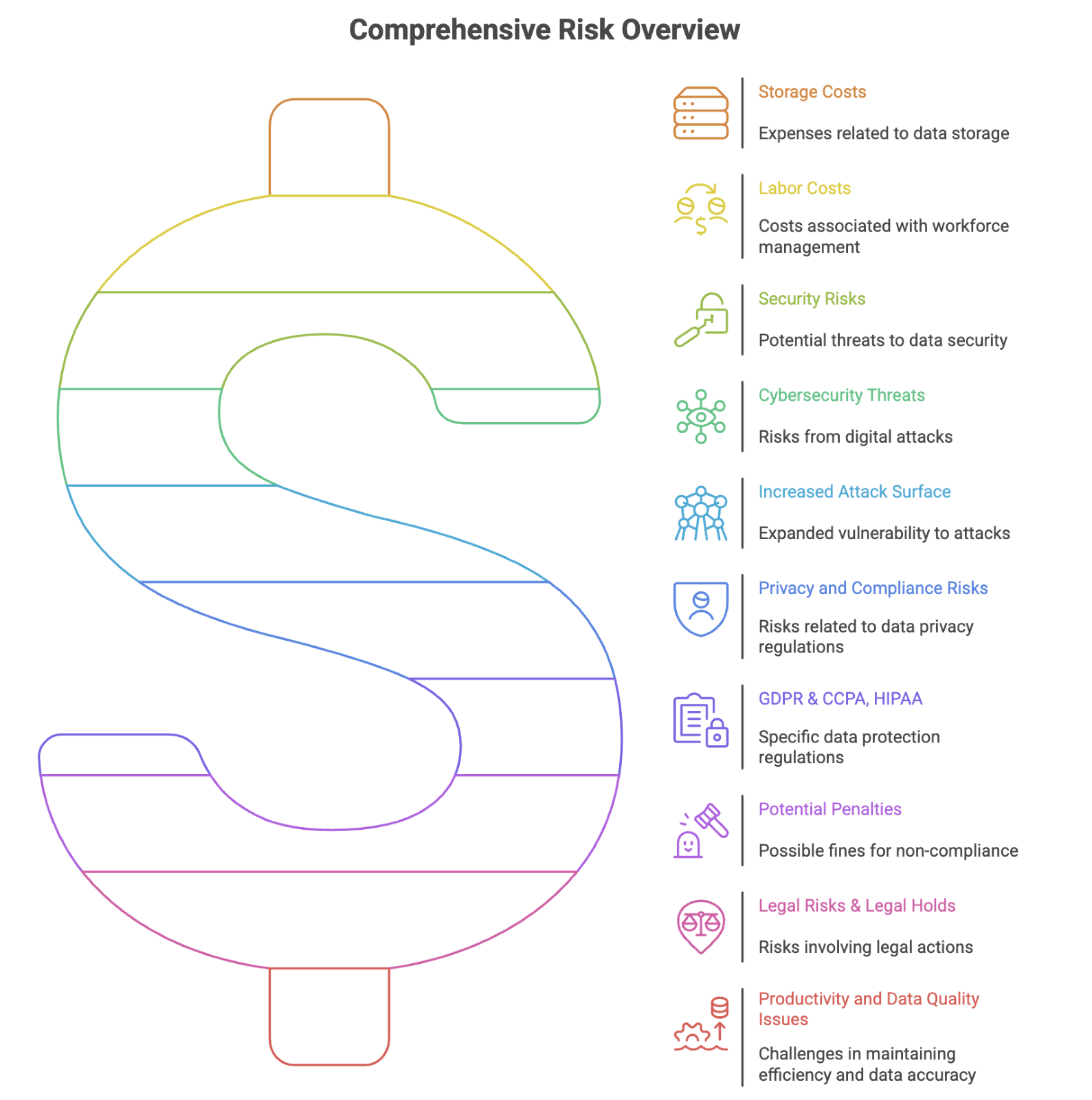
Increased Costs
- Storage Costs: Data governance (DG) defines regulations for data retention, archiving, and destruction. Without it, companies can keep redundant, outdated, and trivial (ROT) data indefinitely. DG ensures that data is stored efficiently, in the appropriate location, and for only as long as necessary, greatly lowering cloud and on-premises storage costs. It further fosters data deduplication.
- Labor Costs: Poor data quality and fragmented data require the employees to spend significant effort searching for appropriate data, rectifying errors, resolving discrepancies, and dealing with data-related concerns. Data governance streamlines data management processes, improves data quality, and establishes clear data ownership, reducing manual effort and increasing operational efficiency across departments (for example, IT, analytics, and compliance).
Security Risks
Determines who has access to what data, under what conditions, and for what reason. It establishes policies for data classification, access control, encryption, and monitoring. This systematic process ensures that sensitive data is identified and protected, significantly reducing the risk of unauthorized access, data breaches, and internal misuse.
Cybersecurity Threats
While cybersecurity focuses on technical defenses, data governance gives strategic context. It requires data backup and recovery procedures, incident response plans, and frequent security assessments. Data governance improves data visibility and classification, allowing for more effective deployment of cybersecurity measures, making the organization more resilient to cyberattacks.
Increased Attack Surface
More potential points where attackers can access or steal data from a system. Uncontrolled data proliferation (data in various locations, usually unclassified and unsecured) directly contributes to this surface. Data governance reduces vulnerabilities by enforcing data minimization and proper disposal and maintaining a clear inventory of data assets.
Privacy and Compliance Risks
This is an essential part of modern data governance. DG provides the framework for understanding and complying with complex data privacy regulations by establishing GDPR & CCPA, HIPAA, and other policies by establishing:
- Data Inventory and Mapping: Understanding how personal data is collected, stored, and transmitted.
- Consent Management: Procedures for obtaining and retaining user consent.
- Data Subject Rights: Procedures for handling requests for access, rectification, or deletion of personal information.
- Data Retention Policies: Ensure that data is only stored for legally required durations.
- Data Breach Notification: Preparedness and protocols for reporting breaches.
Potential Penalties
Noncompliance with data privacy standards can result in significant fines (up to 4% of global annual turnover under GDPR). Robust data governance acts as a preventative measure, considerably minimizing the risk of incurring these enormous financial penalties and the associated reputational damage.
Legal Risks and Legal Holds
Without proper data governance, managing legally required data during lawsuits or investigations becomes costly, chaotic, and prone to errors.
- Data governance ensures Data Identifiability: Knowing where relevant data is stored.
- Data Retention Schedules: Managing data life cycles to prevent the accidental erasure of potentially important information.
- Audit Trails: Recording data access and modification.
Productivity and Data Quality Issues
Inaccurate or insufficient data affects productivity because it requires staff to spend time validating information, contesting reports, and making poor decisions. Data governance addresses this through:
- Define Data Standards: Making precise standards on data formats, definitions, and permitted values.
- Data Cleansing Processes: Procedures for correcting and enriching data.
Data ownership and accountability involve assigning responsibility for data quality to specific persons or teams.
- Data Validation Rules: Using automated checks at data entry points.
By enhancing data quality, DG enables more confident decision-making, streamlines procedures, and boosts overall organizational efficiency.
In addition to these business considerations, there are regulatory constraints that specify how long certain types of data can be stored for. Some require that data be deleted immediately after usage, while others insist that it be preserved permanently.
A comprehensive data retention policy effectively addresses these issues by centralizing control, ensuring clarity, and streamlining data management. You may then distribute this document to your business and users, ensuring that stakeholders are aware of how all of your data is managed and serving as the foundation for automatic data retention activities.
Implementing thoughtful data retention practices is a core element of effective enterprise data governance. By proactively managing what data is kept, for how long, and why, organizations can reduce operational costs, mitigate risk, and enhance regulatory compliance.
In the upcoming article, we’ll dive into how to define, implement, and operationalize dynamic retention and remediation policies using BigID—covering practical techniques for data classification, lifecycle management, and deletion orchestration.
Opinions expressed by DZone contributors are their own.
Comments