

Secure IaC With a Shift-Left Approach
Shift-Left secure Infrastructure as Code helps catch issues early, automate compliance, and build secure, scalable cloud infrastructure.
 CORE
·
CORE
·
Join the DZone community and get the full member experience.
Join For FreeImagine you're building a skyscraper—not just quickly, but with precision. You rely on blueprints to make sure every beam and every bolt is exactly where it should be. That’s what Infrastructure as Code (IaC) is for today’s cloud-native organizations—a blueprint for the cloud. As businesses race to innovate faster, IaC helps them automate and standardize how cloud resources are built. But here’s the catch: speed without security is like skipping the safety checks on that skyscraper. One misconfigured setting, an exposed secret, or a non-compliant resource can bring the whole thing down—or at least cause serious trouble in production. That’s why the shift-left approach to secure IaC matters more than ever.
What Does “Shift-Left” Mean in IaC?
Shifting left refers to moving security and compliance checks earlier in the development process. Rather than waiting until deployment or runtime to detect issues, teams validate security policies, compliance rules, and access controls as code is written—enabling faster feedback, reduced rework, and stronger cloud governance.
For IaC, this means,
- Scanning Terraform templates and other configuration files for vulnerabilities and misconfigurations before they are deployed.
- Validating against cloud-specific best practices.
- Integrating policy-as-code and security tools into CI/CD pipelines.
Why Secure IaC Matters?
IaC has completely changed the game when it comes to managing cloud environments. It’s like having a fast-forward button for provisioning—making it quicker, more consistent, and easier to repeat across teams and projects. But while IaC helps solve a lot of the troubles around manual operations, it’s not without its own set of risks. The truth is, one small mistake—just a single misconfigured line in a Terraform script—can have massive consequences. It could unintentionally expose sensitive data, leave the door open for unauthorized access, or cause your setup to drift away from compliance standards. And because everything’s automated, those risks scale just as fast as your infrastructure.
In cloud environments like IBM Cloud, where IaC tools like Terraform and Schematics automate the creation of virtual servers, networks, storage, and IAM policies, a security oversight can result in-
- Publicly exposed resources (e.g., Cloud Object Storage buckets or VPC subnets).
- Over-permissive IAM roles granting broader access than intended.
- Missing encryption for data at rest or in transit.
- Hard-coded secrets and keys within configuration files.
- Non-compliance with regulatory standards like GDPR, HIPAA, or ISO 27001.
These risks can lead to data breaches, service disruptions, and audit failures—especially if they go unnoticed until after deployment. Secure IaC ensures that security and compliance are not afterthoughts but are baked into the development process. It enables:
- Early detection of mis-configurations and policy violations.
- Automated remediation before deployment.
- Audit-ready infrastructure, with traceable and versioned security policies.
- Shift-left security, empowering developers to code safely without slowing down innovation.
When done right, Secure IaC acts as a first line of defense, helping teams deploy confidently while reducing the cost and impact of security fixes later in the lifecycle.
Components of Secure IaC Framework
The Secure IaC Framework is structured into layered components that guide organizations in embedding security throughout the IaC lifecycle.
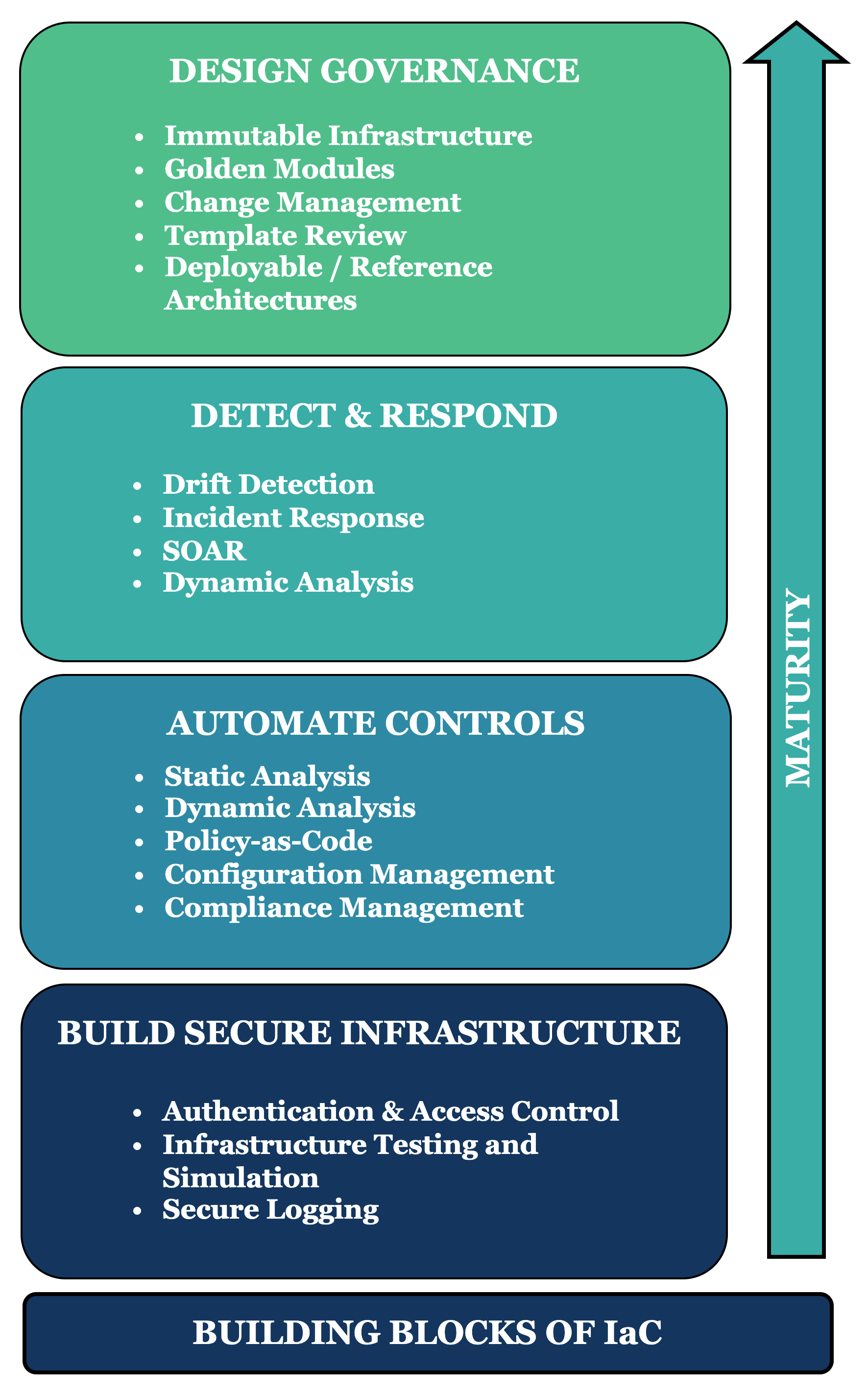
- Building Blocks of IaC (Core foundation for all other layers)—These are the fundamental practices required to enable any Infrastructure as Code approach.
- Use declarative configuration (e.g. Terraform, YAML, JSON).
- Embrace version control (e.g. Git) for all infrastructure code.
- Define idempotent and modular code for reusable infrastructure.
- Enable automation pipelines (CI/CD) for repeatable deployments.
- Follow consistent naming conventions, tagging policies, and code linting.
- Build Secure Infrastructure- Focuses on embedding secure design and architectural patterns into the infrastructure baseline.
- Use secure-by-default modules (e.g. encryption, private subnets).
- Establish network segmentation, IAM boundaries, and resource isolation.
- Configure monitoring, logging, and default denial policies.
- Choose secure providers and verified module sources.
- Automate Controls - Empowers shift-left security by embedding controls into the development and delivery pipelines.
- Run static code analysis (e.g. Trivy, Checkov) pre-commit and in CI.
- Enforce policy-as-code using OPA or Sentinel for approvals and denials.
- Integrate configuration management and IaC test frameworks (e.g. Terratest).
- Detect & Respond - Supports runtime security through visibility, alerting, and remediation.
- Enable drift detection tools to track deviations from IaC definitions.
- Use runtime compliance monitoring.
- Integrate with SOAR platforms or incident playbooks.
- Generate security alerts for real-time remediation and Root Cause Analysis (RCA).
- Detect & Respond - Supports runtime security through visibility, alerting, and remediation.
- Enable drift detection tools to track deviations from IaC definitions.
- Use runtime compliance monitoring (e.g., IBM Cloud SCC).
- Integrate with SOAR platforms or incident playbooks.
- Generate security alerts for real-time remediation and RCA.
- Design Governance—Establishes repeatable, scalable security practices across the enterprise.
- Promote immutable infrastructure for consistent and tamper-proof environments.
- Use golden modules or signed templates with organizational guardrails.
- Implement change management via GitOps, PR workflows, and approval gates.
- Align with compliance standards (e.g., CIS, NIST, ISO 27001) and produce audit reports.
Anatomy of Secure IaC
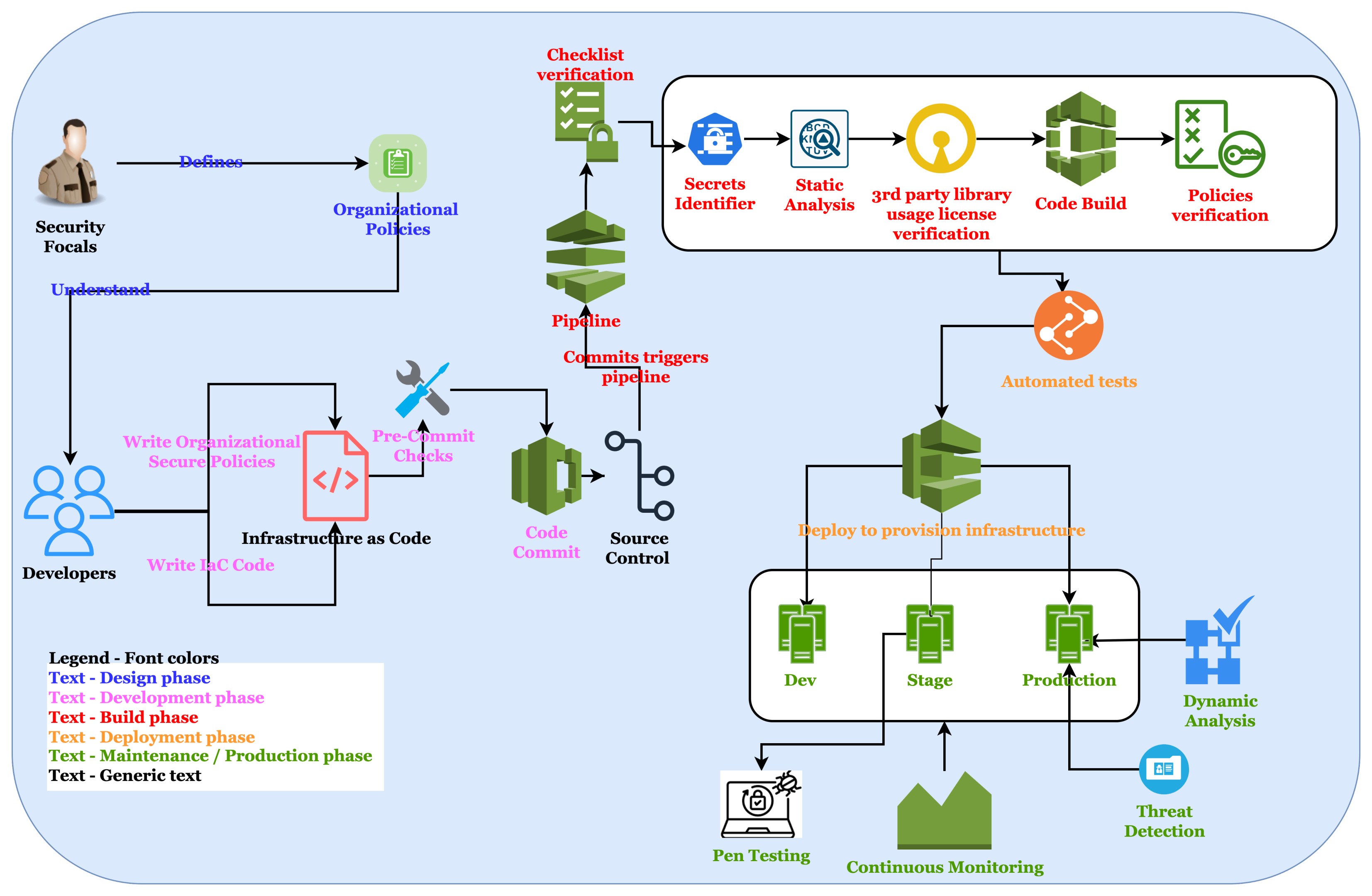
Creating a secure IaC environment involves incorporating several best practices and tools to ensure that the infrastructure is resilient, compliant, and protected against potential threats. These practices are implemented and tracked at various phases of IaC environment lifecycle.
- Design phase of IaC involves not just identifying the IaC script design and tools decision but also includes the design of incorporating organizational policies into the IaC scripts.
- Development phase of IaC involves the coding best practices, implementing IaC scripts and policies involved, and also the pre-commit checks that the developer can run before committing. These checks help a clean code check-in and detect the code smells upfront.
- Build phase of IaC involves all the code security checks and policy verification. This is a quality gate in the pipeline that stops the deployment on any failures.
- Deployment phase of IaC supports deployment to various environments along with their respective configurations.
- Maintenance phase of IaC is also a crucial phase, as threat detection, vulnerability detection, and monitoring play a key role.
Key Pillars of Secure IaC
Below is a list of key pillars of Secure IaC, incorporating all the essential tools and services. These pillars align with cloud-native capabilities to enforce a secure-by-design, shift-left approach for Infrastructure as Code:
- Reference templates like Deployable Architectures or AWS Terraform Modules.
- Reusable, templatized infrastructure blueprints designed for security, compliance, and scalability.
- Promotes consistency across environments (dev/test/prod).
- Often include pre-approved Terraform templates.
- Managed IaC platformsllike IBM Cloud Schematics or AWS CloudFormation
- Enables secure execution of Terraform code in isolated workspaces.
- Supports:
- Role-Based Access Control (RBAC)
- Encrypted variables
- Approval workflows (via GitOps or manual)
- Versioned infrastructure plans
- Lifecycle resource management using IBM Cloud Projects or Azure Blueprints
- Logical grouping of cloud resources tied to governance and compliance requirements.
- Simplifies multi-environment deployments (e.g. dev, QA, prod).
- Integrates with IaC deployment and CI/CD for isolated, secure automation pipelines.
- Secrets Management
- Centralized secrets vault to manage:
- API keys
- Certificates
- IAM credentials
- Provides dynamic secrets, automatic rotation, access logging, and fine-grained access policies.
- Centralized secrets vault to manage:
- Key Management Solutions (KMS/HSM)
- Protect sensitive data at rest or in transit
- Manages encryption keys with full customer control and auditability.
- KMS-backed encryption is critical for storage, databases, and secrets.
- Compliance Posture Management
- Provides posture management and continuous compliance monitoring.
- Enables:
- Policy-as-Code checks on IaC deployments
- Custom rules enforcement
- Compliance posture dashboards (CIS, NIST, GDPR)
- Introduce Continuous Compliance (CC) pipelines as part of the CI/CD pipelines for shift-left enforcement.
- CI/CD Pipelines (DevSecOps)
- Integrate security scans and controls into delivery pipelines using GitHub Actions, Tekton, Jenkins, or IBM Cloud Continuous Delivery
- Pipeline stages include:
- Terraform linting
- Static analysis (Checkov, tfsec)
- Secrets scanning
- Compliance policy validation
- Change approval gates before Schematics apply
- Policy-as-Code
- Use tools like OPA (Open Policy Agent) policies to:
- Block insecure resource configurations
- Require tagging, encryption, and access policies
- Automate compliance enforcement during
planandapply
- Use tools like OPA (Open Policy Agent) policies to:
- IAM & Resource Access Governance
- Apply least privilege IAM roles for projects, and API keys.
- Use resource groups to scope access boundaries.
- Enforce fine-grained access to Secrets Manager, KMS, and Logs.
- Audit and Logging
- Integrate with Cloud Logs to:
- Monitor infrastructure changes
- Audit access to secrets, projects, and deployments
- Detect anomalies in provisioning behavior
- Integrate with Cloud Logs to:
- Monitoring and Drift Detection
- Use monitoring tools like IBM Instana, Drift Detection, or custom Terraform state validation to:
- Continuously monitor deployed infrastructure
- Compare live state to defined IaC
- Remediate unauthorized changes
- Use monitoring tools like IBM Instana, Drift Detection, or custom Terraform state validation to:
Checklist: Secure IaC
1. Code Validation and Static Analysis
Integrate static analysis tools (e.g., Checkov, TFSec) into your development workflow.
Scan Terraform templates for misconfigurations and security vulnerabilities.
Ensure compliance with best practices and CIS benchmarks.
2. Policy-as-Code Enforcement
Define security policies using Open Policy Agent (OPA) or other equivalent tools.
Enforce policies during the CI/CD pipeline to prevent non-compliant deployments.
Regularly update and audit policies to adapt to evolving security requirements.
3. Secrets and Credential Management
Store sensitive information in Secrets Manager.
Avoid hardcoding secrets in IaC templates.
Implement automated secret rotation and access controls.
4. Immutable Infrastructure and Version Control
Maintain all IaC templates in a version-controlled repository (e.g., Git).
Implement pull request workflows with mandatory code reviews.
Tag and document releases for traceability and rollback capabilities.
5. CI/CD Integration with Security Gates
Incorporate security scans and compliance checks into the CI/CD pipeline.
Set up approval gates to halt deployments on policy violations.
Automate testing and validation of IaC changes before deployment.
6. Secure Execution Environment
Utilize IBM Cloud Schematics or AWS Cloud Formation or any equivalent tool for executing Terraform templates in isolated environments.
Restrict access to execution environments using IAM roles and policies.
Monitor and log all execution activities for auditing purposes.
7. Drift Detection and Continuous Monitoring
Implement tools to detect configuration drift between deployed resources and IaC templates.
Regularly scan deployed resources for compliance.
Set up alerts for unauthorized changes or policy violations.
Benefits of Shift-Left Secure IaC
Here are the key benefits of adopting Shift-Left Secure IaC, tailored for cloud-native teams focused on automation, compliance, and developer enablement:
- Early Risk Detection and Remediation
- Faster, More Secure Deployments
- Automated Compliance Enforcement
- Reduced Human Error and Configuration Drift
- Improved Developer Experience
- Enhanced Auditability and Traceability
- Reduced Cost of Security Fixes
- Stronger Governance with IAM and RBAC
- Continuous Posture Assurance
Conclusion
Adopting a shift-left approach to secure IaC in cloud platforms isn’t just about preventing mis-configurations—it’s about building smarter from the start. When security is treated as a core part of the development process rather than an afterthought, teams can move faster with fewer surprises down the line. With cloud services like Schematics, Projects, Secrets Manager, Key Management, Cloud Formation, and Azure Blueprints, organizations have all the tools they need to catch issues early, stay compliant, and automate guardrails. However, the true benefit extends beyond security—it establishes the foundation for platform engineering. By baking secure, reusable infrastructure patterns into internal developer platforms, teams create a friction-less, self-service experience that helps developers ship faster without compromising governance.
Opinions expressed by DZone contributors are their own.
Comments