

Building Secure Transaction APIs for Modern Fintech Systems Using GitHub Copilot
Use GitHub Copilot to build secure fintech APIs faster by adding input validation, rate limiting, and safe error handling, without compromising compliance or trust.
Join the DZone community and get the full member experience.
Join For FreeGitHub Copilot is not just a new tool anymore. It's becoming a code productivity accelerator tool. In regulated industries like fintech, where speed must match uncompromising security standards. AI-assisted coding can shift the developer workflow from reactive to proactive.
In fintech, where delays can mean failed transactions or regulatory breaches, building performant and secure APIs quickly is mission-critical. This is where GitHub Copilot comes in with speed and structure to help developers build secure components without breaking the flow. This is a key advantage when time-to-market is critical in financial applications.
APIs are the digital backbone of financial infrastructure in fintech, as they directly power functions such as instant payments, identity verification, and fraud detection. Every financial transaction, starting from mobile banking to stock trading, depends on robust API performance.
But this also means a single insecure or unstable endpoint can interrupt services, which can trigger compliance failures or expose user data. GitHub Copilot can help accelerate the development of secure transaction APSs by:
- Validating sensitive inputs
- Enforcing rate limits to protect from abuse
- Responding to exceptions without leaking internals
Rather than just listing implementation steps, this guide explains why each security enhancement is necessary. It grounds every Copilot suggestion in a real fintech context.
Prerequisite Setup
If you're new to Flask, GitHub Copilot, or building microservices, this guide to building a stateless microservice will help you set up your environment locally. We’ll extend that Flask project here with a focus on strengthening security and resilience.
Step 1: Strengthening Input Validation
APIs handling financial transactions should and must validate every field. This is important, and we often overlook it by assuming the API errors will handle them more effectively. It not only prevents app crashes but also guards against injection attacks and logic flaws.
Let’s enhance the /process_transaction API for security, building upon the implementation from another guide to vibe coding with GitHub Copilot in fintech APIs.
Copilot Prompt for Input Validation
Add the below prompts in your routes.py:
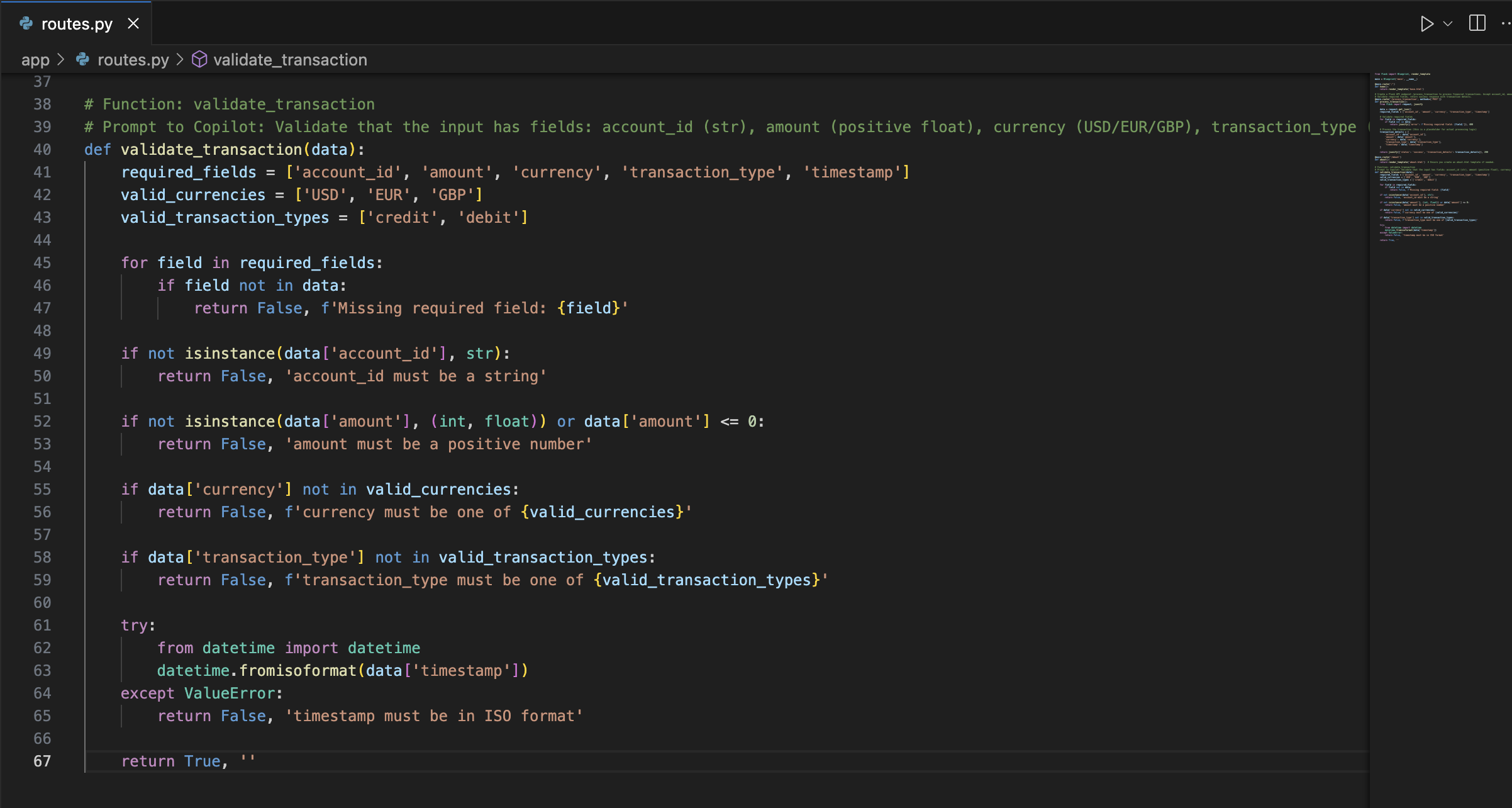
# Function: validate_transaction
# Prompt to Copilot: Validate that the input has fields: account_id (str), amount (positive float), currency (USD/EUR/GBP), transaction_type (credit/debit), timestamp (ISO format)
The Copilot suggestion is as follows: Press the tab key on the keyboard, and we will see the code with validation generated (see lines 38 to 67).
Why is this important?
Missing or malformed fields can lead to transactional failure or compliance errors. Unvalidated currency fields can result in inaccurate conversions or money laundering risks. Finally, validating the amount ensures transactions are logically sound and resistant to exploits like negative refunds.
Copilot helps build the structure fast, but picking the right rules needs fintech knowledge.
Step 2: Add Rate Limiting to Prevent Abuse
Even if an API works correctly, it can still be attacked by bots or too many automated requests. Automated scripts or bots can easily flood the API with repeated requests. They will overload the servers, slow down the service, and crash the system, making the API unavailable during critical financial operations.
Copilot Prompt for Rate Limiting
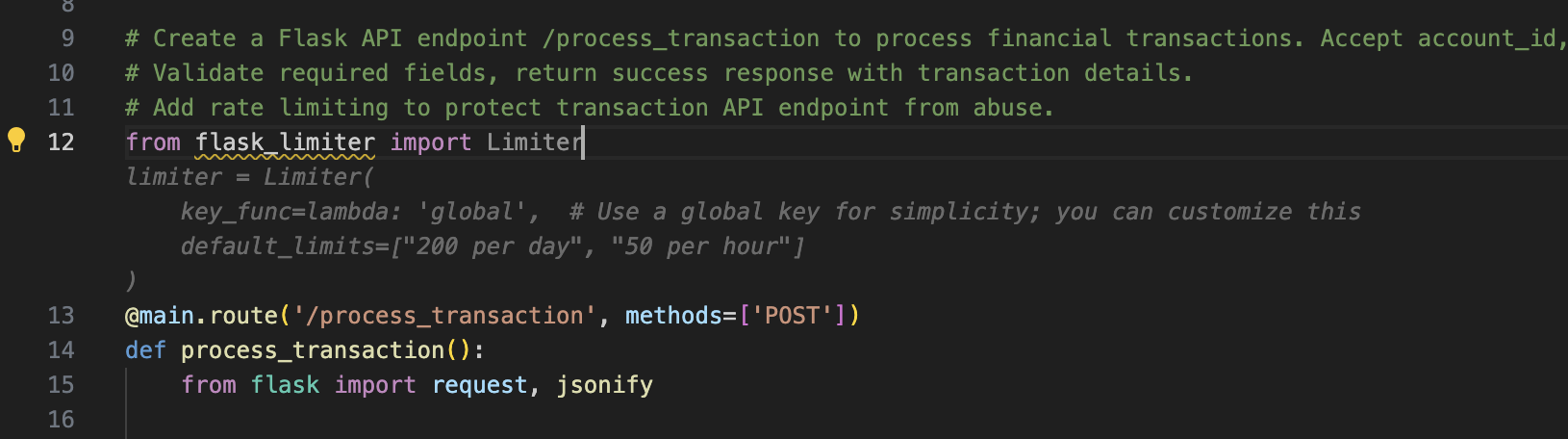
# Add rate limiting to protect transaction APIThe Copilot suggestion is as follows: Just hit the tab on the keyboard, and we will see the rate-limiting code is generated (see lines 12 to 15). We see that the default 200 per day and 50 per hour limit is generated, which can be adjusted based on needs.
Why is this important?
It helps stop Denial-of-Service (DoS) attacks that try to crash the system. It blocks users from misusing promotions or guessing rules by force. Finally, it supports fair usage rules required by API policies and regulations, like open banking.
Copilot adds decorators, but setting proper thresholds requires operational awareness.
Step 3: Improve Error Handling
Unstructured or poorly handled errors can leak sensitive information about how the system works. For example, stack traces might show file names, function calls, or database queries. This gives attackers insights into the internal logic or data structures, making it easier to exploit vulnerabilities.
Copilot Prompt for Error Handling
# Handle errors securely for transaction APIThis time let's try, copilot in-line editing, which appears when we select the API and click the Copilot option, and write the prompt to accept the generated code.
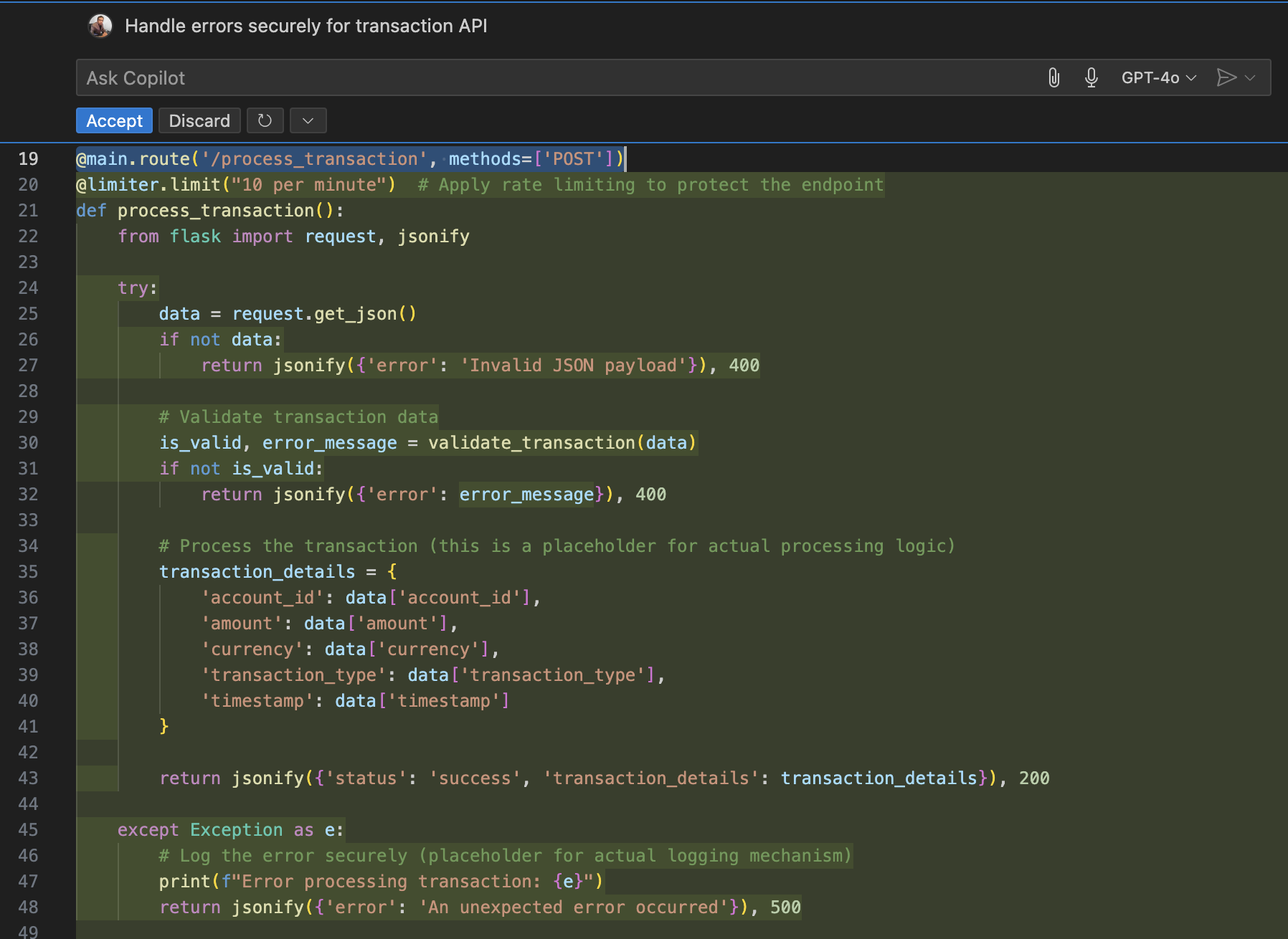
A basic security check was performed using the prompt generated by Copilot's code. However, we need to implement a more robust error handling check to enhance security. Let's try some different and specific prompts.
#Handle errors securely for the transaction API. Handle erros 400, 429 and 500.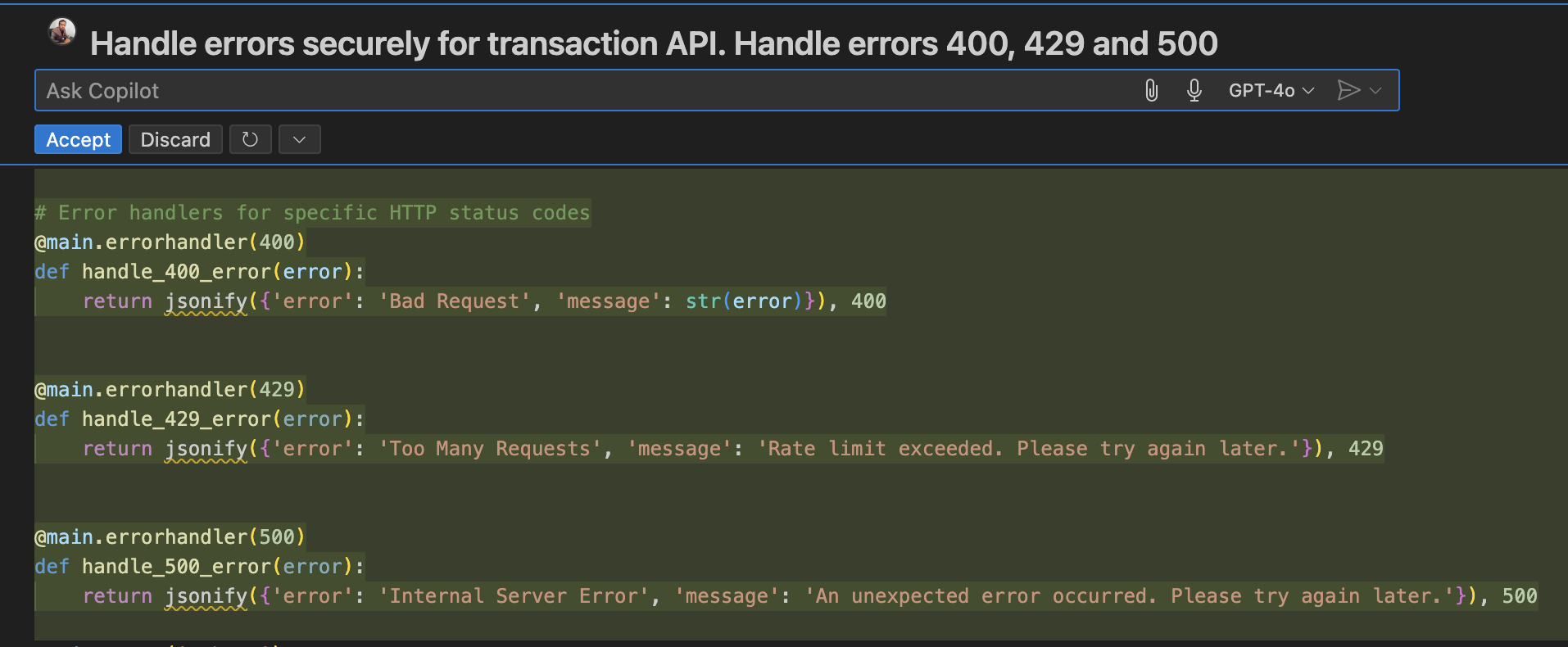
Why is this important?
This prevents leaking of internal server logic to attackers. It offers consistent messaging to users without exposing systems. Also, it complies with security audits (e.g., PCI-DSS, SOC 2). Copilot structures this well, but we had to change the responses depending on business context and technical aspects as well to handle major error-handling scenarios.
Summary
|
Feature
|
Copilot Helps With
|
Needs Manual Expertise
|
|
Input Validation
|
Function structure
|
Domain rules (e.g, valid currencies)
|
|
Rate Limiting
|
Setup + decorators
|
Threshold tuning per endpoint
|
|
Error Handling
|
Basic error setup
|
Be specific about error codes and error messages for users.
|
Final Thoughts
The foundational part of any application is security. It isn’t just a feature — in fintech, security, compliance, and speed of execution matter above anything else.
API weaknesses have direct financial consequences. GitHub Copilot helps secure development velocity, but final accountability rests with the developer experts in the area. In conclusion, Copilot is a tool, not a replacement for design judgment.
Vibe coding means working at high speed with high quality. It works well when combined with fintech security expertise. AI coding assistants are here to stay, and they're the future of every company's software engineering teams. Developers who succeed will be those who strike a balance between speed and responsibility.
Opinions expressed by DZone contributors are their own.
Comments