

Stop Preparing for Audits — Build the Pipeline That Audits Itself
The four-layer stack that ships compliance on every commit cuts audit prep by 80% and turns your next audit into a query.
Join the DZone community and get the full member experience.
Join For FreeEvery engineering team I have read about that built continuous compliance the right way reports the same three things: audit prep drops from weeks to hours, evidence requests get answered with a query instead of a scramble, and the compliance team stops being the group everyone dreads talking to.
The stack that gets you there in 2026 is not experimental anymore. Every piece is production-grade, mostly open source, and the pattern is documented in enough public engineering blogs that you can copy it without reinventing anything. This is a walkthrough of what that stack actually looks like, what each layer does, and the concrete benefit each one produces.
If you're still running compliance as an annual project instead of a pipeline concern, this is the article I wish someone had put in front of me two years ago.
The Four Layers That Matter
A continuous compliance stack has four layers. Each one solves a specific class of problem and produces evidence at a different granularity.
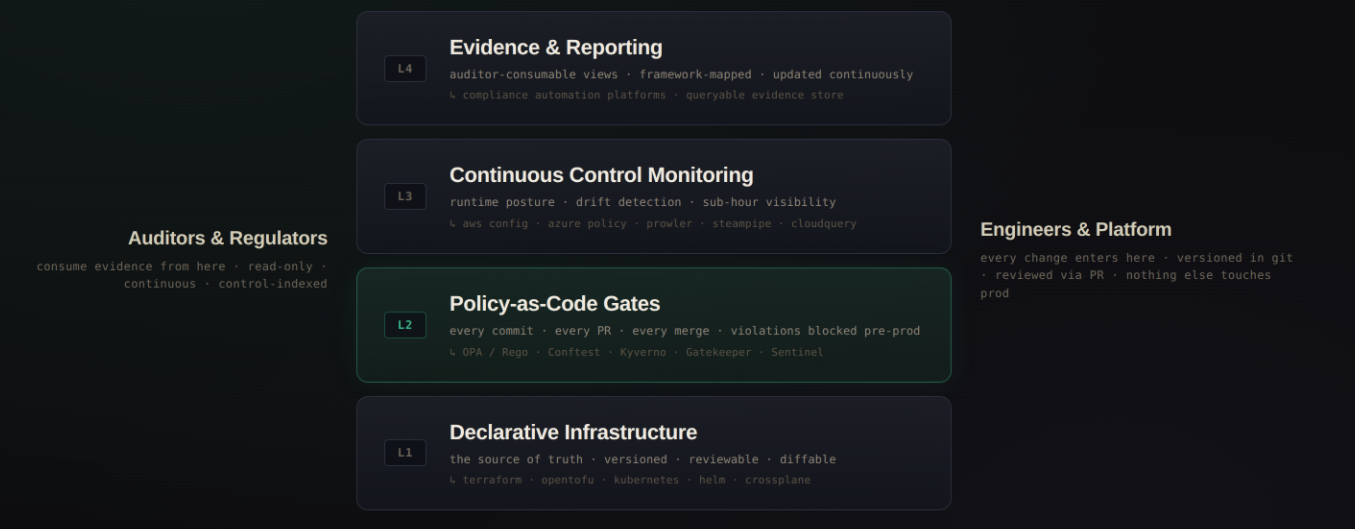
You build them bottom-up. Trying to build Layer 4 without Layers 1-3 is the classic mistake. You end up with a dashboard that reports what the auditor asked about, not what's actually true.
Layer 1: Everything Is Code, or You Have No Floor to Build On
Nothing about continuous compliance works if your production environment is a set of manually-clicked buttons in a cloud console. The prerequisite is that every piece of infrastructure exists as a versioned, reviewable file.
For most teams in 2026, this means Terraform or OpenTofu for cloud resources, Kubernetes manifests or Helm charts for workloads, and something like Crossplane if you want the whole platform expressed as CRDs. The specific tool matters less than the invariant: if someone can change production without opening a pull request, that change is invisible to every layer above it.
The concrete benefit: any auditor question of the form "what was running on date X" becomes git log --before=X on the infra repo. No CMDB lookup, no interview, no reconstruction.
Layer 2: Policy as Code Gates the Pipeline
This is where the audit stops being a separate activity and becomes part of the deploy loop.
The pattern is simple: every change to Layer 1 gets evaluated against a set of machine-readable policies before it can merge. If it violates a policy, the pipeline blocks it. The policy engine that has won this space is Open Policy Agent with its Rego language.
Here is what a real policy looks like, checking that no S3 bucket in a Terraform plan can be created without encryption:
package terraform.s3

deny contains msg if {
    resource := input.resource_changes[_]
    resource.type == "aws_s3_bucket"
    resource.change.actions[_] == "create"
    not resource.change.after.server_side_encryption_configuration
    msg := sprintf(
        "S3 bucket '%s' created without encryption at rest",
        [resource.address]
    )
}
You wire this into your pipeline with Conftest or a native OPA integration, run it on every terraform plan, and the merge is blocked if any deny rule fires. The developer gets the error in their PR within seconds, fixes it, and the violation never touches production.
Every control you would otherwise sample once a year becomes a rule you enforce on every commit. Access controls, encryption requirements, tagging standards, network segmentation, cost guardrails, data residency. All the same shape.
For Kubernetes specifically, the modern option is Kyverno or Gatekeeper, both of which run OPA-style policies as admission controllers so violations are rejected before workloads land in the cluster.
The concrete benefit: the control isn't sampled; it's enforced. Every artifact of every deploy is compliant by construction. The auditor doesn't have to trust that Sarah reviewed the change; they can inspect the policy code, verify it matches the control language in the framework, and see the immutable log of every evaluation.
Layer 3: Continuous Control Monitoring for What Escapes the Pipeline
Not everything comes through the pipeline. Someone will always have break-glass access. A managed service will drift. A misconfiguration will slip through because you didn't have a policy for it yet.
This is where continuous monitoring lives. The stack of choice depends on your cloud, but the pattern is consistent:
- AWS Config with Config Rules that continuously evaluate resource state against desired configuration
- Azure Policy with built-in and custom definitions
- Google Cloud Security Command Center with Security Health Analytics
- Prowler, Steampipe, or CloudQuery for cloud-agnostic queries across your posture
The key move: Export the evaluation results on a schedule of minutes or hours into a queryable evidence store. Something like S3 + Athena, or a proper data warehouse if you're doing this seriously. Every finding gets a timestamp, a resource identifier, a control mapping, and a status.
Now your posture is a table you can query. "How many production databases were unencrypted on any given day in the last twelve months" is a SELECT statement, not a project.
The concrete benefit: drift detection in minutes instead of quarters. When a misconfiguration appears, the pipeline that catches it is the same one that alerts the engineer, opens a ticket, and can even remediate automatically for specific classes of issues.
Layer 4: Evidence Pipeline, Not Evidence Collection
The last layer is where most attempts fail. Teams build great pipelines and monitoring, then when the auditor shows up, they still scramble to export screenshots into a shared drive.
The move is to invert the flow. Instead of collecting evidence when asked, you continuously publish evidence in a format the auditor's tooling can consume. For SOC 2 and ISO 27001, the emerging pattern is:
- Every control gets a stable identifier that maps to the framework (SOC 2 CC6.1, ISO 27001 A.8.24, etc.)
- Every policy, monitoring rule, and pipeline check declares which control(s) it enforces as metadata
- The evidence store aggregates the results into a control-indexed view, updated continuously
- The auditor gets read-only access to that view, either through a compliance automation platform or a direct query interface
Compliance automation platforms in this space (Vanta, Drata, Secureframe, Sprinto, and a growing number of others) have made much of this out of the box, but the value only shows up if the underlying pipeline actually produces the evidence they consume. The tool doesn't create compliance; it packages it.
The concrete benefit: your next audit stops being a project. The auditor logs into the evidence view, samples what they need, and produces the report. Your team's involvement drops from hundreds of hours to dozens.
The Numbers People Are Reporting
Public case studies from engineering blogs and industry conferences have converged on a consistent shape of return:
- Audit prep time: 3-6 weeks of engineering time collapses to under 40 hours
- Evidence request turnaround: from days to minutes for anything the pipeline already tracks
- Control coverage: 100% of applicable resources instead of sampled 15-30
- Time to detect drift: from quarterly review cycles to sub-hour
- Cost of external audit engagement: 30-70% reduction as auditor hours shift from evidence collection to review
These are not marketing numbers from vendors. They're what practitioners are reporting in State of DevOps reports, at conferences like SREcon and DevOps Enterprise Summit, and in engineering blogs from companies that have actually done it.
A 90-Day Rollout That Works
You do not need a six-figure consulting engagement to start. The pattern that consistently works:
Weeks 1-2: Pick one control and one policy. Choose something high-value and easily codified. "No public S3 buckets" or "all databases must have encryption at rest" are perfect starting points. Write the Rego policy, wire it into a single pipeline, and prove the end-to-end works.
Weeks 3-6: Expand to a family of controls. Cover all the encryption controls, or all the access control policies, or all the network segmentation rules. Do not try to cover everything at once. Pick a category and finish it.
Weeks 7-10: Wire in continuous monitoring for the same controls. Now the same rules that gate the pipeline are also checking runtime state. Any drift, any exception, any resource created outside the pipeline gets flagged within an hour.
Weeks 11-13: Build the evidence view. Even a simple query against your monitoring store is enough to start. The point is that the auditor can pull the current state of these controls without your team producing a spreadsheet.
At the end of ninety days, you have a working continuous compliance loop for one control family. It will already be more rigorous than your previous annual audit for those controls. Now you expand.
The Mistake Nobody Warns You About
Every failed continuous compliance program I've read about failed for the same reason: they tried to codify the existing controls exactly as the compliance team had written them for a human audit.
Human-audit controls are written in prose. "Access to production systems is reviewed quarterly by the appropriate manager." That sentence contains three ambiguities that don't exist in code: what counts as "access," who is "appropriate," what is "reviewed."
When you move to code, you have to force a specificity that the prose let you skip. Which is uncomfortable, because now the compliance team, the engineering team, and eventually the auditor have to agree on the exact definition. That agreement is where the value lives. The pipeline is downstream of it.
Teams that skip this conversation and try to auto-generate policies from a control library end up with policies that either don't fire (too permissive, technically enforced but meaningless) or fire on everything (too strict, engineering routes around them). The policies have to be a real translation of what the control means, not a syntactic conversion.
Budget the first two weeks of each control family for this conversation. It's the highest-leverage part of the whole build.
What Comes Next
The near-term direction that engineering teams should watch:
Machine-readable audit standards. Right now every control framework is prose. The OSCAL project from NIST is defining a machine-readable format for control catalogs, profiles, and assessment results. When this reaches critical mass, the manual translation step above collapses.
Regulator-consumable evidence. DORA and the SEC cyber rules are the leading edge. Both point toward a future where regulators expect continuous evidence rather than periodic attestation. If you build now, you're ready. If you don't, you're playing catch-up under enforcement pressure.
AI agents as compliance actors. LLM-based agents that read policy documents, propose Rego translations, review pipeline results, and draft explanations for auditors are already being tested at large orgs. The interesting question is not whether they help (they do) but how you audit them, which is a whole other problem.
The takeaway: Continuous compliance is no longer a future state. It's a solved architectural pattern that any team can start implementing in the next sprint. The teams that build it now will spend the next decade shipping faster and paying less for audits than the teams that don't. That's the entire pitch.
Opinions expressed by DZone contributors are their own.
Comments