

Stable Diffusion: The Community’s AI
Stable Diffusion AI is revolutionizing the art industry with innovative technology that boosts creativity and transforms our appreciation of art.
Join the DZone community and get the full member experience.
Join For FreeCreativity and art have always been exclusive domains of the human imagination. Still, in recent years, artificial intelligence (AI) has burst into the art world, challenging our perceptions and expanding the boundaries of artistic creation. In this context, Stable Diffusion emerges as a powerful art-generating AI that is revolutionizing the way we conceive and experience artistic expression.
Stable Diffusion stands out for being an open-source solution with the possibility of being completely free. With its transformative potential, this AI opens new doors to creativity and provides artists with a powerful tool to explore and realize their artistic visions.
As in previous articles, we will explore in depth this artificial intelligence called Stable Diffusion, examining its operation, features, and benefits in the field of generative art.
What Is Stable Diffusion?
Stable Diffusion is an open-source artificial intelligence engine developed by the company Stability AI, designed to generate images from text, but little by little it has been used for other purposes that will be explained later. It uses a diffusion model, which gives its name to this AI, Stable Diffusion, to be able to generate images from scratch.
Internally, this AI employs a machine learning system, which means that as it is used, it progressively learns to produce accurate results, improving its performance over time.
The imaging process consists of three distinct stages. To begin with, Stable Diffusion will encode the provided text (prompt). Next, it will generate information about the image creation, and finally, it will use a decoder to render the image from the text.
Stable Diffusion was previously trained by its creators to recognize celebrities. But how was it trained? To properly train this system, Stable Diffusion was trained with millions of pairs of captioned images, filtering for good-quality images that humans had rated as the ones they liked the most.
Features and Benefits of Stable Diffusion
One of the main features and advantages of Stable Diffusion is that its source code is publicly available, allowing any developer to create tools from the code base. This gives the community great flexibility to develop improvements and grow artificial intelligence. In addition, being an open-source project, developers can train and adapt Stable Diffusion to their specific needs and projects.
Although its primary function is to generate images from text requests, Stable diffusion can also edit existing images. Users can upload an image and request the addition or removal of specific objects, a process known as Image to Image, i.e., users can generate new images from existing images, either editing them or adding specific elements to them as requested.
An advantage that is also valued in the community is that it can be used in English, Spanish, or other languages.
How To Use It
Having explained AI and its features, let’s see how we can use it to create our images.
There are different methods; the easiest is to access the stablediffusionweb.com website and scroll down to the section called Playground.

The disadvantage of this method is that it is a bit slow, and you will have to refine it a lot to get a result you like, which translates into “trial and error.”
Another method that is more widespread in the community to use Stable Diffusion is to use the Dream Studio web tool, developed by the same creators of the AI. To access it, go to this website. With this tool, we can even select the version of Stable Diffusion that best suits us and different parameters that will adjust the creation of our image.
To use it, we will access the web mentioned before, register with Google, for example, and we will be able to write our prompts to start generating images.
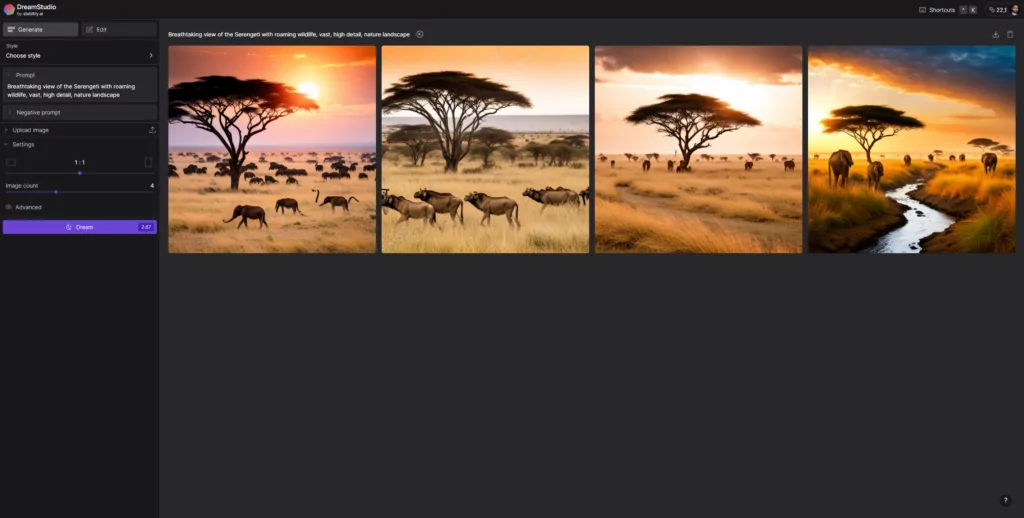
Note that we start with a small amount of coins for free and these are recharged over time, although you always have the option to pay to get more coins (it is a system similar to the one we explained in the GPT-3 article).
Another option is to use Stable Diffusion on your computer through a project available on GitHub, which means that you will work directly with your computer hardware. Take into consideration that a powerful GPU and high performance are required to use it properly.
Finally, Mac users have the option of using a native application called DiffusionBee, installable like any other native Apple application.
Curiosity: Animation With Stable Diffusion
Although artificial intelligence has received a lot of criticism for its application and diffusion, the truth is that the revolution in certain areas of our lives is unstoppable.
Some companies are starting to use this type of technology for their campaigns and brands. A great example of this is the new Coca-Cola ad entitled “Masterpiece.” The ad takes place in a museum where recognized characters from famous paintings come to life to give a bottle to one of the young women in the museum. You can see this ad on their YouTube channel.
Another case was that of a studio called Corridor Digital. It decided to make a comic chapter about a rock-paper-scissors battle in anime style. You can see the video at this link.
If you want to know more about the creation process and how they did it, you can access their website, where they have a one-hour tutorial on how it was done.
Conclusion
In conclusion, the availability of an open-source art-generating artificial intelligence represents a significant breakthrough in the field of artistic creation and technological innovation. This tool, which is freely accessible to developers worldwide, allows creative minds to unleash their imagination and explore new artistic possibilities.
Being open source, this artificial intelligence encourages collaboration and knowledge sharing within the developer community. This means that more and more people will be able to benefit from this technology, improving it and adapting it to their own needs and projects.
In addition, the free nature of this tool is a key factor in its widespread adoption. By being able to use it on their equipment, artists and programmers have the freedom to experiment and create without economic restrictions, which promotes the democratization of art generated by artificial intelligence.
In short, this free and open-source art-generating artificial intelligence opens new creative possibilities and drives innovation and collaboration in the global developer community. It represents a valuable resource for artists and technology enthusiasts, allowing them to explore and expand the boundaries of creativity in art.
Published at DZone with permission of Isaac Alvarez. See the original article here.
Opinions expressed by DZone contributors are their own.
Comments