

DZone
Thanks for visiting DZone today,
Edit Profile
  • Manage Email Subscriptions
  • How to Post to DZone
  • Article Submission Guidelines
Sign Out View Profile
  • Post an Article
  • Manage My Drafts
Newsletter
Log In / Join
Refcards Trend Reports
Events Video Library
Refcards
Trend Reports

Events

View Events Video Library

Related

  • Delegated Transport, Forked Authorization: Where Chat and AI-Agent Integrations Actually Break
  • Contract-First Integration: Building Scalable Systems With Flyway, OpenAPI, and Kafka
  • The "Zombie API" Attack: Why Your Old Integrations Are Your Biggest Security Risk
  • 6 Integration Patterns That Look Good on Paper and What Happens When They Hit Production

Trending

  • Solving Comprehension Debt in AI-Generated Codebases
  • Building Multi-Rail Payment Failover to Stop Latency Spikes and Double Debits
  • Building a Real Pipeline With senro: Monorepos, Caching, and Triggers
  • Engineering Data Observability: Detecting Schema Drift, Data Drift, and Silent Pipeline Failures

Draft This article hasn't been published, so readers can't see it.

In moderation This article is waiting for review, so readers can't see it yet.

Deleted This article has been deleted, so readers can't see it.

  1. DZone
  2. Software Design and Architecture
  3. Integration
  4. Using Facades to Decouple API Integrations

Using Facades to Decouple API Integrations

By 
Bruno Pedro
·
Mar. 13, 13 · Interview
Post on X (opens in a new tab) Share on LinkedIn (opens in a new tab)
12.5K Views

Join the DZone community Save articles, join the discussion, and download Refcards and Trend Reports with a free account.

Join for free Already a member? Log in

the most important part of building an integration with an api is actually writing the code that will connect with the web service and invoke its methods. i'll show you why using the façade pattern to decouple calls from your existing code is a good idea and help you identify what kind of problems you might be able to prevent.


so, first things first, what is the façade pattern?


a façade is an object that provides simple access to complex - or external - functionality. it might be used to group together several methods into a single one, to abstract a very complex method into several simple calls or, more generically, to decouple two pieces of code where there's a strong dependency of one over the other.


what happens when you develop api calls inside your code and, suddenly, the api is upgraded and some of its methods or parameters change? you'll have to change your application code to handle those changes. also, by changing your internal application code, you might have to change the way some of your objects behave. it is easy to overlook every instance and can require you to doublecheck multiple lines of code.


there's a better way to keep api calls up-to-date. by writing a façade with the single responsibility of interacting with the external web service, you can defend your code from external changes. now, whenever the api changes, all you have to do is update your façade. your internal application code will remain untouched.
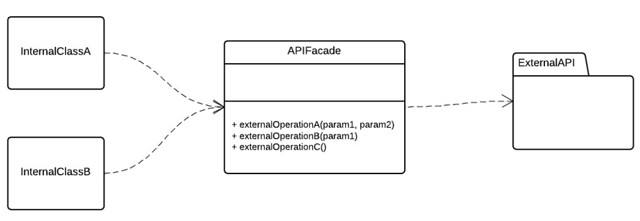


from a test driven development point-of-view, using a facade offers a big advantage. you're now able to write simple tests against the façade without affecting your internal code test results. by using this strategy, you'll be able to know immediately whenever an api is not working as you expected and make the necessary changes to the façade.


this is the approach we follow at cloudwork when building integrations between any third-party apis. api façades act as tight compartments that protect the rest of the application from external changes and simplify the way we interact with different web services.


this article is cross-posted at using facades to decouple api integrations .

API Integration

Opinions expressed by DZone contributors are their own.

Related

  • Delegated Transport, Forked Authorization: Where Chat and AI-Agent Integrations Actually Break
  • Contract-First Integration: Building Scalable Systems With Flyway, OpenAPI, and Kafka
  • The "Zombie API" Attack: Why Your Old Integrations Are Your Biggest Security Risk
  • 6 Integration Patterns That Look Good on Paper and What Happens When They Hit Production

Partner Resources

×

Comments

Loading comments

The comments didn't load

Please try again in a moment.

Likes

Loading

The next likes didn't load. Please try again.

The likes didn't load

Please try again in a moment.

See who liked this

Log in or join DZone for free to see who liked this article.

Log in Join for free
  • RSS
  • X
  • Facebook

ABOUT US

  • About DZone
  • Support and feedback
  • Community research

ADVERTISE

  • Advertise with DZone

CONTRIBUTE ON DZONE

  • Article Submission Guidelines
  • Become a Contributor
  • Core Program
  • Visit the Writers' Zone

LEGAL

  • Terms of Service
  • Privacy Policy

CONTACT US

  • 3343 Perimeter Hill Drive
  • Suite 215
  • Nashville, TN 37211
  • [email protected]

Let's be friends:

  • RSS
  • X
  • Facebook