

A Look at ForkJoinPool and Parallel Streams
The ForkJoin pool was put into place to support parallel streams. Get a look at how the pool works and how the work-stealing algorithm help divide up tasks.
 CORE
·
CORE
·
Join the DZone community and get the full member experience.
Join For FreeThe Common ForkJoin Pool was introduced in Java 8 to support parallel streams, CompletableFuture, etc. ForkJoin is based on parallel computing, where a problem gets divided into sub-problems until the sub-problems are simple enough to solve simultaneously in separate threads, after which the results are aggregated.
The algorithm that's been used in ForkJoin implementations is the 'Work-Stealing Algorithm' to ensure that no CPU is idle.
Let's take a look at work-stealing algorithm.
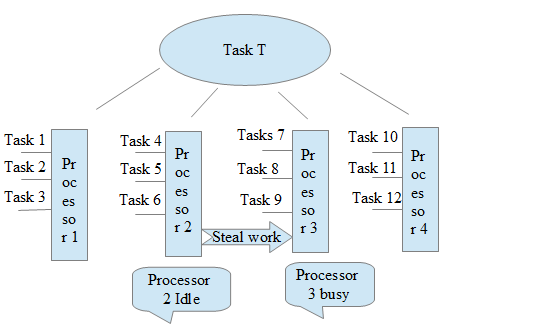
Suppose there are four processors on a system and Task T has been divided into 12 subtasks, shown below, from T1 to T12.
Each processor has three subtasks. But suppose Processor 3 is too busy with work and Processor 2 is idle—it either finished all the tasks or it's in a waiting state. Then, Processor 2 will ask to Processor 3 if it needs help and takes a percentage of the tasks. So, Processor 2 is 'stealing the work' from Processor 3.
The below snapshot depicts this process:
Now let's look at the snapshot below to understand the ForkJoin framework:
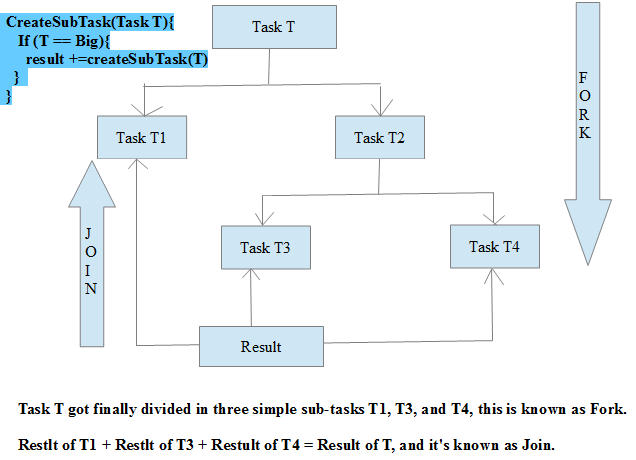
So above snapshot shows the recursive approach to divide the task until subtask is a simple task.
We create an instance of ForkJoinPool as below -
ForkJoinPool pool = new ForkJoinPool(parallelism);
Here, parallelism is the target parallelism level (number of processors), which can be seen below:
Runtime.getRuntime().availableProcessors(); // returns 4 on my system
To support parallelism for collections using parallel streams, a common ForkJoinPool is used internally.
We can get a common pool using the ForkJoin static method below:
ForkJoinPool commonPool = ForkJoinPool.commonPool();
To see the parallelism level for this commonPool, use:
commonPool.getParallelism(); //returns 3 on my system
The ForkJoin framework provides two types of tasks: 'RecursiveTask' and 'RecursiveAction'. The difference between these two is that RecursiveTask can return a value while RecursiveAction cannot.
Let's see an example using RecursiveTask.
FibonacciComutation.java:
package arun.test.forkjoin;

import java.util.concurrent.RecursiveTask;
import org.apache.commons.logging.Log;
import org.apache.commons.logging.LogFactory;

/**
 * @author arun.pandey
 */
public class FibonacciComputation extends RecursiveTask<Integer> {
    public static final Log LOG = LogFactory.getLog(ForkJoinTest.class);
    private final int number;

    public FibonacciComputation(int number) {
        this.number = number;
    }

    @Override
    public Integer compute() {
        if (number <= 1)
        return number;
        FibonacciComputation f1 = new FibonacciComputation(number - 1);
        f1.fork();
        LOG.info("Current Therad Name = "+Thread.currentThread().getName());
        FibonacciComputation f2 = new FibonacciComputation(number - 2);
        return f2.compute() + (Integer)f1.join();
    }
}
The client code is shown below:
FibonacciComutationClient.java:
package arun.test.forkjoin;

import java.util.concurrent.ForkJoinPool;
import org.apache.commons.logging.Log;
import org.apache.commons.logging.LogFactory;

 /**
  * @author arun.pandey
  */
public class FibonacciComutationClient {
    public static final Log LOG = LogFactory.getLog(FibonacciComutationClient.class);

    public static void main(String args[]){
        //to calculate 20th element of Fibonacci-Series
        int number = 20;
        int poolSize = Runtime.getRuntime().availableProcessors();
        ForkJoinPool pool = new ForkJoinPool(poolSize);
        long beforeTime = System.currentTimeMillis();
        LOG.info("Parallelism  => "+ pool.getParallelism());

        Integer result = (Integer) pool.invoke(new FibonacciComputation(number));

        LOG.info("Total Time in MilliSecond Taken ->  "+ (System.currentTimeMillis() - beforeTime));
        LOG.info(number +"the element of Fibonacci Number = "+result);
    }
}
If you execute the client code, you can see the execution time lesser than a normal recursive Fibonacci series implementation. Since it's dividing into subtasks it's a bit faster.
I hope this gives you a better understanding of the ForkJoin framework. Happy learning!
Opinions expressed by DZone contributors are their own.
Comments