

You Already Have an AI Working Agreement. Write It Down.
You already have an AI working agreement. Now, write it down to turn scattered AI decisions into an inspectable artifact.
 CORE
·
CORE
·
Join the DZone community and get the full member experience.
Join For FreeTL;DR: The AI Working Agreement
Your team already has rules for using AI. Some live in templates, some in habits, exceptions, and one person’s memory. The AI Working Agreement puts the decisions that matter in one place: what the team delegates to AI, what stays human, what must be reviewed, what never enters a model, who owns which workflow, and how the agreement changes. Write it, and a new colleague can read your team’s AI decisions on their first day, while the decisions stay when someone leaves.
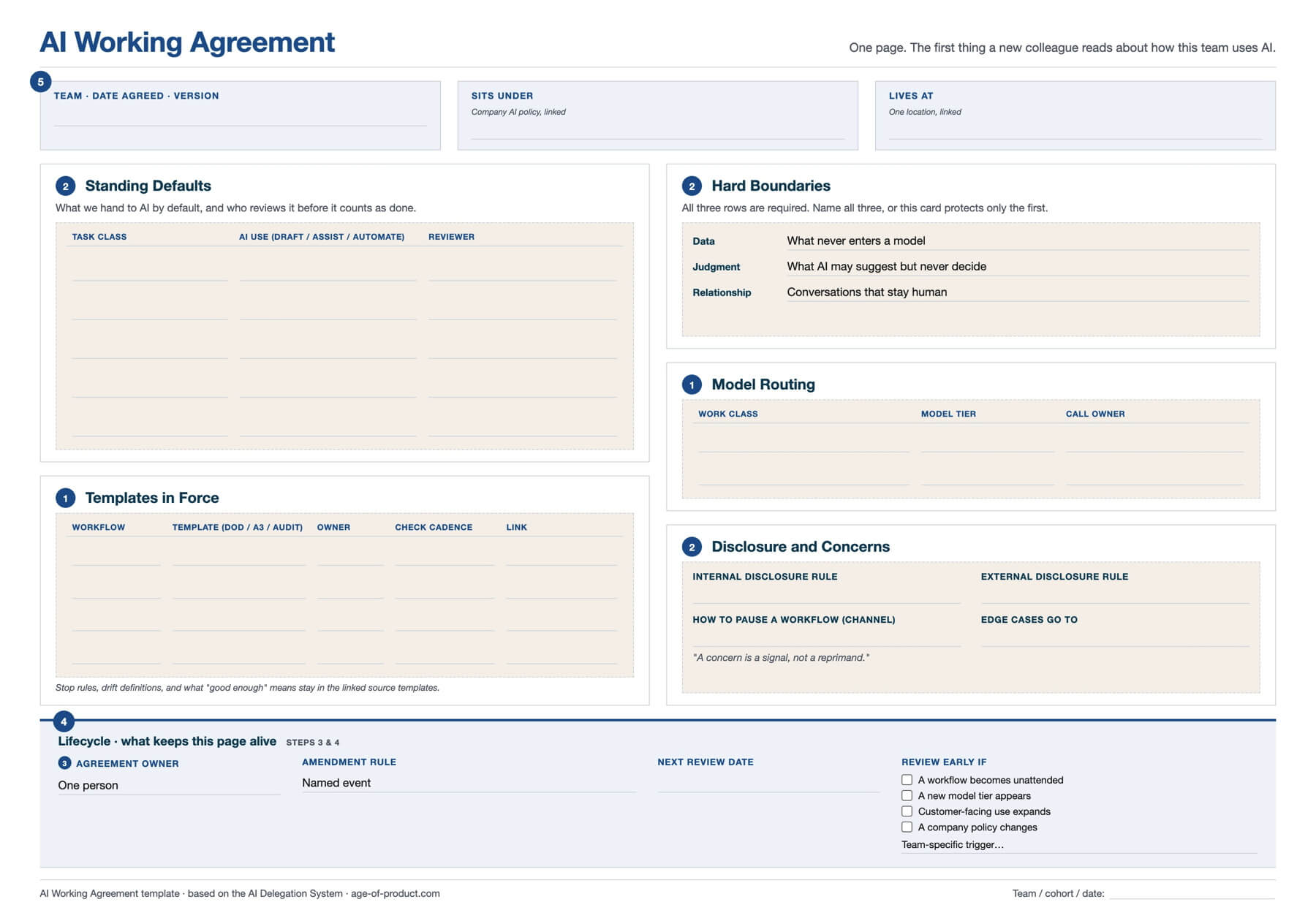
Thesis: Team-level AI governance fails more from uncodified judgment than from missing policies. The AI Working Agreement turns scattered AI decisions into one inspectable artifact, so a team can onboard people, survive departures, and challenge its own habits before those habits harden into risk.
Your Team Already Has AI Rules, Mostly Unwritten
Your team already has rules for how it uses AI. Some are explicit, some aren’t. They show up in who reviews AI-written customer messages, what nobody pastes into a model, which workflows run unattended, and who gets the call when the output feels wrong.
Those unwritten rules are everyday practices and fragile at the same time. They live in habits and in the memory of whoever set them. Call this your team’s AI posture, and notice that most teams have never seen theirs in one place.
An AI Working Agreement is that posture, written down: a single artifact that records what your team hands to a model, what stays human, what gets reviewed and by whom, and how the agreement changes. What you have today is not at that level yet. It is the raw material for it. It becomes an agreement the moment the team can read, challenge, and change it.
If the team cannot state a rule in a single sentence, it probably never agreed on the rule. What looked like consensus was often habit, deference, indifference, or the private judgment of the fastest, most AI-confident person in the room. Real alignment shows when five people make the same call with nobody watching. (Remember what they say about “culture”: it is what happens when nobody is looking.) The agreement is where you find out whether you have it, before the next new hire, departure, or customer question finds out for you.
Your Template Discussions Are the Raw Material
If you have followed the AI Delegation System, you have a head start, because its templates already force the decisions. A team that took them seriously argued about the AI Definition of Done for the Friday status update, filled the A3 Handoff Canvas for the release-notes workflow, wrote three lines of an AI Routing Policy, and put the AI Delegation Audit on the calendar. Real decisions emerged from those sessions.
Then the decisions scattered. The AI Definition of Done sits in the team wiki. The A3 Handoff Canvas is a PDF in a shared folder. The AI routing choice lives in one person’s memory of a Sprint Planning session. The audit cadence is a recurring invite that everyone accepts, but nobody uses.
Look at what each template settled:
- The AI Definition of Done settles what gets verified, how you label AI-touched output, and what “good enough” means for each task class.
- The A3 Handoff Canvas defines who owns each workflow, the stop rules, and what never enters a model.
- The AI Routing Policy settled which model tier runs which work, and who owns the call.
- The AI Delegation Audit settled how often you inspect delegated work and what counts as drift.
Add those together, and you have the raw material of an AI Working Agreement. You made real decisions about trust, review, routing, boundaries, ownership, and inspection. They are just spread across different documents and several people’s heads. If you never touched the templates, you still made these calls, only less deliberately. Either way, the decisions exist, scattered and uninspectable.
The Reason to Write It Down Is a Person, Not an Auditor
There is a familiar argument for codifying AI decisions. One day, a customer’s procurement team or your governance people will ask how you govern your internal AI use, and a written record will reply, not with a shrug, but with documents. I have made the argument in earlier articles on the AI Delegation Lifecycle. It is also the weakest reason to act, because it points to a meeting that might happen in two years.
The stronger reason is sitting two desks away, and they start on Monday.
When a new product manager, coach, developer, analyst, designer, or support colleague joins, they inherit your AI decisions whether anyone tells them or not. If those decisions live in four documents and several memories, the new colleague learns them the slow and expensive way: by getting one wrong, by sending something they should have reviewed, or by reopening a question the team settled six months ago. Every team has watched a capable new hire spend the first month rebuilding context that already existed.
A codified AI Working Agreement changes this first-week experience. The new colleague reads one artifact and knows the team’s standing posture: what you draft with AI and review by hand, what you automate, what stays human, what never goes near a model, and who to ask when a case does not fit. They contribute sooner, and they do it without a senior colleague reciting the unwritten rules from memory.
An Agreement in One Head Leaves When That Person Does
The same page is what carries the AI Working Agreement past a departure. In the MegaBrain.io course scenario, an engineer leaves, and the automation keeps running. The team knows the workflow exists, but not why it runs on that model, what the review step was meant to catch, or when the trust decision expired. Then a status update tells an enterprise prospect that a security feature is in production. It was descoped three months earlier. The system did not fail technically. The team lost the decision record that made the automation originally trustworthy when the engineer left.
An agreement that lives in one head is that person’s practice, not the team’s. You lose it the day they change teams; it represents a single point of failure. Codification is what makes the decision belong to the team rather than the individual; that’s why you write an AI Definition of Done rather than trusting each developer’s private standard. The AI Working Agreement keeps the delegation decisions from leaving with the person who made them. That benefits the people still on the team now, well before any audit asks.
The One-Page Record
You are not filling this in from scratch. The document records decisions you already made, so most of the writing is transcription. Here is a partial example for one team, to show what finished language sounds like:
- Standing defaults: Customer-facing text may be drafted with AI and reviewed by the Product Owner/Manager or Support Lead before it goes out. Internal meeting summaries may be AI-assisted, shared with a note that AI was used.
- Hard boundaries: No customer secrets, security findings, or contract terms enter public or non-approved AI tools. Performance feedback and conflict conversations stay human. AI may suggest a prioritization call, but never decide it.
- Templates in force: Release notes run on the A3 Handoff Canvas. Friday status updates are run against the AI Definition of Done and checked monthly in the AI Delegation Audit.
- Disclosure norm: AI-touched shared work is disclosed inside the team. External disclosure follows customer, legal, and procurement rules.
- Raising a concern: Anyone can pause an AI-assisted workflow by flagging it in Slack. The concern is a signal, not a reprimand.
- Amendment rule: Changes happen in the Retrospective or the AI Delegation Audit. One owner, one review date.
- Review triggers: Revisit the agreement when a workflow becomes unattended, a new model tier appears, customer-facing use expands, or a company policy changes.
Hard boundaries come in three kinds: data boundaries (what never enters a model), judgment boundaries (what AI may suggest but not decide), and relationship boundaries (conversations that stay human). Name all three, or the row protects only the first.
The AI Working Agreement is not a replacement for an organizational AI policy. If your company has rules about tools, data, procurement, legal review, customer disclosure, or security, the team agreement sits underneath them. The policy defines the outer boundary. The working agreement translates that boundary into daily team behavior.
The amendment rule and the review triggers are what keep this alive. Without them, the agreement freezes on the day you wrote it while the models and your habits keep moving, and within two quarters, it describes a team that no longer exists.
Where Teams Get Stuck
Four failure modes show up:
- The decisions that never get harvested: The team does good template work and never writes the agreement, so the consensus stays in people’s heads and leaves with them. This is the common case, and it is the reason for this article.
- The agreement is treated as extra bureaucracy: Someone calls codification governance overhead, and the team skips it, not realizing they’ve already done the hard part and are just one page away from keeping it.
- The policy copy-paste: The team pastes the company AI policy into the wiki and calls it an AI Working Agreement. A policy states what is allowed. A working agreement states how this team behaves. The first does not answer who reviews the Friday update.
- The frozen agreement: Written once at an offsite, never amended, until the document and the team’s real behavior share nothing.
Create Your First AI Working Agreement in 45 Minutes
Most of this meeting is transcription, which is why it is short.
- Gather what you already decided (10 minutes): Put your AI Definition of Done, A3 Handoff Canvases, routing lines, and AI Delegation Audit cadence on the table. Read the decisions out loud.
- Fill the gaps (15 minutes): Write the rows that no single template owns: standing defaults, hard boundaries, the disclosure norm, and the concern path. Argue the disagreements. A disagreement here is a decision you never actually made.
- Assign ownership (5 minutes): Name one owner for the agreement itself. Then list only the owners for the active workflows, templates, and recurring checks that need stewardship. A norm does not need an owner. A running automation does.
- Set the amendment rule and review date (5 minutes): Decide how the AI Working Agreement will change and when you will next review it.
- Decide where it lives (5 minutes): One page, one location, and it becomes the first thing a new team member reads about how you use AI.
The clock has 5 minutes of slack. Spend it on the argument, which is where the agreement is really made.
Conclusion
Pick the person on your team whose AI judgment you rely on most. Now imagine they leave on Friday. List the AI decisions that would go with them: which workflows run on which model, what each review step is meant to catch, what the team would never let a model touch. If that list lives only in their head, you do not have an AI working agreement. You have a single point of failure with a helpful personality.
Write the page. You already made the decisions. The only question left is whether they belong to your team or to one person who might not be here next quarter.
Key Questions This Article on the AI Working Agreement Answers
What is an AI Working Agreement?
It is a one-page, team-agreed record of how a team uses AI: standing defaults, hard boundaries, which delegation templates are in force, and who owns them, the disclosure norm, and how the agreement changes. It collects decisions the team has already made, in templates or in habits, into one place that the team can inspect and amend.
How is it different from an organizational AI policy?
A policy states what the company allows about tools, data, and disclosure. The working agreement sits underneath the policy and translates it into daily team behavior: who reviews what, which workflow runs on which model, and what never enters a model. The policy sets the outer boundary. The AI Working Agreement runs the team inside it.
When should a team create one?
As soon as AI-touched work becomes repeatable, shared, customer-facing, or partly automated. While AI use is still individual experimentation, lightweight norms are enough. Once the team depends on the output, the AI Working Agreement should exist.
Why write it down if the team already agreed?
Because in-the-room consensus breaks down when people leave, and some of it was never a real consensus to begin with. A codified agreement shows a new colleague the team’s AI decisions on day one, keeps those decisions when someone departs, and exposes the rules the team only thought it had agreed on.
How do you keep the AI Working Agreement up to date?
With an amendment rule: the agreement changes only through a decision in a named event, carries a review date, and has an owner. That is what stops it from freezing while the team and the models move on.
Published at DZone with permission of Stefan Wolpers. See the original article here.
Opinions expressed by DZone contributors are their own.
Comments