

Caching Mechanisms Using Spring Boot With Redis or AWS ElastiCache
From database bottlenecks to lightning-fast APIs, improve your app’s performance by implementing caching in Spring Boot with Redis and ElastiCache for microservices.
Join the DZone community and get the full member experience.
Join For FreeTo decrease latency, improve responsiveness, and lessen database loads, caching has become crucial for today's performance-demanding applications. Successful caching strategies can be implemented by developers using Redis or AWS ElastiCache in conjunction with Spring Boot's elegant caching abstraction.
Low-latency responses, high throughput, cost-effectiveness, and scalability are all becoming more and more important for modern applications. Effective caching can improve responsiveness to requests for recently requested data by 10–100 times, while reducing the database load by 70–90%.
Patterns of Caching
Lazy Loading Cache-Aside Pattern
The most common caching pattern is cache-aside, also known as lazy loading, in which data is loaded into the cache by the application code. The application searches the cache when data is requested. The data are returned instantly when cached data is present (cache hit). The data are taken from the primary data store and cached for the subsequent request if there is no data (cache miss).
- When to apply: Read a lot of work with erratic-access patterns. Applications whose functionality will not be accessible due to cache failures. If you wish to manage precisely which data is cached,
- Advantages: Easy to comprehend and apply. Application availability is unaffected by cache failure. Only the requested data is cached; no extraneous data is stored.
- Drawbacks: Cache miss, startup/initial penalty. If invalidation is not adequately managed, stale data may persist longer in the cache. Cache management logic is handled by the application code.
Write-Through Pattern
The write-through pattern guarantees that the cache always contains consistent new data by executing all data writes for the cache and primary data store simultaneously. Before a successful acknowledgment is obtained, all write operations are performed in both storage systems.
- When to apply: Applications that need consistent data workloads requiring a lot of writing, where new data is essential for reading more quickly than writing
- Advantages: Database and cache consistency, minimizing instances of cache misses. Situations that are easier to read
- Drawbacks: Write latency increased (two storage operations). More intricate error-handling. Data that is rarely used can cause cache pollution
Write-Behind (Write-Back) Pattern
Because the Write-Behind pattern updates the cache before asynchronously updating the primary data store, it can offer exceptional write performance. While the database update can occur during slower periods when it optimizes performance but adds complexity to ensure data durability, the cache update occurs instantly.
- When to apply: Regularly writes Applications that are capable of withstanding eventual consistency. When writing, performance is crucial.
- Advantages: Outstanding writing performance, decreased database load. It is simple to accomplish batched writes.
- Drawbacks: Data loss risk in the event that the cache fails before being stored.
The Caching Architecture of Spring Boot
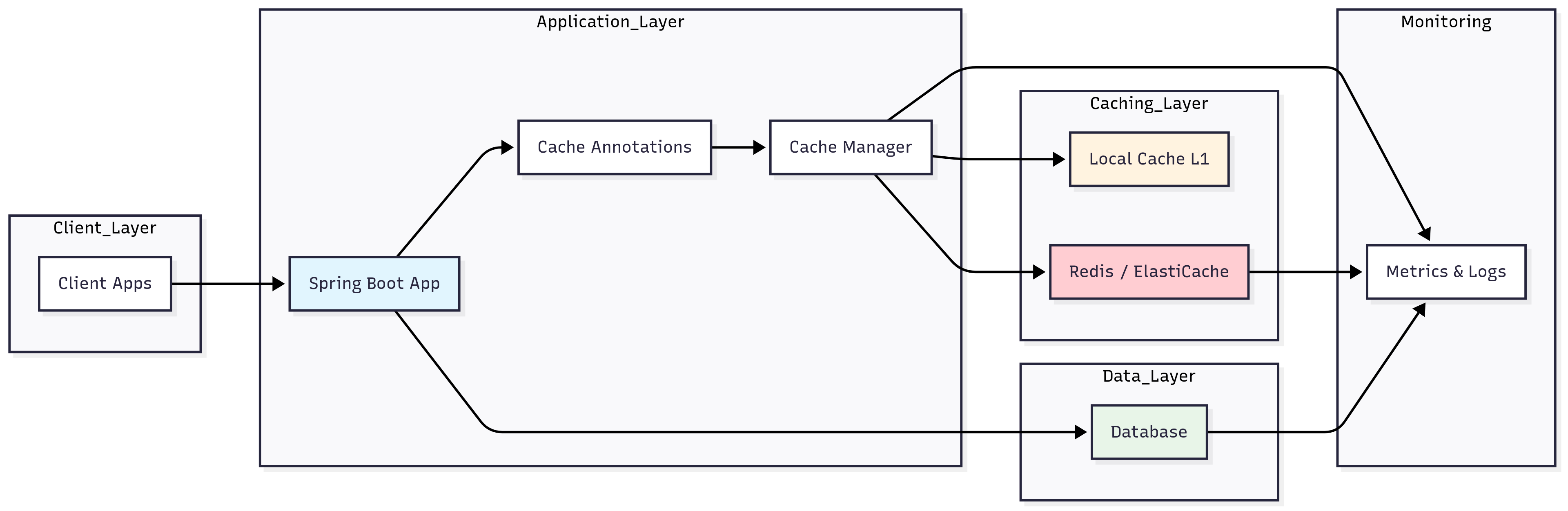
A single API that is compatible with several caching providers is offered by Spring Boot's caching abstraction. The abstraction uses aspect-oriented programming (AOP) to automatically apply caching logic (i.e., transparent caching) and intercept service calls.
Annotation-based approach: Annotations are used in declarative caching to explain caching behavior.
@Cacheable: If the cache is empty, this initiates the cache population process.@CachePut: Updates the cache even if an entry has already been made.@CacheEvict: Eliminates a cache entry@Caching: Combines multiple cache operations@CacheConfig: Offers a standard base cache configuration at the class level.
Generation of Cache Keys
- The default strategy uses all method params
- Custom key generation using spEL expressions
- Key generators for when you have complex scenarios
- Notes on serializing objects
Redis Integration Strategies
Single-Instance Redis
- Sufficient for development and/or small application
- Single point of failure
- Simpler configuration and monitoring
- Limited scalability
Redis Cluster Mode
- Scale horizontally with multiple nodes
- Automatic failover for high availability
- Data partitioned across the cluster node
- More complicated installation/monitoring
Data Serialization Considerations
The serialization choice does have performance implications:
JSON Serialization
- Human-readable
- Readable in multiple languages
- Takes up more space
- Serialization/deserialization is slow
Binary Serialization
- Compact / data efficient
- Faster parsing
- Not human readable
- Possible problems with data version compatibility
AWS ElastiCache Integration
Benefits of ElastiCache for Redis
AWS ElastiCache offers managed Redis infrastructure with:
- Managed service: Automatic backups, patching, monitoring
- High availability: Multi-AZ deployments with automatic failover
- Scalability: Vertical and horizontal scaling
- Security: VPC integration, encryption-at-rest, and in-flight
- Performance: Superior I/O and memory optimization
Cluster Configuration Strategies
Replication Groups
- Primary-replica architecture for read scaling
- Automatic failover to replica nodes
- Cross-AZ replication for DR
Cluster Mode
- Data is sharded across multiple shards
- Max 500 nodes per cluster
- Automatic resharding
Advanced Caching Techniques
Multi-Level Caching
Multi-level caching is combining local and distributed caching for maximum efficiency. There are two levels to this strategy:
Level 1 (L1) — Local Cache
- In-memory cache within each application instance
- Access is ultra-fast (nanoseconds)
- Limited by JVM heap size
- No network overhead
Level 2 (L2) — Distributed Cache
- Shared across application instances
- Capacity greater than the size limitation of the JVM heap
- But vulnerable to latency when accessing
- Consistent across every deployment of the application
Cache Warming Strategies
Cache warming is the act of preloading the cache with the most frequently accessed data, freeing the user from the cost of additional initial cache misses. Proactive cache warming not only saves time and improves allocation performance, but also significantly improves perceived performance.
Application Startup Warning
- Warming up the application at the time of initialization.
- Application-specific analytic information to identify frequent or accessed data.
- Warming up can be done stone cold or gradually to avoid overloading the system with the initial call.
Scheduled Warming
- For time-perishable data, we can periodically refresh the cache.
- It is easier to set up warming during off-peak times.
- Certain times or days of the week may show a predictable pattern, which may be effective in pre-warming.
Intelligent Cache Invalidation
Strong cache invalidation achieves consistency with the best performance:
Time-To-Live (TTL) Invalidation
- Easiest and the most predictable invalidation
- Serving stale data is a risk, by invalidating after a TTL duration
- Meaningful for data with known update patterns
Event-Driven Invalidation
- Invalidation as soon as data is changed
- More complicated dependencies to manage
- Provides fresh data
Tag-Based Invalidation
- Tags allow groups of shared cache entries.
- Cache invalidation for closely related data can be done in bulk.
- The dependency management is simplified.
Performance Optimization Techniques
Connection Pool Management
Connection pool management is an important place to configure for Redis performance:
- Pool size: Understand the trade-off of resource consumption with performance
- Connection validation: Know the health of the connection and have a happy path
- Timeout configuration: Understand when connections hang
- Retry logic: Think of transient failures and what the application can tolerate.
Memory Management
There are many factors in memory use with Redis:
- Memory policies: Eviction policies (LRU, LFU, TTL)
- Data structures: Be cognizant of what Redis data type to use
- Compression: Compress large values
- Memory monitoring: Fragmentation and memory usage monitoring
Network Optimization
To eliminate network overhead:
- Pipelining: Multiple commands
- Connection multiplexing: Reusing connections
- Data locality: Place the cache and the application together
- Compression: Reduce payload on data during streaming
Monitoring and Observability
Key Metrics
| Type | metric | purpose |
|---|---|---|
| Performance | Cache hit ratio | Measure cache effectiveness |
| Avg. response time | Track system speed | |
| Throughput (ops/sec) | Monitor system capacity | |
| Memory utilization | Track resource usage | |
| Reliability | Connection pool usage | Track system failures |
| Error rates | Track system failures | |
| Failover events | Ensure high availability | |
| Network latency | Monitor network performance | |
| Business | Cost per cache op | Track operational costs |
| DB load reduction | Measure cache benefits | |
| User experience impact | Monitor user-facing performance |
Health Monitoring
| Check type | what to monitor | action |
|---|---|---|
| Connection | Redis connectivity | Verify active connections |
| Performance | Response times | Detect speed degradation |
| Capacity | Memory & connections | Watch resource thresholds |
| Dependencies | Downstream systems | Monitor external health |
Security Considerations
| Area | Control | Implementation |
|---|---|---|
| Authentication | Redis AUTH | Enable password auth |
| Encryption | TLS | Protect data in transit |
| Network | VPC | Enforce network isolation |
| Access Control | IAM roles | Fine-grained permissions |
| Data Protection | Encryption at Rest | Secure stored cache data |
| Credentials | Key Rotation | Rotate secrets regularly |
| Monitoring | Audit Logging | Track access & changes |
| Data Handling | Sensitive Data Policy | Avoid caching sensitive info |
Testing Strategies
| Test Type | Focus Area | What to Validate |
|---|---|---|
| Unit | Mock dependencies | Isolate business logic |
| Cache behavior | Verify cache annotations | |
| Key generation | Ensure consistency | |
| Integration | End-to-end flow | Validate workflow with cache |
| Performance impact | Measure speed improvements | |
| Failure scenarios | Verify graceful fallback | |
| Load | Cache under stress | Check scale limits |
| Failover testing | Ensure HA works | |
| Capacity planning | Determine optimal sizing |
Best Practices
| Area | Practice | Description |
|---|---|---|
| Cache Keys | Consistent namin | Use standard conventions |
| Hierarchical structure | Logical grouping of keys | |
| Avoic collisions | Prevent key conflicts | |
| Expiration patterns | Use TTL for lifecycle management. | |
| Error Handling | Graceful fallback | Handle cache downtime smoothly |
| Proper logging | Record cache failures | |
| Avoid cascading | Prevent failure propagation | |
| Data Consistency | Invalidation strategy | Clear/update cache correctly |
| Monitor freshness | Track data age & staleness | |
| Handle concurrency | Manage simultaneous updates |
Common Pitfalls
| Pitfall | Problem | Solution |
|---|---|---|
| Cache Stampede | Multiple threads reload same key | Use locking/request coalescing |
| Hot Key Problem | Uneven load on few keys | Distribute/shard keys |
| Memory Leaks | Unbounded growth | Apply TTL & size limits |
| Stale Data | Old values served | Proper invalidation strategy |
| Over-Caching | Storing unnecessary data | Cache only hot/frequent items |
Conclusion
There are many factors to consider (i.e., access patterns, consistency, and performance goals) when implementing caching strategies with Spring Boot and Redis/ElastiCache. The success of the implementation relies on the caching patterns you identified and the monitoring you executed, and optimization based on your real usage patterns is what you can call success.
Caching strategies can produce successful implementations. As a recommended way to use caching, you will likely start with simple patterns, and as your requirements evolve, you may develop more complex strategies and develop more strategy complexity. You should consider diligently monitoring and checking periodically to ensure that your caching strategy continues to be effective as your application grows.
Finally, caching should not be considered a silver bullet; it is effective when utilized well and maintained. As we have speculated, caching will improve performance and end-user experience and help avoid unnecessary infrastructure costs.
Opinions expressed by DZone contributors are their own.
Comments