

Building a Practical Cloud-Native Golden Path: A Guide to Kubernetes-Based Service Delivery, Self-Service, and Developer-Friendly Defaults
Golden paths standardize software delivery with self-service workflows, deployment guardrails, and observability while preserving team autonomy.
 CORE
·
CORE
·
Join the DZone community and get the full member experience.
Join For FreeEditor’s Note: The following is an article written for and published in DZone’s 2026 Trend Report, Cloud-Native Foundations: Kubernetes, Platform Engineering, and Distributed Operations at Scale.
Every engineering organization that I have worked with eventually faces the same issue, which is that each team ships services differently. One team used Helm, another wrote raw manifests, and a third would have built a custom Bash script. As these different approaches accumulate, the supporting deployment steps often end up scattered across multiple Wiki pages that quickly go stale. New engineers then spend their first two weeks copying configuration values from an old repository and hoping they still work.
A golden path fixes this without turning the platform team into a gatekeeper. It provides users with a standardized workflow for the shortest and most obvious route from a fresh repo to a production workload. This guide walks you through designing a minimum viable golden path, where guardrails belong, and how to keep it useful after v1.
Choose the First Golden Path
Start with one workflow to standardize first; the strongest candidate is usually the workflow your teams ship most often, or one that teams experience the most friction with. In many organizations, that workflow is a stateless HTTP service exposing a REST or gRPC API endpoint, deployed to Kubernetes and owned by one application team. For this walkthrough, we will use orders-api, a stateless HTTP service on Kubernetes, as our reference throughout this article.
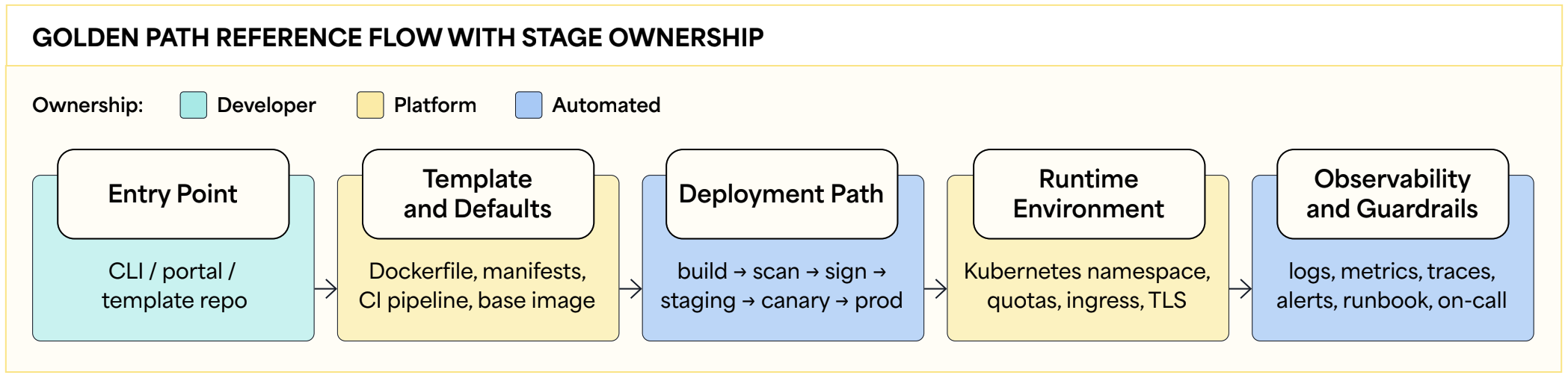
The intended users are application developers, not platform engineers — those who create the golden path itself. The path starts with a create-service command in a CLI or a form in an internal developer portal. It should end when the service is running in production with logs, metrics, ownership, and on-call rotation attached.
Keep the first version deliberately narrow. A workload that needs GPU nodes, a queue-driven scaling model, or a stateful sidecar can wait. Trying to capture every exception at the beginning turns a practical delivery path into a long platform program.
A golden path’s success criteria are qualitative, not quantitative. Analyze the first release by user adoption and experience. Are teams using standardized workflows instead of copying an old repository? Can a new engineer understand the end-to-end deployment process without asking around? Are on-call handoffs easier because services have the same operational shape? The answers to these questions matter more than looking at any adoption numbers displayed on a dashboard in the first few months.
Define What the Path Standardizes
A golden path is a curated set of decisions that are made once and reused consistently across services:
- The workload template should provide a Dockerfile, fully maintained base image, Kubernetes manifests, probes, resource requests and limits, a Pod Disruption Budget (PDB), autoscaling defaults, and consistent labels.
- The delivery pipeline should build, test, scan, sign, and publish the image.
- The platform defaults should include namespace rules, quotas, network policies, ingress, TLS, logging, metrics, tracing, and basic alerts.
The path should not own product decisions; teams will still choose their language, framework, business logic, schema, feature flags, test strategy, and service-specific objectives. This boundary is very important. If we over-standardize, developers will work around the platform, and if we under-standardize, every instance will start with a different set of commands and dashboards. Also make sure the path is easy to find. One internal documentation page, one command, and one entry in the developer portal are enough. If a developer has to ask which template to use, the path has already failed and created friction.
The table below shows the differences between shared standards the path owns and decisions each service team owns.
Shared Standards vs. Team-Owned Decisions
|
shared standard |
team decision |
|---|---|
|
Dockerfile, base image, patching cadence |
Language and framework choice |
| Deployment manifests, probes, resource requests/limits, PDB, Horizontal Pod Autoscaler |
Business logic, schema, feature flags |
|
Build, test, scan, sign, and publish pipeline |
Test suites specific to the service |
|
Namespaces, quotas, network policies, ingress, and TLS defaults |
Non-standard scaling (queue-driven consumers, GPU jobs) |
|
Logging, metrics, tracing, and alerting defaults |
Business-specific dashboards and SLOs |
Turn Common Requests Into Self-Service Actions
Once the path is created and available to users, review the top 10 tickets your platform team receives. Look for repeated requests such as creating namespaces, adding a database, registering a DNS name, rotating a secret, or creating another environment. These are all good candidates because the desired outcome is already understood, and the steps are mostly predictable.
For the Orders API golden path, the platform team can provide the following self-service actions and apply guardrails based on the risk from each change:
- Fully automated. These actions are reversible and have a limited blast radius. Creating a development namespace for orders-api, spinning up a preview environment on a PR, or rotating a non-production secret happens on demand without a human involved to review.
- Light review. Actions that change cost, security exposure, or shared infrastructure should require a light review. Provisioning production Postgres for orders-api opens a pre-filled change request that needs one approval. A new public DNS record on a shared domain is reviewed through a one-click approval on a pre-filled PR.
- Approval mechanism. Every self-service action generates a PR against a config repo, pre-fills the values, tags the reviewer, and merges on approval. The change flows through the same pipeline as code, and every action leaves an audit trail because it’s a git commit.
The self-service interface should offer supported choices instead of exposing raw cloud APIs. For example, allowing every team to choose any PostgreSQL version, instance class, or backup schedule can leave the platform team operating 30 different database configurations. A better approach is to provide a small, opinionated set of options such as small, medium, and large. This gives developers enough flexibility while keeping the operational model understandable.
For our Orders API, the developer-facing configuration can stay small:
# svc.yaml
 name: orders-api
 owner: team-orders
 tier: standard        # small | standard | high
 runtime: http
 dependencies:
   - kind: postgres
     size: small        # opinionated preset, not raw config
 on_call: orders-oncall
The configuration captures the developer’s intent, while the golden path translates each request into an approved action with the right guardrail and a clear record of what happened. The table below shows how this works for the Orders API.
Orders API Self-Service Actions, Guardrails, and Evidence
|
Step |
Self-Service Action |
Guardrail |
Evidence |
|---|---|---|---|
|
Create service |
Run svc new via CLI or submit a portal form |
Template pinned to current version; namespace quotas applied |
Repository created with owner metadata; entry in service catalog |
|
Add dependency |
Pick from opinionated list (small/medium/large DB) |
One-click PR review for prod-tier resources |
Merged PR against config repo with reviewer name |
|
Deploy to prod |
Merge to main triggers promotion |
Progressive rollout with auto-rollback on error/latency signals |
Deployment record with canary metrics and rollback status |
|
Rotate secret |
Run svc rotate-secret |
New version issued; old version revoked after grace window |
Audit log entry linked to requester |
Create a Consistent Path From Code to Deployment
Every service on the golden path should move through the same basic stages: pull request → merge to main → staging → production. The exact tooling can vary, but the meaning of each stage should not.
- At the PR stage, CI runs unit tests, linting, the container build, and security checks. Produce an immutable image tagged with the commit identifier, but do not deploy it to production.
- On merge to main, the same image is promoted to staging automatically. Rebuilding at each stage creates uncertainty because the artifact tested is no longer guaranteed to be the artifact released. Run integration and smoke tests in this stage.
- Promoting the image to production reveals the delivery guardrails. Start with a small percentage of traffic (5-10%), monitor health signals, and continue increasing traffic to 25%, then 100%. Roll back automatically when error rate, latency, or probe failures cross agreed thresholds.
A developer should not have to recreate this logic in every repository — it should be baked into the deployment tooling.
A failed orders-api canary would look like this end to end:
- The pipeline promotes the new image to 5% of production pods.
- The error rate for the /orders endpoint rises sharply during the observation window.
- The deployment controller restores the previous image and drains the new pods based on the rollback threshold.
- The pipeline posts a message in the orders-oncall service channel with a link to the failing dashboard and offending commit identifier (SHA).
- An incident record is created automatically only when rollback fails, or the service remains unhealthy.
Teams may skip a stage for a documented case (e.g., configuration-only change), but the exception should be an explicit setting with an owner, not an informal workaround.
# pipeline stages (pseudo)
on_pr: [test, lint, build, scan, sign]
on_merge: [promote_to_staging, integration-tests]
on_green: [canary-5, wait-signals, canary-25, wait-signals, full-rollout]
On_regress: [auto-rollback, notify-oncall, record-failure, open-incident]
Observability and Day-1 Operational Defaults
Even if its pods are running, a service is not ready until the owning team can determine whether it is healthy and knows what action to take when it is not. The golden path should therefore create the minimum operational surface at the same time as the service. The template includes the following list on day one:
- Structured logs to the central log store, with request ID and trace identifiers
- Request rate, error rate, latency percentiles, and saturation metrics
- Distributed traces with a platform-managed sampling default
- A standard dashboard created from the service name
- Alerts for high errors, high latency, restart loops, and resource pressure
- Liveness and readiness checks connected to a health endpoint
Ownership should also be captured during service creation. Ask for the team, on-call rotation, and support channel, then reuse those values in alert routing, the service catalog, and the runbook. Generate a simple runbook with sections dedicated to common failures such as stalled deployments, elevated errors, and pod eviction. A partially completed runbook with a familiar structure is far more useful than a blank page, and consistency here pays off during an incident.
Keep the Golden Path Useful Over Time
Exceptions are inevitable, so record the failure reason, owner, and expiry date rather than letting the exception become a permanent member. At review time, either the service returns to the path or the platform team decides the pattern is common enough to support.
Treat templates and defaults like product code: review changes, version them, and provide a propagation method. When a base image or manifest default changes, open a change against each service instead of relying on teams to notice a document update. Silent drift is one of the fastest ways to lose developer trust in the path.
Track a small set of signals such as the time from service creation to first production deployment, template version distribution, open exceptions, and the percentage of new services created through the path. Pair those numbers with developer feedback. A slow step that teams repeatedly bypass tells you where the next path improvement belongs.
A new template version without a propagation plan becomes a fork. Extend the path when a pattern is used by three or more teams, but keep it narrow while it is still one team’s edge case.
# template bump propagation (pseudo)
 on template_release(new_version):
   for svc in services_on_path():
     open_pr(svc,
            bump_template = new_version,
             auto_merge    = svc.opts.auto_bump,
             reviewer      = svc.owner)
Making the Golden Path Useful in Practice
A golden path succeeds when it is easier to follow than to work around. Start with one common workflow, standardize what is shared, and leave product choices with the service team. Make routine actions self-service, place checks in the delivery flow, and include observability from the first deployment. Usage signals can then inform future improvements to the path. A small path that ships, earns trust, and changes steadily will have a greater impact on engineering speed than a broad platform program that remains unfinished.
Resources:
- CNCF TAG App Delivery
- OpenTelemetry General Semantic Conventions
- Kubernetes Pod Security Standards
- Backstage Software Templates
- “Building a CI/CD Pipeline With Kubernetes” by Naga Santhosh Reddy Vootukuri
- Kubernetes Security Essentials, DZone Refcard by Yitaek Hwang
- Platform Engineering Essentials, DZone Refcard by Apostolos Giannakidis
This is an excerpt from DZone’s 2026 Trend Report, Cloud-Native Foundations: Kubernetes, Platform Engineering, and Distributed Operations at Scale.
Read the Free Report
Opinions expressed by DZone contributors are their own.
Comments