

Cloud Complexity Is an Operating Model Problem: Why Infrastructure Maturity Alone Can’t Solve Scale, Reliability, and Team Friction
Cloud-native platforms need more than mature infrastructure. Learn how shared standards, platform engineering, and self-service can reduce delivery friction at scale.
 CORE
·
CORE
·
Join the DZone community and get the full member experience.
Join For FreeEditor’s Note: The following is an article written for and published in DZone’s 2026 Trend Report, Cloud-Native Foundations: Kubernetes, Platform Engineering, and Distributed Operations at Scale.
After a few years of operating a shared Kubernetes environment, the shift in the center of gravity becomes clear. Cluster provisioning, container scheduling, and upgrades become routine, yet releases still stall over ownership, access, telemetry, and cost allocation.
Consider a hypothetical product team adding a stateful order-processing service to a shared platform. The service has an API, a worker, database migrations, and a data store backed by cluster-managed persistent storage, and it must run in staging and production. We will follow that service through its delivery path to examine where mature infrastructure stops helping, how local workflow differences compound, and which operating model decisions restore consistency without stripping teams of useful autonomy.
When Infrastructure Maturity Stops Solving the Hard Part
At first glance, onboarding the service should be routine. The cluster exists, the CI system can build an image, and infrastructure as code can create the namespace. Then the service reaches production and encounters a different StorageClass, quota profile, network policy, or service account configuration from staging.
Each difference may be valid, but the delivery workflow didn’t surface the environment contract early enough. This is the practical limit of infrastructure maturity. Reliable clusters provide capable building blocks, while reliable delivery also requires a shared agreement about how teams use those blocks, what evidence a release produces, where exceptions go, and who owns the outcome.
How Cloud Complexity Starts to Compound
Follow the service through one release and the pattern becomes clearer:
- The same components use inconsistent service and environment identifiers across logs and traces.
- Ownership labels exist in one cluster but not the other.
- The team copies a pipeline because the shared template cannot sequence migrations.
- Production access and policy exceptions move through separate ticket queues.
The operational cost shows up in the manual coordination required before each deployment. An engineer has to reconstruct which rules apply every time. During an incident, responders can’t move cleanly from an alert to the owning team, deployment record, runbook, and cost center. Finance sees shared-cluster spend that cannot be attributed reliably, while the security team receives evidence in different formats.
OpenTelemetry semantic conventions and FinOps allocation practices rely on consistent service, environment, and allocation metadata, so local naming schemes undercut the value of the underlying tools. As the same pattern spreads across clusters and cloud accounts, small differences become a persistent operating burden.
Operating Models Set the Terms of Scale
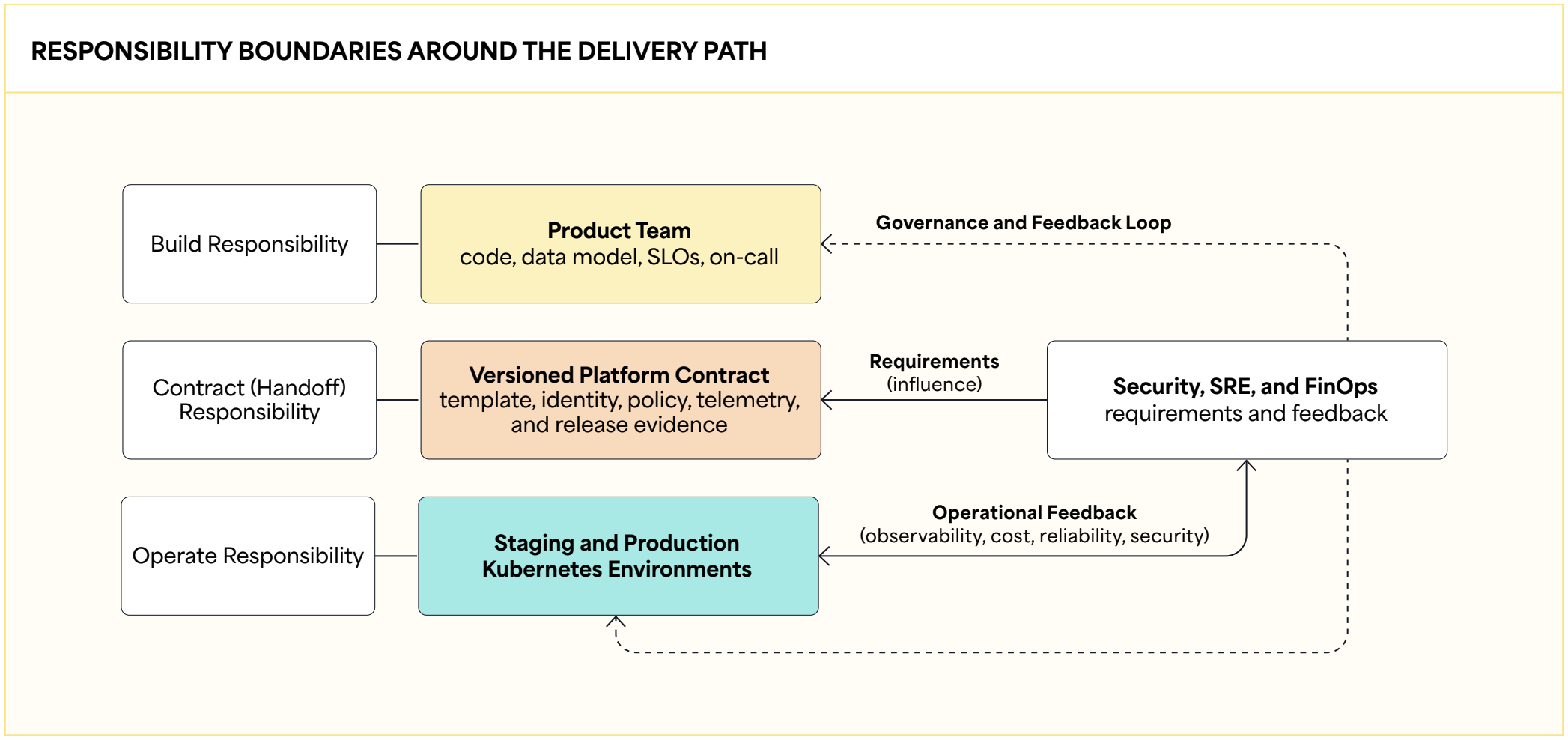
The operating model decides who turns those building blocks into a usable delivery system. For our example, the product team owns the order domain, data model, migration safety, scaling behavior, SLOs, and on-call response. The platform team owns the interface through which the service receives a namespace, workload identity, baseline policy, deployment workflow, and telemetry defaults. Security, SRE, and FinOps teams contribute requirements and review the evidence that the workflow produces. This split keeps service-specific decisions close to the people who understand them while centralizing cross-cutting capabilities that every team would otherwise rebuild.
CNCF’s platform guidance makes an important distinction here: A platform team is responsible for the interfaces and experience around shared capabilities, even when another team or provider operates the backing service. In practice, a mature platform offers versioned workflows, clear support boundaries, self-service for common requests, and feedback loops based on real usage. In this way, the platform team is an enabler of consistency rather than the operator of every component.
Standardization, Autonomy, and Shared Operating Logic
The defensible baseline is narrower than a universal application architecture. For this service, shared standards should cover:
- Service and environment identity
- Workload identity and minimum network policy
- Resource requests, quota expectations, and cost-allocation metadata
- Release evidence, rollback behavior, and minimum telemetry
These rules belong in the shared workflow because inconsistency affects other teams and complicates incident response, security, and cost allocation. The product team still chooses its schema, partitioning strategy, cache design, scaling thresholds, and release timing, and defines SLOs around the behavior users experience.
The stateful workload then tests that boundary. A default pipeline built for stateless HTTP services may need a supported hook for migrations and worker rollout. An overly broad standard becomes an approval layer or bottleneck, while an overly narrow one leaves every team maintaining its own release and recovery logic. A bounded extension with an owner, tests, constraints, and review date preserves autonomy without creating an unsupported parallel system.
Why Team Friction Turns Into a Scaling Tax
Weaknesses in the operating model become most visible in the friction between teams. If a developer must request a namespace, ask another team for credentials, copy a pipeline, and find a production approver, the architecture may be automated while delivery remains ticket-driven. Each handoff adds queue time and loses context.
Adding a portal without changing that path gives the developer one more place to check. Effective self-service completes the request, applies policy, records the change, and returns a clear support path. To see whether self-service is reducing friction, track metrics like request-to-environment time, time to first production deployment, exception rate, support demand, and failed-deployment recovery time.
CNCF recommends tracking fulfillment and new-service delivery latency; DORA advises applying delivery metrics in the context of a specific service. Together, these measures show whether the workflow reduced coordination overhead or moved it to another queue.
When Control Models Backfire
The order-processing service example exposes two ways the control model can fail:
- Overly rigid standardization. A workflow designed only for stateless services forces the team to create a separate migration path, fragmenting release evidence.
- Unbounded local variation. Unrestricted cluster access allows identity, policy, and resource controls to drift between teams.
The scalable approach pairs a narrow baseline, enforced through mechanisms like admission policies, with a documented extension path for legitimate workload-specific behavior, keeping the standard credible without turning each exception into a permanent fork.
|
Operating Assumptions That Fail at Scale |
||
|---|---|---|
|
Old Assumption |
Why It Breaks |
Operating Model Replacement |
|
Healthy clusters make a workload portable |
Storage, identity, policy, and quota profiles differ by environment |
Versioned environment contract with a shared baseline |
|
One shared pipeline can serve every workload |
Stateful rollout and migration steps don’t fit the default sequence |
Core workflow with bounded, tested hooks |
|
A portal provides self-service |
Tickets and manual approvals remain behind the interface |
Workflow that provisions, enforces policy, and records evidence |
|
Local conventions remain harmless when teams own their services |
Metadata and controls drift across services |
Small enforced baseline with governed exceptions |
Making Cloud Complexity More Manageable
To begin, you don’t need to redesign your entire platform. You can trace one representative delivery workflow and find where coordination breaks. For the order-processing service example, map the path from repository creation to production, including owners, queues, controls, evidence, and exceptions. Improvements should then be tested through adoption and outcomes such as lead time, failed-deployment recovery time, support demand, exception volume, and cost-attribution coverage. This sequence shows whether the platform is reducing operational variation for real workloads before the model expands to more teams and environments.
References:
- Platforms for Cloud-Native Computing, CNCF
- Resource Quotas, Kubernetes
- Storage Classes, Kubernetes
- Admission Control in Kubernetes, Kubernetes
- Resource Semantic Conventions, OpenTelemetry
- Allocation FinOps Framework Capability, FinOps Foundation
- Service Level Objectives, Google SRE
- Software Delivery Performance Metrics, DORA
This is an excerpt from DZone’s 2026 Trend Report, Cloud-Native Foundations: Kubernetes, Platform Engineering, and Distributed Operations at Scale.
Read the Free Report
Opinions expressed by DZone contributors are their own.
Comments