

Data Governance Challenges in the Age of Generative AI
Navigate privacy, security, and compliance challenges for innovation. Effective data governance is now more critical due to recent generative AI developments.
Join the DZone community and get the full member experience.
Join For FreeData governance refers to the policies and processes that ensure the management, integrity, and security of organizational data. Traditional frameworks like DAMA-DMBOK and COBIT focus on structured data management and standardizing processes (Otto, 2011). These frameworks are foundational in managing enterprise data but often lack the flexibility needed for AI applications that process unstructured data types (Khatri & Brown, 2010).
Generative AI: An Overview
Generative AI technologies, including models like GPT, DALL·E, and others, are becoming widespread in industries such as finance, healthcare, and e-commerce. These models generate text, images, and code based on large datasets (IBM, 2022). While the potential of these technologies is vast, they pose governance issues that are not addressed by traditional data management strategies, especially when handling vast, diverse, and unstructured datasets.
The Intersection of Data Governance and Generative AI
Studies show that generative AI impacts data governance by affecting how data is collected, processed, and utilized (Gartner, 2023). Managing unstructured data — such as media files and PDFs — which does not fit traditional data governance models due to its schema-less nature is crucial. Without effective management and governance, AI applications risk mishandling sensitive data, leading to security breaches and compliance failures.
Key Challenges in Data Governance With Generative AI
Data Privacy and Security Risks
Generative AI systems process vast amounts of data, often including sensitive information. Without robust security measures, organizations face significant risks of data exposure and breaches. Legal frameworks like the General Data Protection Regulation (GDPR) and the California Consumer Privacy Act (CCPA) mandate stringent data privacy standards, necessitating advanced governance strategies to comply (European Union, 2018; CCPA, 2020).
Ethical and Compliance Issues
The use of generative AI raises ethical concerns, such as biases in AI outputs and manipulation of data. Compliance challenges arise as organizations attempt to align AI operations with existing regulatory frameworks, which were not designed for the complexities introduced by AI (IBM, 2022). New governance models must account for these issues by integrating ethical standards and compliance checks into AI development processes.
Quality Control and Data Integrity
Quality control is crucial in ensuring that AI-generated outputs are reliable. Tools such as AWS Glue, Google Cloud’s Data Quality features, and Microsoft Azure Data Factory are essential for maintaining data integrity in AI models. These platforms offer capabilities like data profiling and quality scoring, which help organizations monitor and enhance the quality of their data.
Theoretical Framework
Data Governance Frameworks
Traditional frameworks like DAMA-DMBOK and COBIT emphasize structured data management, data quality assurance, and compliance (Khatri & Brown, 2010). However, these frameworks often fall short when applied to unstructured data, a common element in generative AI. The lack of schema-less data management capabilities poses a risk, as AI models rely heavily on diverse datasets (Otto, 2011).
Generative AI Frameworks
Generative AI demands new governance frameworks that accommodate its unique challenges. Integrating AI-specific considerations such as fine-grained access control, user role permissions, and unstructured data management tools like AWS Glue, AWS Lake Formation, Google Cloud Data Catalog, and Microsoft Azure Cognitive Services is essential. These platforms emphasize the need for robust strategies in AI data management, focusing on discoverability and privacy (Gartner, 2023; IBM, 2022).
Proposed Framework for Data Governance in Generative AI
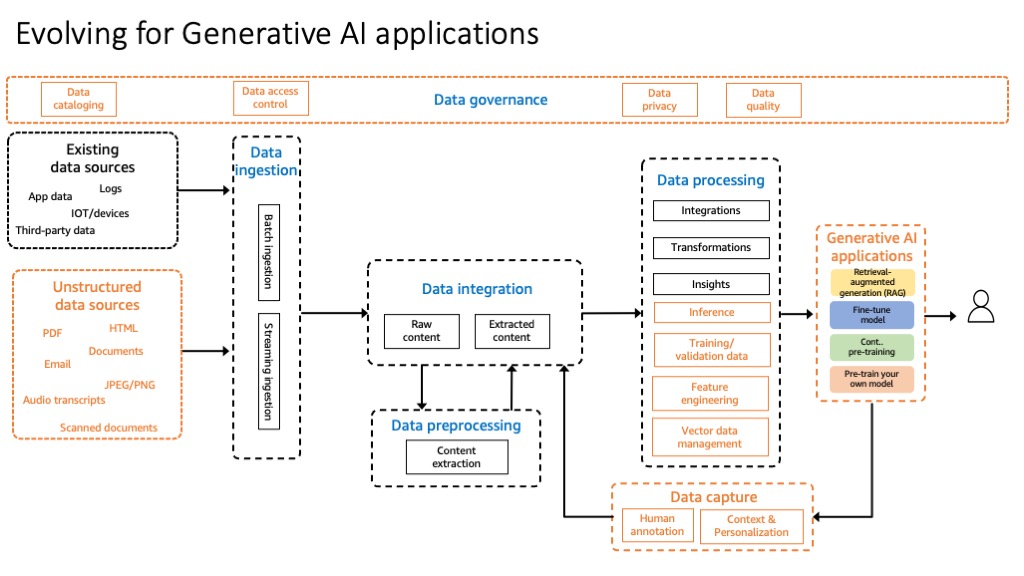
The proposed framework incorporates elements from traditional governance models but extends to include tools specifically designed for managing unstructured data and ensuring privacy. For instance, AWS services such as Amazon Textract and AWS Glue can automate data cataloging and metadata extraction, enhancing data governance efficiency in AI applications. This hybrid approach allows organizations to maintain traditional governance standards while integrating AI-specific tools for improved data management.
Strategies for Effective Data Governance in the Age of Generative AI
Policy and Framework Development
Organizations must develop AI-specific policies that integrate data privacy, security, and compliance considerations. Data privacy policy such as masking Personally Identifiable Information(PII) using Hashing or Redaction techniques or following field level encryptions. Segregating data based on geography and localizing the AI frameworks local to that area. Divert the traffic based on origin into respective AI frameworks. Adapting traditional frameworks like DAMA-DMBOK with AI-focused tools can address these challenges.
However, modernized tools from cloud providers like AWS Glue and Amazon Macie help with data privacy. Most AWS services are designed to be compliant with the geographical region where they are deployed. So, choosing an appropriate service in your region helps you adhere to data residency compliance requirements.
Technological Solutions
Using AI and ML technologies to automate governance processes is vital. AWS, Google Cloud, and Microsoft Azure offer advanced tools for managing AI data and ensuring compliance (Gartner, 2023). Implementing these solutions enhances the efficiency and security of data governance practices. Also, data quality and data enrichment solutions are important components of the data governance process. When malformed data is ingested into Generative AI frameworks, it can cause large language models to hallucinate. Using data quality scores from tools like AWS Glue or Informatica can be ingested along with the data, which will give better context to the Generative AI on which data to use. Data enrichment solutions can be used to avoid bias and toxicity by inducing Synthetic Data Generation, Entity Resolution, and modifying the data points. Later, these can be used to train the Large Language Models (LLMs).
Continuous Monitoring and Auditing
AI-based monitoring tools can be used for real-time tracking of data usage and potential security threats, allowing organizations to respond swiftly to anomalies. Regular audits using automated tools, such as AWS Audit Manager or Azure Purview, ensure compliance with governance policies, promote transparency, and highlight areas for improvement to maintain effective data governance.
Data Integration and Interoperability Solutions
Investing in a unified data management platform that consolidates various data sources — such as data lakes and warehouses — allows consistency and compliance across AI systems. The adoption of such interoperability standards and open APIs facilitates secure data exchange between different systems, maintaining data integrity and security across AI platforms while supporting a cohesive governance environment. We have a proven track record for ingesting structured data, but ingesting unstructured data is vital in data integrations. As of today, ingestion of unstructured data involves separating the data and metadata and normalizing the data by bringing in a schema. By doing this, you will be able to catalog the unstructured metadata, which gives you better discoverability.
With a unified data cataloging system, you will be able to better discover and enable better integrations as these data are normalized. Data cataloging tools like AWS Glue Data Catalog, Azure Data Catalog, and Google Cloud Data Catalog provide this functionality. AWS services like Amazon Textract, Amazon Comprehend, and Amazon Rekognition extract metadata from unstructured data into these data catalogs. Data integration tools like AWS Glue and Informatica help in data integration.
Cross-Functional Teams and Collaboration
Building cross-functional teams that include data scientists, IT specialists, compliance officers, and business leaders is crucial for aligning data governance strategies with business goals and regulatory requirements. Taking external stakeholders, like regulators and industry experts, in a loop also helps organizations stay informed about any newer regulations and best practices, ensuring proactive policy adjustments.
Conclusion
The successful implementation of data governance initiatives for generative AI has established a robust, production-ready foundation for secure data management and machine learning. The solutions for building well-governed generative AI data platforms on the cloud like AWS. You can divide solutions into two main workstreams to address the unique requirements of generative AI.
In Workstream 1, an Amazon S3 data lake with AWS Lake Formation was set up to ensure secure access, with data pipelines and quality checks providing clean, labeled datasets for model training. Workstream 2 introduced an Amazon Bedrock environment for sophisticated data enrichment, including synthetic data generation and entity resolution to minimize bias and toxicity, and an Amazon SageMaker setup for deploying real-time classification models. Together, these workstreams create a scalable, adaptable framework that supports ongoing data-driven insights.
This production-grade setup not only makes data accessible, secure, and organized for model training and operations but also highlights gaps in traditional data governance methods. Generative AI requires enhanced governance practices that exceed traditional frameworks, particularly around privacy, unstructured data management, and continuous monitoring. By integrating AI-specific policies, advanced management tools, and continuous monitoring, organizations can better safeguard data assets, ensuring both security and flexibility in production environments.
Future research should build on this foundation by assessing AI governance frameworks across industries, helping organizations to develop best practices that adapt to rapidly changing AI landscapes. This ongoing exploration will support the evolution of governance strategies, ensuring robust compliance, data integrity, and operational resilience at scale.
Opinions expressed by DZone contributors are their own.
Comments