

Facilitate AI-Human Architectural Thinking
Three pillars of the thinking framework: landscape view, decisional view, and structural view — an effective architectural modeling approach.
Join the DZone community and get the full member experience.
Join For FreeArchitectural thinking or modeling will only be effective when it involves a landscape, decisional, and structural view. People talk a lot about systems thinking, but to ensure a viable architectural model, systems thinking must approach it from the three pillars of thinking.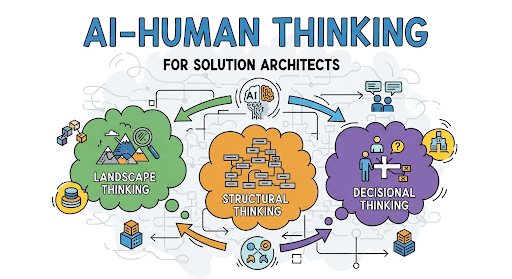
AI-powered architectural thinking or modeling also requires these three pillars of thinking. Let’s briefly look at each of these from a perspective of enterprise solution architecture (ESA), which falls somewhere between enterprise architecture (EA) and solution architecture (SA).
Landscape Thinking
An enterprise solution architecture needs to simplify the complex solution environment and present a big-picture view, which requires abstraction at a certain level. The landscape view contains layered views for different viewpoints. Defining an appropriate level of abstraction is a unique capability as a human.
Decisional Thinking
Decisional thinking requires a mix of art and science and is more challenging to learn. In the enterprise solution modeling, the decision-making considers architectural principles, requirement mapping, key choice considerations, governance measures, and constraints or risks, all of which influence each other.
Decisional thinking, or trade-off analysis, can be well-conducted through an AI-human collaboration in which a human makes the final decision.
Structural Thinking
Structural architecture, including its relationships, is foundational to enterprise solution architecture. It involves more systems thinking in terms of functional and operational aspects. Unlike logical thinking or MECE (mutually exclusive, collectively exhaustive) thinking, structural thinking requires a more many-to-many relationship mapping. AI can help greatly in the structural thinking space.
The Architectural Elements That Facilitate the AI-Human Thinking
The following figure shows the foundational elements that facilitate AI-human architectural thinking. Whatever your solution architectural styles, clear thinking from these three dimensions will produce a viable architecture via iterations.
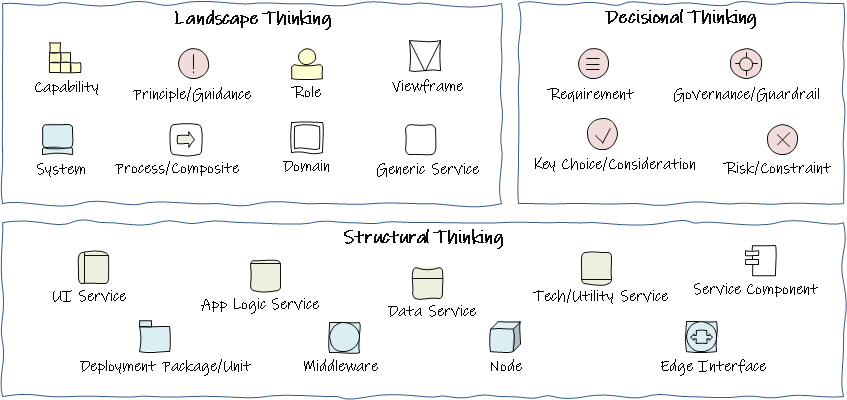
Now IT folks are more into the AI landscape, which is shifting rapidly from isolated models to integrated, autonomous systems. The key trend is moving from "model-centric" to "application-centric." So, for AI-blended architecture at an enterprise solution level, you need to have a holistic architecture model before delving into agentic AI applications, AI tech stack, multi-context processing (MCP), and retrieval-augmented generation (RAG), or machine learning operations (MLOps) for generative AI.
It's been attempted to think that AI is so powerful that it can handle complex architectural elements. Yes, at the AI level, it can and will do. Still, for an effective AI-human collaborative architecture and shared model among all key stakeholders in an enterprise solution, the elements need to be minimally and meaningfully represented. A pedantic nomenclature or classification will defeat its purpose for holistic thinking in a complex environment.
The Three Pillars of Thinking Are Related as a Whole
In reality, some IT folks focus more on tradeoff analysis while others focus more on structural modeling. Or some enterprise architects focus more on landscape thinking. This parochial architectural thinking may sound right, but it often falls short of architectural viability. For example,
- Decisional thinking alone is not enough, no matter how well your decisional framework is, unless it involves structural and landscape thinking
- Entangled complexity must be streamlined and clarified through a structural thinking process before a meaningful analysis can be applied, and in turn, the right decision can make the system less complex.
- A well-formed landscape model will not land well without a solid structural thinking process.
- A well-architected solution model may not comply with the maintainability or long-term objectives if the landscape or decisional thinking is poorly thought out.
Therefore, in a large-scale and complex solution environment, all these three pillars of thinking must be incorporated into a consistent thinking framework, preferably embodied in a modeling form.
AI can help gather information, analyze work-in-progress views, and correlate model elements, while a human provides guidance and decision criteria.
Exceptional Cases
There are many cases where variations or exceptions exist to the three pillars of the thinking framework. For example:
- For an easy or small solution, a mere structural or decisional thinking may be sufficient.
- For a special activity purpose, different types of thinking are required, such as strategic thinking and innovative thinking. Note that all these thoughts can be related and applied to the three pillars of thinking in an enterprise solution model.
- For a specific purpose, a landscape view is enough for an enterprise's holistic view, and a structural view is sufficient for a solution design
Summary
This article presents a practical viewpoint of the three pillars of the thinking framework, which ensures a holistic consideration of the enterprise solutions or complex IT cases.
The thinking framework will work well when paired with a corresponding modeling composed of landscape elements, decisional elements, and structural elements. To gain more insights when developing your solutions, you may try agile ESA modeling (lean mode) to facilitate AI-human architectural thinking, assisted by AI prompts, centered around these three thinking elements.
My extensive solution project experience shows that unclear architecture is the leading cause of major solution issues later on. By adopting an AI-human architectural thinking approach in an agile and iterative approach, your enterprise solution can be much better maintained and adapted to achieve your architectural conformance objectives.
AI-human collaboration is powerful when humans direct, and AI does the intelligent analytics. Note that for an effective enterprise solution architecture, AI is a heavy-duty assistant but not a driving force.
Thank you for your time and interest in reading this article. I’d love to hear your comments.
Reference
- Mastering Enterprise Solution Modeling/Gu, Sean. APRESS, 2024
Opinions expressed by DZone contributors are their own.
Comments