

Beyond Django and Flask: How FastAPI Became Python's Fastest-Growing Framework for Production APIs
How the async-first framework captured 40% of new Python developers in 2025 and why enterprise teams are making the switch in early 2026
 CORE
·
CORE
·
Join the DZone community and get the full member experience.
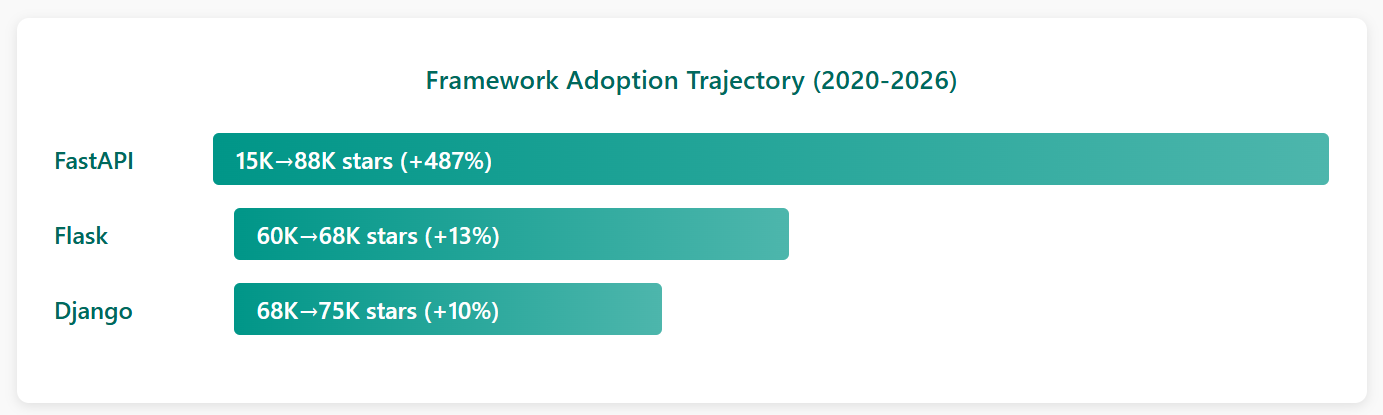
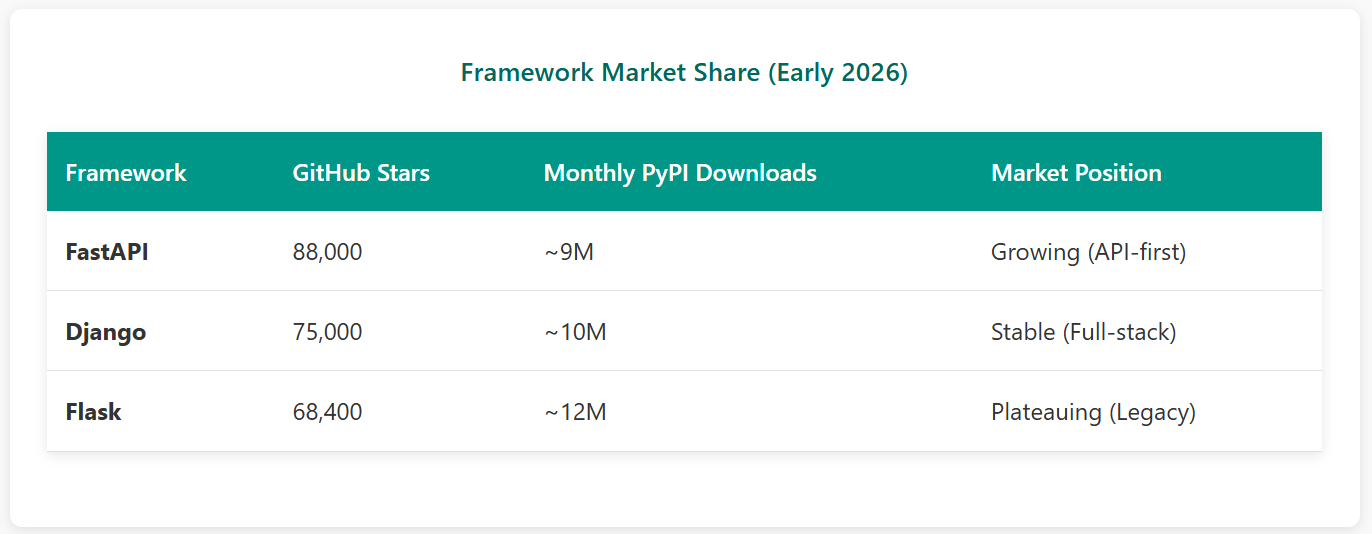
Join For FreeIn December 2025, FastAPI achieved what many thought was impossible just three years ago: it surpassed Flask in GitHub stars, reaching 88,000 compared to Flask's 68,400. This isn't just a popularity contest. It represents a fundamental architectural shift in how professional developers are building production APIs in 2026.
The numbers from early 2026 tell an even more compelling story. According to the latest JetBrains Python Developer Survey, FastAPI jumped from 29% to 38% adoption among Python developers in 2025 — a staggering 40% year-over-year increase. The 2025 Stack Overflow survey confirmed the trend with a five-percentage-point surge, making it one of the most significant shifts in the web framework landscape.
Even more revealing: among developers starting new projects in late 2025 and early 2026, FastAPI has become the default choice over Django and Flask. PyPI download statistics show FastAPI (9 million monthly downloads) has essentially caught up to Django, while Flask’s growth has plateaued.
The 2026 Reality: Enterprise Adoption Accelerates
What separates 2026 from previous years is the shift from early-adopter experimentation to enterprise production deployment. Microsoft, Netflix, and Uber aren’t just using FastAPI — they’re standardizing on it for new API services. According to Belitsoft’s 2025 Python Development Trends analysis, FastAPI has “eclipsed Flask and Django” among professional developers building async-native, API-first applications.
This enterprise momentum creates a self-reinforcing cycle. When industry leaders adopt a framework, it validates the technology for risk-averse organizations. The talent pool grows. The ecosystem matures. The feedback loop accelerates adoption even further.
The Async-First Era Has Arrived
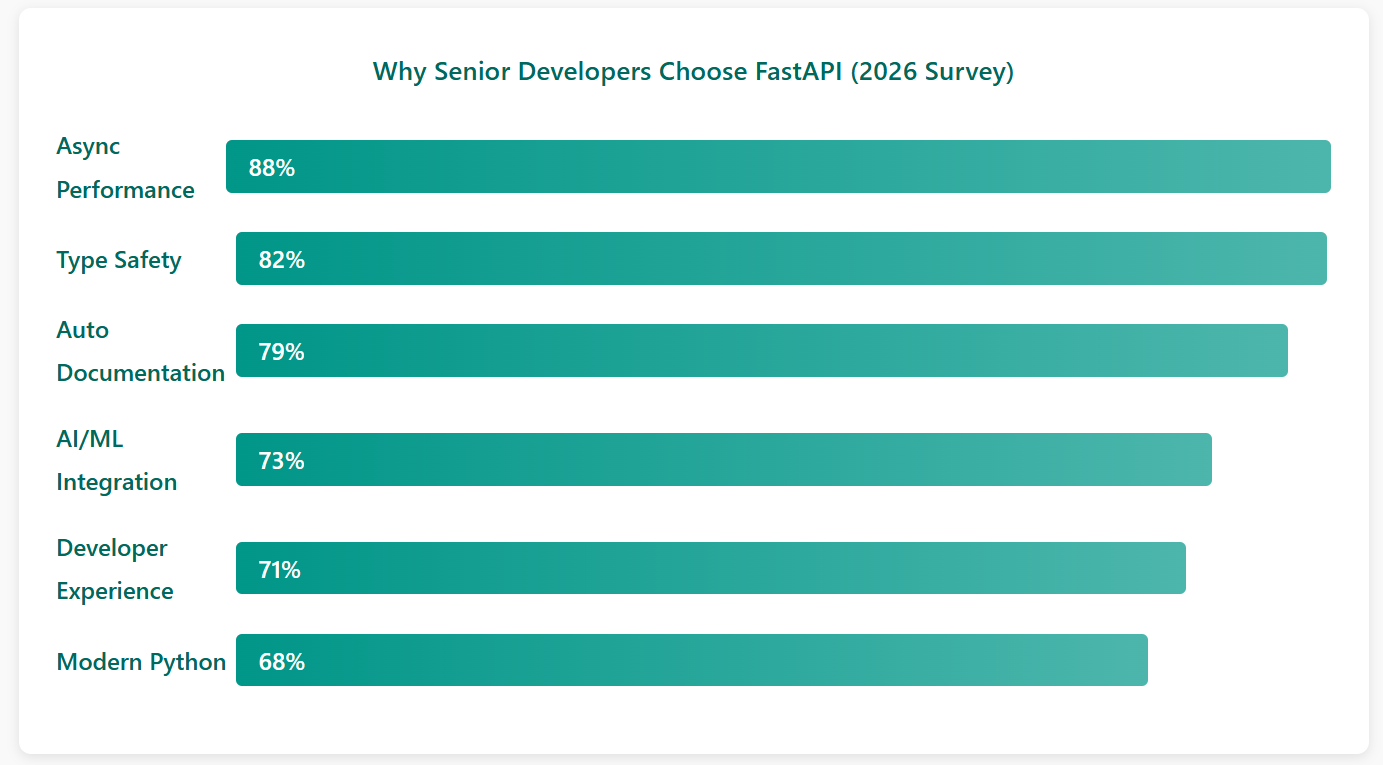
The web development landscape fundamentally changed in 2025–2026 with the rise of agentic AI systems. Modern applications don’t make single API calls — they orchestrate multiple steps: embedding generation, vector database searches, LLM inference calls, and result streaming. These are inherently I/O-bound, async-heavy workloads where traditional synchronous frameworks create bottlenecks.
FastAPI was architected for exactly this pattern. Built on Starlette (an ASGI web toolkit) and leveraging Python’s native asyncio, it handles thousands of concurrent requests without the thread-per-request overhead that limits WSGI frameworks. Real-world benchmarks consistently show FastAPI handling 20,000+ requests per second compared to Flask’s 4,000 — a 5x improvement.
Critical architectural change: The industry has moved from “async as an optimization” to “async as the foundation.” In 2026, if your framework wasn’t built async-first from day one, you’re working against the architectural grain of modern web applications.
Type Safety Becomes Non-Negotiable
Python’s dynamic typing has always involved a trade-off: rapid development at the cost of potential runtime errors. FastAPI fundamentally changes this equation through Pydantic integration, making type hints operational rather than merely documentary.
Here's what this looks like in practice:
from fastapi import FastAPI
from pydantic import BaseModel, Field
from typing import Optional
class UserCreate(BaseModel):
  username: str = Field(..., min_length=3, max_length=50)
  email: str
  age: Optional[int] = Field(None, ge=0, le=150)
  app = FastAPI() @app.post("/users/")
  async def create_user(user: UserCreate): # user is guaranteed valid by this point
  return {"username": user.username, "email": user.email}
FastAPI automatically validates incoming requests, returns detailed error messages for invalid data, and generates OpenAPI documentation. Your IDE provides autocomplete on model fields. Type checkers catch errors before runtime.
This isn’t just developer convenience — it’s production reliability.
Automatic Documentation That Actually Matters
Every experienced developer knows the pain of outdated API documentation. Teams ship endpoint changes, parameter modifications, or response structure updates, and documentation quickly becomes inaccurate.
FastAPI eliminates this entire category of problems. Navigate to /docs on any FastAPI application, and you get a fully interactive Swagger UI generated automatically from your code. The /redoc endpoint provides an alternative ReDoc interface. Both update in real time as you modify endpoints.
For teams practicing contract-first API design, this is transformative. Your implementation is the contract. There’s no drift, no synchronization problems, and no separate documentation repository to maintain.
When you have multiple microservices, frontend teams consuming APIs, and third-party integrations, this zero-overhead documentation becomes critical infrastructure.
The AI/ML Integration Catalyst
FastAPI’s timing couldn’t have been better. The explosion of AI applications in 2024–2025 created massive demand for frameworks optimized for ML model serving. Data scientists work in Python. When they need to deploy models as production APIs, FastAPI has become the obvious choice.
The statistics confirm this pattern. According to 2025 survey data, 42% of ML engineers use FastAPI, compared to 22% using Django and 28% using Flask. This isn’t random — FastAPI’s async capabilities align perfectly with ML serving patterns, where inference calls take variable amounts of time.
With the AI application market reaching $62.4 billion in 2025 (37.2% CAGR), FastAPI sits at the intersection of the industry’s fastest-growing segments: machine learning model serving and high-performance API development.
2026 enterprise reality: Teams building RAG (Retrieval-Augmented Generation) systems, LLM orchestration layers, or AI agent APIs are choosing FastAPI by default.
The framework's async architecture naturally handles the I/O-heavy patterns of modern AI applications.
Production-Ready Ecosystem Maturity
FastAPI is no longer experimental. The ecosystem has matured to enterprise production standards, with robust libraries for:
- Database integration (SQLAlchemy 2.0, SQLModel)
- Authentication (OAuth2, JWT with scopes)
- Background tasks (Celery, Dramatiq)
- Observability (OpenTelemetry, Prometheus)
Multiple development teams report a 30–40% reduction in API development time compared to traditional frameworks. This primarily comes from eliminating boilerplate validation code, automatic documentation generation, and intuitive design patterns.
The Django and Flask Response
Django added async support in version 3.1 and has improved it through Django 5.x releases. However, the framework’s ORM remains largely synchronous, creating bottlenecks in async views. Database operations are executed in thread pools, which works functionally but introduces overhead under load.
Teams often isolate AI-heavy endpoints into separate FastAPI services rather than forcing Django to handle workloads it wasn't designed for.
Flask can run under ASGI servers but wasn't architected async-first. The 2024 Flask ecosystem review by Miguel Grinberg noted that while Flask remains a solid choice for traditional web applications, async-first frameworks like FastAPI, Starlette, and Sanic are increasingly the default for modern API development.
The verdict is clear: frameworks retrofitting async capabilities can't match the performance and developer experience of frameworks designed async-first from conception.
When to Choose What in 2026
Despite FastAPI’s momentum, the choice isn’t always clear-cut. Each framework still has legitimate use cases.
Choose FastAPI When:
- Building APIs or microservices: Especially those requiring high concurrency and async I/O
- Deploying ML models: The async architecture and type safety make it purpose-built for AI serving
- Starting greenfield projects: Modern async-first architecture aligns with where the ecosystem is headed
- Performance matters: I/O-bound workloads see 3-5x throughput improvements
- Team wants modern Python: Type hints, async/await, and contemporary patterns
Choose Django When:
- Building full-stack monoliths: The batteries-included approach with ORM, admin, and auth saves time
- Database-heavy CRUD apps: Django's mature ORM and migration system are battle-tested
- Team expertise exists: Deep Django knowledge in your organization has real value
- Admin interface matters: Django's built-in admin is still unmatched for content management
Choose Flask When:
- Rapid prototyping MVPs: The minimalist approach gets proof-of-concepts running quickly
- Simple web applications: Content-driven sites with moderate traffic where async isn't needed
- Maximum flexibility required: Projects needing complete architectural freedom
- Team familiarity: Existing Flask expertise and established patterns
The 2026 Migration Reality
Should your team migrate existing Django or Flask applications to FastAPI? The answer depends on context and shouldn't be driven by hype. Consider migration for I/O-heavy APIs spending most time waiting on external services, new microservices where greenfield architecture allows modern patterns, ML model serving where async and type safety provide clear value, and performance-critical endpoints where 3-5x throughput improvements justify the effort.
For established Django applications deeply integrated with the ORM, admin interface, and ecosystem, wholesale migration rarely makes sense. The pragmatic approach many teams take: keep existing Django services while building new microservices in FastAPI. This hybrid strategy leverages existing investments while adopting modern patterns for new development.
Looking Forward: Python 3.14 and Free-Threading
The async-first movement is just one part of Python's performance evolution. Python 3.14, arriving in late 2026, will be the first version with complete free-threading support (no Global Interpreter Lock). This will enable true parallel execution of Python code across CPU cores.
FastAPI positions itself well for this future. The framework's async architecture already handles I/O concurrency efficiently. When CPU-bound tasks become truly parallel through free-threading, FastAPI applications will benefit from both async I/O concurrency and parallel CPU execution.
The Bottom Line
FastAPI surpassing Flask in GitHub stars isn’t just a milestone — it’s confirmation of a structural shift in Python web development.
The industry has moved toward async-first, type-safe, API-centric architectures. FastAPI was designed for this world.
The 40% year-over-year adoption growth, enterprise deployments, and dominance among ML engineers show this isn’t hype — it’s a baseline shift for modern Python API development.
For teams starting new projects in 2026, the default has changed. Unless you specifically need Django’s batteries-included approach or Flask’s minimalism, FastAPI aligns more closely with where modern Python web development is heading.
Opinions expressed by DZone contributors are their own.
Comments