

Consumer Ecosystem Design for Efficient Configuration Based Product Rollouts
Distributed architectures enable insurance teams to build scalable, configurable ecosystems—minimizing code changes and accelerating time to market.
Join the DZone community and get the full member experience.
Join For FreeIn a regulated and complex industry like Insurance, one of the biggest challenges facing speed to market is the complexity in regulations and the state variations. Both the variations and complexities cause the code to become unmanageable and complex with all sorts of conditional statements and business logic creeping into consumer applications, making it extremely hard to manage or develop.
This is where distributed architecture/components shine allowing not only to break down piece into smaller manageable parts but also reducing single point of failures. How to effectively distribute the architecture is where the key lies in whether a system will truly be configurable to allow for speed to market.
Note: This article does not take into account the recommendations to design or build a Product Ecosystem which is significantly different from a consumer ecosystem. The consumer ecosystem primarily focuses on building the front end aspects of a platform to truly make it configurable thereby letting minimal code changes during actual requirements implementation to allow business teams to quickly deliver state, compliance and product related requirements to market.
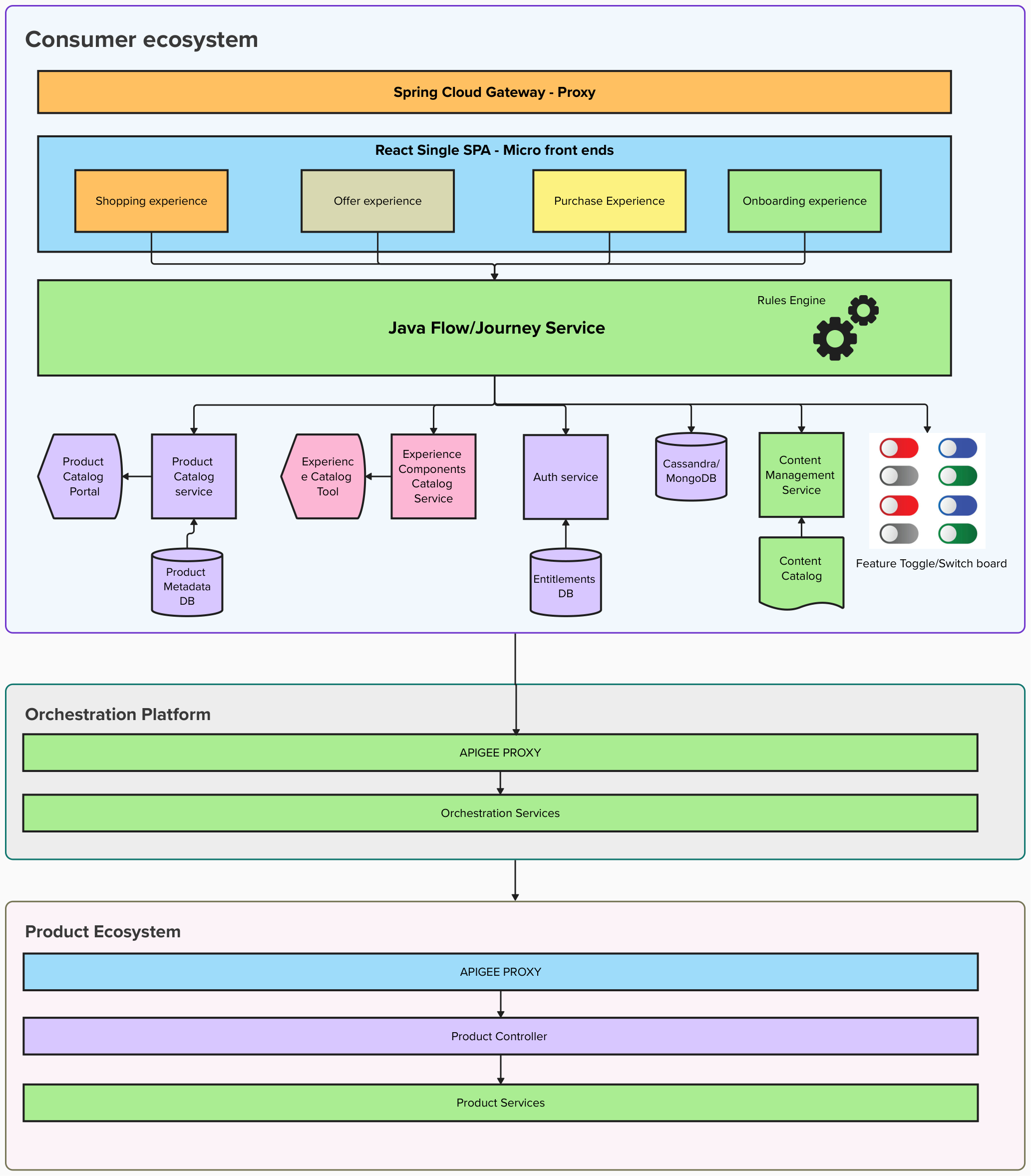
Below is an overview of each of these components and how they can be built, setup and configured such that user experience changes in the consumer ecosystem can be configuration based with minimal to low code changes for every iteration of feature or product rollouts.
Product Directory Catalog
The Product Directory catalog serves as a centralized repository for product metadata. It exposes metadata fields (such as product name, description, effective dates, distribution channel codes, and eligibility criteria) via REST APIs. Both consumer and product-based ecosystems can access this catalog, enabling product enablement and configuration across multiple channels (call center portals, third-party web portals, consumer web portals, etc.). This separation ensures that product metadata changes can be managed independently of the application logic, supporting rapid rollout and compliance with regulatory requirements. Ideally, the product catalog would have a web portal in front of the catalog service allowing business and system engineering users to collaborate on turning products ON OR OFF in production.
Experience Directory Catalog
Experience Directory catalogs manage the configuration of UI questions and flows based on product, state, and user context. By externalizing experience logic (such as which questions to ask, in what order etc), these catalogs prevent complex conditional logic from polluting the core journey component. This separation allows business teams to update or introduce new experiences without code changes, ensuring agility and compliance. Variations in components could be extended to actors (ex:- Call Centers, Consumers, Third Party agencies etc.), states and also line of business (ex: auto, homeowners, renters, boat etc.)
Flow or Journey Managers
The Journey Manager is the central Java service orchestrating the customer journey. It connects to various directory catalogs (product, experience), rule engines, and orchestration components to drive a seamless, configurable user experience. The Journey Manager abstracts business logic and workflow, enabling rapid adaptation to new requirements. It acts as the transaction engine and system of engagement, managing various flows such as shopping flow, offer flow, purchase flow, shopping cart, onboarding flows and cross sell flows. This component connects to the orchestration services downstream and constructs tailor made responses based on product data provided by orchestration for the UI components to be rendered on screen.
Rule-Based Engines
Rule-based engines (Ex: Drools) can be a really handy tool to automate decisions within a consumer ecosystem based flow/journey manager components to help decide on which pages or flows to render dynamically based on the state of the flow or journey. They help evaluate customer data against configured rules, enabling consistent and accurate decision-making. For example, a rules engine within the consumer ecosystem can help decide whether to introduce a cross sell flow into a while in the sales flow of a particular product. This dynamic evaluation of reduces complexity within the java based code by abstracting the rules into a rules that can easily be configured.
Reverse Proxies
Reverse proxies act as intermediaries between clients and backend services, providing load balancing, SSL/TLS termination, caching, and security (such as web application firewalls). They route requests to the appropriate backend service (e.g., Journey Manager) and protect the system from attacks, ensuring high availability and secure communication.
Micro-Frontend/Single SPA Application
A micro-frontend architecture, implemented as a single SPA (Single Page Application) using React, allows independent teams to develop and deploy features in isolation. The container application orchestrates the loading and unloading of micro-frontends, enabling modular development and reducing interdependencies. This approach supports rapid iteration and deployment of new features, aligning with the configurable nature of the consumer ecosystem.
Content Management System
The Content Management System (CMS) is a centralized platform for organizing, storing, and accessing content pertaining to the pages of a portal or even regulatory documents. Ideally the content management system would expose the content to the Single SPA web applications through the Flow/Journey Manager components. This in turn reduces the complexity and size of the central flow/journey manager component by externalizing content to allow users across business and legal domains to collaborate, iterate and configure content in production without needing to make code changes.
Experience Toggle Boards (Switches)
Experience Toggle or Switch Boards provide a centralized interface for enabling or disabling features, experiences, or products across the ecosystem. They allow business teams to control rollout, perform A/B testing, and manage feature flags without code changes. This capability is critical for rapid experimentation and risk mitigation.
Other potential components
Context Handler Services - Allows other systems like partner services and legacy applications to enter into the consumer eco system through a consistent context for the journey to initiate a transaction.
Conclusion
In regulated industries like insurance, complex requirements can slow software development. Distributed architectures—using microservices and modular components—break systems into manageable, independently configurable parts, reducing complexity and single points of failure while enabling faster adaptation.
Key components such as Product and Experience Directory catalogs, Journey Manager, rule-based engines, reverse proxies, micro-frontends, and content management systems let teams collaborate efficiently. By externalizing configuration and business logic, these minimize code changes and support rapid, compliant rollouts. Toggle boards and context handlers add flexibility.
A well-architected, distributed ecosystem helps organizations quickly respond to regulatory and market changes, delivering scalable, resilient solutions that maintain compliance and speed to market.
Opinions expressed by DZone contributors are their own.
Comments