

Building Trust in LLM-Generated Code Reviews: Adding Deterministic Confidence to GenAI Outputs
LLMs are excellent at generating code reviews, but production systems need more than just recommendations — they need trust.
 ·
·
Join the DZone community and get the full member experience.
Join For FreeIn a previous article, Automating AWS Glue Infra and Code Reviews with RAG and Amazon Bedrock, I described how I built a GenAI-powered code review system for AWS Glue jobs using a retrieval-augmented generation (RAG) approach. Given a use case, the system searched all associated jobs, retrieved each job script and a predefined engineering checklist from S3, invoked an LLM, and generated a structured Markdown (.md) review file per job.
Each checklist item was evaluated with:
- a Pass or Fail status
- an explanation
- a recommendation
The result was a readable code review artifact that could be stored, shared, and audited. However, once this system moved beyond experimentation, a new question became unavoidable:
How much should we trust this review?
That realization led me to a deeper conclusion: Confidence is not something an LLM can reliably produce. It must be engineered around it.
This article describes how I enhanced my GenAI system to produce measurable confidence, without relying on the LLM to self-assess its correctness.
The Limitation of Pass/Fail in GenAI Reviews
A binary Pass/Fail status is misleading.
While it works well for human consumption, it hides important distinctions that matter in production systems:
- Was the failure obvious or marginal?
- Was the judgment based on strong evidence or weak inference?
- Was the model certain, or was it guessing due to missing context?
In practice, two “Fail” results can be very different:
- One may be due to a checkpoint violation
- Another may be inferred due to ambiguity or incomplete configuration
Treating these outcomes as equivalent makes downstream automation risky.
This is where most GenAI systems quietly break.
They look confident, but provide no measure for how correct the analysis is, and how much of it is actually factual and contexted.
Redesigning the LLM Output Contract
The first step toward confidence evaluation was not writing scoring logic; it was redesigning what the LLM was required to produce.
In the original implementation, each checkpoint returned:
- Status: Pass/Fail
- Explanation
- Recommendation
To make the output evaluable, the contract was expanded to include two key changes.
1. Introducing “Uncertain” as a First-Class Status
The model was explicitly allowed to respond with:
- Pass
- Fail
- Uncertain
This change served a critical purpose.
Instead of forcing the model to choose a confident-sounding answer, it could now acknowledge ambiguity when context was insufficient.
In production GenAI systems, uncertainty is not a weakness — it is clarity and transparency that eventually builds trust.
2. Requiring Evidence Anchored to Code
For failures, the model was instructed to provide specific code snippets as evidence. In case of no evidence, the status was to be marked as uncertain.
And the best part of this prompt update is that these two additions transformed the LLM output from “human-readable” to machine-evaluable.
The Core Design Principle: Separate Authorship From Evaluation
The key architectural decision I made was this:
The LLM writes the review. The system evaluates the review.
The LLM is responsible for:
- interpreting code
- review the checklist items
- generate human-readable findings
The system is responsible for:
- enforcing structure by prompt update
- evaluating completeness
- calculating confidence
- aggregating and annotating results
This separation prevents a common failure mode in GenAI systems, where the model is allowed to be both the author and the judge of its own output.
Extracting Structure From the Review Output
Once the Markdown review is generated, the LLM is no longer involved.
The system parses the document to extract, for each checkpoint:
- section name
- checkpoint description
- status (Pass/Fail/Uncertain)
- presence of evidence
The goal is not to re-understand the review, but to measure what was produced.
Computing Confidence Deterministically
With structured data extracted, confidence evaluation becomes a pure engineering problem.
A simplified example of checkpoint confidence logic:
- Pass → high confidence (1.0)
- Fail with evidence → high confidence (1.0)
- Fail without evidence → reduced confidence (0.6)
- Uncertain → intentionally low confidence (0.4)
Each checkpoint receives a numeric score. These scores are then averaged to produce:
- Section-level confidence
- Overall confidence
At no point do we ask the LLM if it is “sure.”
Annotating Confidence Without Rewriting the Review
A critical design constraint was preserving authorship.
The LLM was never retriggered. Instead, confidence information is appended to the same file already containing the review. At the end of the document, a system-generated confidence summary is added:
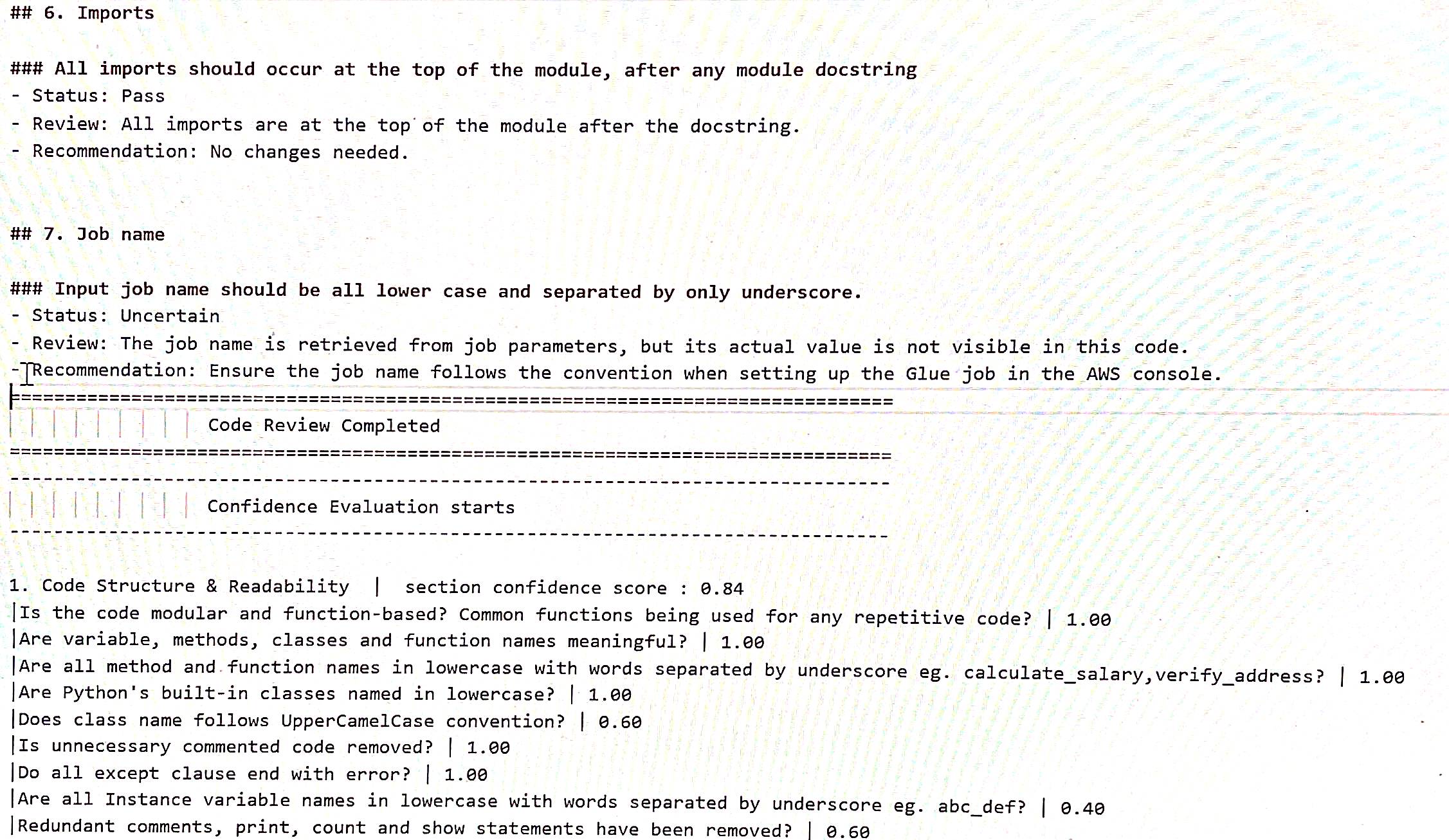
This makes it explicit:
- Review – what the model produced
- Confidence score – what the system evaluated
Such separation is essential for auditability and trust.
From a Code Review Tool to a Reusable Trust Pattern
Although this system was implemented for a code review use case, the underlying pattern is not specific to code at all.
At its core, the problem being solved is this: Any system that uses GenAI to produce evaluative output must also provide a way to measure how much that output can be trusted.
This applies equally to:
- policy and compliance validation
- data quality and schema checks
- infrastructure reviews
- document audits
- risk and eligibility assessments
In all these cases, the GenAI component is responsible for interpretation, reasoning, and recommendation, while the surrounding system is responsible for trust and accountability.
The confidence layer described here acts as a contract boundary between the LLM and the rest of the platform. It converts unstructured, generative output into deterministic signals that downstream systems can reason about.
One practical benefit of this approach is that it enables AI-aware CI/CD pipelines. Instead of blindly trusting generative output, teams can define explicit gating criteria such as:
- block deployment if overall confidence falls below a threshold
- require manual review for sections with low confidence
- track confidence trends across versions to detect regression
This shifts GenAI from being an advisory tool to being a governed system component — one that can participate safely in automated workflows.
Viewed this way, the confidence layer is not a feature of a single application, but a reusable architectural pattern for production GenAI systems.
Engineering Learnings From Adding a Confidence Layer
Several broader lessons were learnt:
- GenAI systems should be designed with explicit trust boundaries. Allowing the model to both generate conclusions and evaluate their correctness collapses an important boundary. Separating authorship (LLM) from evaluation (system logic) creates clarity, auditability, and control.
- Uncertainty should be explicit, not hidden. Forcing binary outcomes increases perceived confidence while reducing actual trust.
- GenAI reliability comes from architecture, not prompts. Prompts influence quality, but guarantees come from contracts, structure, and deterministic logic.
- Knowing where to stop the model is a key GenAI skill. Effective systems use LLMs for reasoning — and systems for judgment.
Closing Thoughts
As GenAI systems move from demos to production, the question will shift from “What can the model do?” to “What can we trust it to do?”
Confidence is not a feature you ask for. It is a property you design for.
By separating LLM-generated insight from system-generated evaluation, we can build GenAI applications that are not only impressive but reliable, explainable, and fit for real-world use.
The code for the updated implementation is available on GitHub. Clone URL: https://github.com/chhabrapooja/Adding-deterministic-confidence-to-GenAI-Outputs.git
I will make the repository public upon publication of this article.
Opinions expressed by DZone contributors are their own.
Comments