

Meta-Learning: The Key to Models That Can "Learn to Learn"
Learn how meta-learning helps AI adapt fast with little data—plus key methods, challenges, and use cases powering next-gen intelligent systems.
 ·
·
Join the DZone community and get the full member experience.
Join For FreeMeta-Learning: The Key to Models That Can "Learn to Learn"
As artificial intelligence (AI) systems continue to evolve, one of the biggest challenges we face is getting machines to generalize well from limited data. Traditionally, training an AI model for a specific task requires vast amounts of labeled data, a problem that is not only costly but also time-consuming. However, a breakthrough concept known as meta-learning or "learning to learn" is quickly changing the way we think about AI training.
In simple terms, meta-learning aims to train models that can adapt quickly to new tasks with very little data. This technique is poised to make AI systems more flexible and capable of solving a wide range of problems with less effort.
This article explores how meta-learning works, the key techniques involved, and its potential applications. By the end, you'll understand how meta-learning is paving the way for more intelligent, adaptable AI systems.
What Is Meta-Learning?
Meta-learning is a field within machine learning that focuses on algorithms capable of learning how to learn. In traditional machine learning, an algorithm is trained on a specific dataset and becomes specialized for that task. In contrast, meta-learning models are designed to generalize across tasks, learning the underlying principles that allow them to quickly adapt to new, unseen tasks with minimal data.
The idea is to make machine learning systems more like humans — able to leverage prior knowledge when facing new challenges. For example, imagine teaching a child how to recognize animals. Instead of showing them thousands of pictures of each animal, you could teach them a few general rules about how animals tend to look, allowing them to recognize new animals they’ve never seen before.
This is where meta-learning shines. By training models to adapt to new situations with few examples, we move closer to creating systems that can handle the diverse, dynamic environments found in the real world.
The Three Types of Meta-Learning
Meta-learning can be broadly categorized into three main types: model-based, optimization-based, and metric-based approaches.
1. Model-Based Meta-Learning
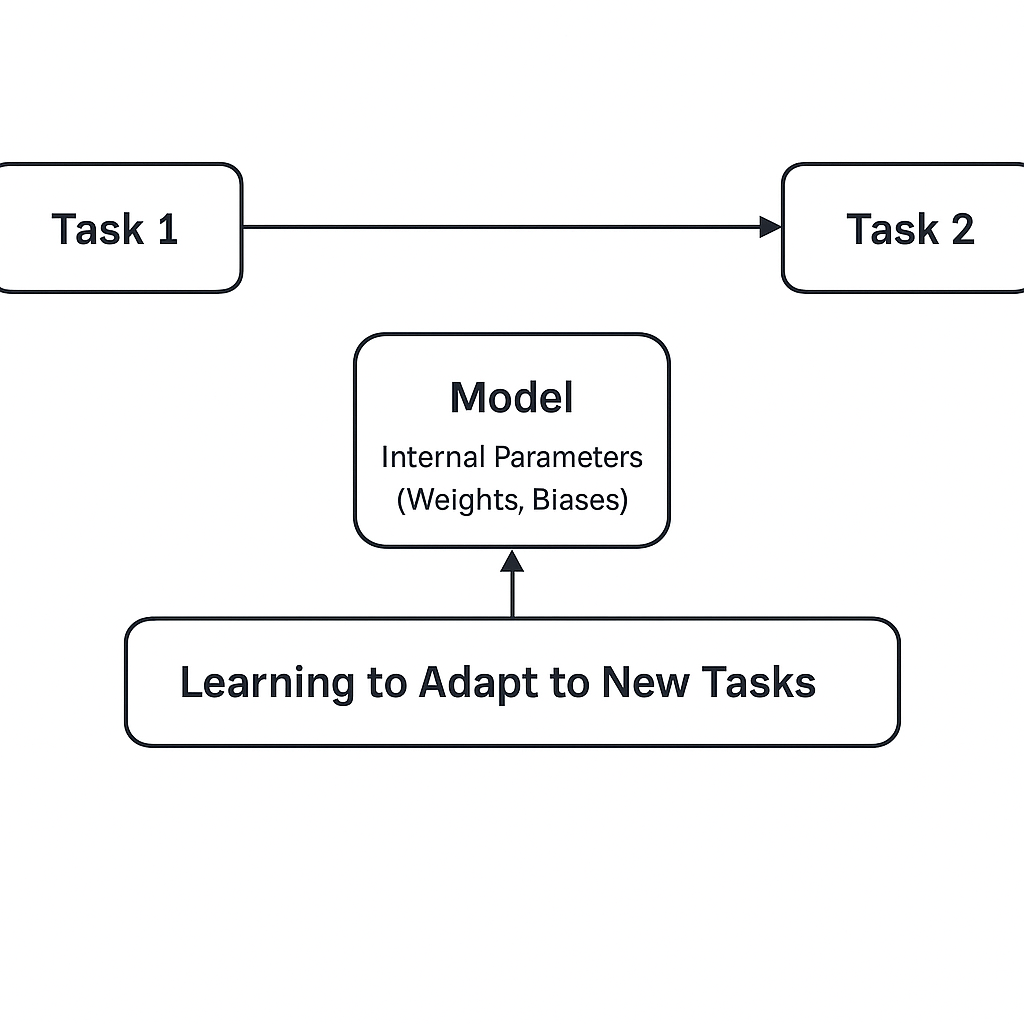
In model-based meta-learning, a model learns how to generalize from one task to another by adjusting its internal parameters. The idea is to design a model that can adapt quickly to new tasks by modifying its weights and biases based on the data it has already seen.
Example: The popular approach to model-based meta-learning is recurrent neural networks (RNNs), particularly long short-term memory (LSTM) networks. These models can learn to generalize from one task to another by recognizing patterns across various tasks.
2. Optimization-Based Meta-Learning
Optimization-based approaches focus on making the model better at learning new tasks through improved optimization techniques. Instead of training a model from scratch every time, the idea is to fine-tune a pre-trained model using a few examples from a new task.
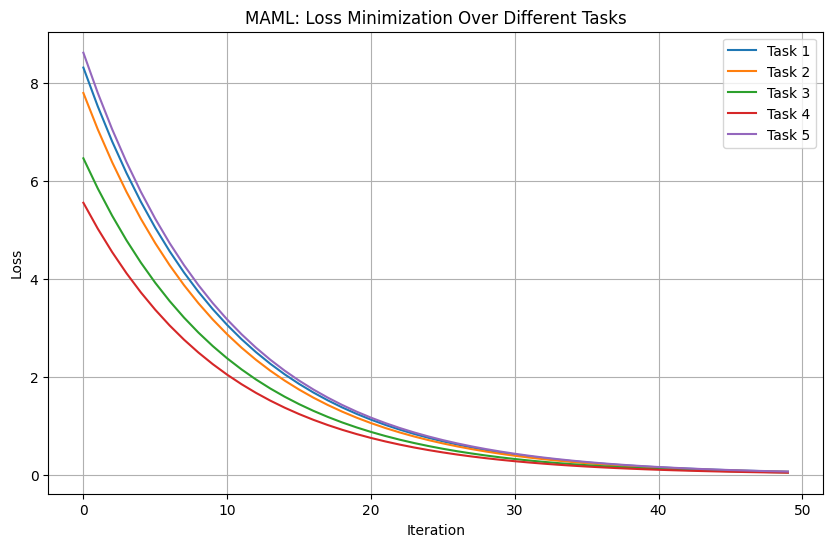
MAML (Model-Agnostic Meta-Learning) is one of the most famous algorithms in this category. MAML optimizes a model's initialization such that it can be adapted to new tasks with just a few gradient updates.
Example: Suppose you're training a model to recognize animals. Using MAML, you could take an already pre-trained model and adapt it to new animals with just a handful of images.
3. Metric-Based Meta-Learning
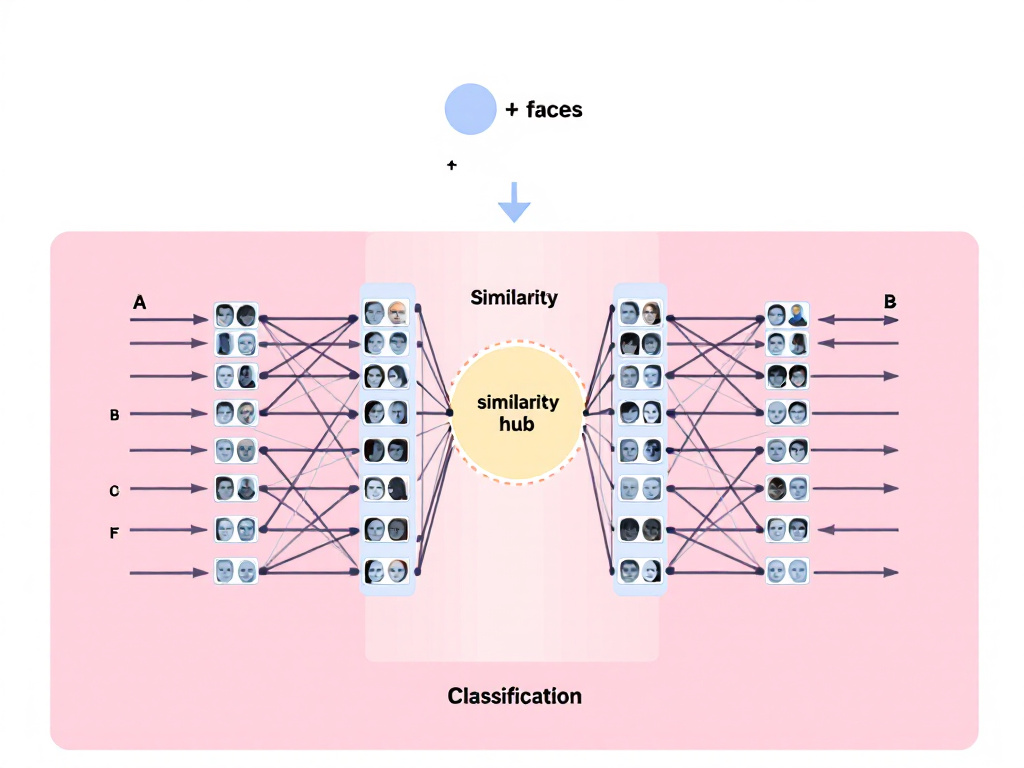
Metric-based meta-learning works by learning a similarity metric across tasks. The model is trained to compare examples from different tasks and determine which ones are similar or different based on some metric.
Siamese Networks and Prototypical Networks are examples of this approach. These models learn to compute similarities between pairs of inputs, which is particularly useful for few-shot classification tasks.
Example: In a facial recognition system, a metric-based model might learn to compare new faces to a database of known faces by measuring the "distance" between them in feature space.
Key Techniques in Meta-Learning
To dive deeper into the mechanics of meta-learning, let's look at some key techniques that power this field.
1. Few-Shot Learning
Few-shot learning is the cornerstone of meta-learning. In few-shot learning, a model is trained to recognize new tasks based on a very limited amount of labeled data. This contrasts with traditional machine learning models, which require large amounts of data to perform well.
Few-shot learning relies heavily on meta-learning algorithms, which ensure that the model generalizes well even when given only a few examples.
2. Transfer Learning
Transfer learning is closely related to meta-learning. In transfer learning, a pre-trained model is fine-tuned on a new task, typically with far fewer examples than it was originally trained on.
Meta-learning takes this concept further by teaching models to adapt to completely new tasks, not just fine-tuning on similar ones.
3. Neural Architecture Search (NAS)
Meta-learning is often combined with neural architecture search (NAS), a technique where meta-learning algorithms help design optimal neural network architectures for specific tasks. NAS automates the process of finding the best architecture for a task, significantly reducing the time and resources required for manual architecture tuning.
Applications of Meta-Learning
Meta-learning has a broad range of applications across various industries, from healthcare to robotics and finance. Let’s explore some of these applications.
1. Personalized Healthcare
In healthcare, meta-learning can be used to personalize treatment plans for patients. By training models on a variety of medical data and enabling them to adapt to specific patients with minimal data, doctors can make more accurate predictions and decisions tailored to individual patients.
2. Autonomous Robots
Robots, especially in dynamic environments, need to adapt to new situations on the fly. Meta-learning allows robots to learn from previous experiences and generalize to new tasks quickly, such as learning how to navigate new environments or perform new tasks with limited training data.
3. Financial Forecasting
In the finance industry, meta-learning is used to develop models that can predict market trends, even in cases where historical data is sparse or unreliable. These models can be trained on different types of financial data, making them highly adaptable to new market conditions.
4. Natural Language Processing (NLP)
Meta-learning is increasingly being applied to NLP, particularly in few-shot learning tasks. Models like GPT-3, which were trained on vast amounts of data, can use meta-learning techniques to quickly adapt to specialized tasks, such as sentiment analysis or language translation, with minimal task-specific data.
Challenges and Future of Meta-Learning
While meta-learning has made significant strides, it is not without its challenges. Here are some key obstacles that need to be overcome:
- Computational resources: Meta-learning algorithms can be computationally expensive, particularly when training on multiple tasks or optimizing for few-shot learning. Research is ongoing to make these algorithms more efficient and scalable.
- Data privacy: In some applications, like healthcare or finance, data privacy is a significant concern. Meta-learning systems that require access to large datasets need to ensure that sensitive data is handled securely.
- Generalization: Even though meta-learning algorithms are designed for generalization, the models still often struggle to adapt when faced with tasks that are too different from the ones they were trained on. Further advancements are needed to make models more flexible and robust across a wide range of tasks.
Conclusion
Meta-learning represents the next frontier in machine learning, enabling models that are adaptable and capable of generalizing across a wide range of tasks with minimal data. By making machines more capable of learning from fewer examples, meta-learning has the potential to revolutionize fields like healthcare, robotics, finance, and more.
While there are still challenges to overcome, the ongoing advancements in meta-learning techniques, such as few-shot learning, transfer learning, and neural architecture search, are making it an exciting area of research with vast potential for practical applications.
As we move towards an AI-driven future, meta-learning will likely be at the heart of creating systems that are not just powerful but also highly adaptable to the ever-changing demands of the real world.
Opinions expressed by DZone contributors are their own.
Comments