

Portable Intelligence Architecture: When the Runtime Becomes the Hard Problem
As AI inference moves closer to live context, the hard problem shifts from model quality to runtime design. Portable Intelligence Architecture solves this.
 ·
·
Join the DZone community and get the full member experience.
Join For FreeFor two decades, we focused on moving data to the intelligence. Now, we’re seeing a massive shift: we have to move the intelligence to the data. That flip changes everything. Your host platform isn’t just an API gateway anymore; it’s an operating system.
The Meeting That Wasn’t About Models
The meeting that changed how I think about AI infrastructure had almost nothing to do with models. We spent months obsessing over model quality. Then, over a few weeks, the agenda quietly reorganized itself. We were talking about onboarding third-party units. We debated what happens when two versions of the same model disagree under replay. We worried about whether one tenant’s inference could starve a neighbor’s on a shared accelerator. We fought over who pays for a millisecond.
At some point, I wrote down what was actually on the whiteboard: routing, versioning, isolation, admission control, resource accounting, governance boundaries, and latency budgets. That is not a machine learning agenda. That started to look more like an operating systems agenda. We had stopped solving an AI problem and started designing a runtime. It happened the way architecture usually happens, as an accumulation of decisions that only later reveal their shape.
This article names and outlines that shape. I call it the Portable Intelligence Architecture, or PIA. It is not a product, a vendor category, or a rebranding of edge ML. It is an architecture pattern that several teams appear to be converging on independently, and an argument that the runtime layer deserves to be treated as a first-class architectural concern rather than an implementation detail discovered later in production.
Twenty Years of Moving Data to Intelligence
We’ve been living in an API-first world because, for a long time, the math was simple: intelligence was expensive and centralized, payloads were small, and network costs were rounding errors. It made sense to ship the data to the model.
That premise was right for its time. If you’re running a proprietary fraud model that needs nightly retraining and a custom feature store, you don't ship that code to the caller. You expose an endpoint. The caller sends a few kilobytes, and you send back a score. That made sense at the time.
Every abstraction we’ve built lately has just been a refinement of where that intelligence lives.
Libraries. APIs. Microservices. Containers. Portable Intelligence Units.
I see this as a ladder. Libraries were linked. APIs were called. Microservices were deployed. Containers were scheduled. Each step made the unit more self-contained and independent.
A Portable Intelligence Unit (PIU) is just the next rung. It’s a versioned, resource-declared unit that brings the inference straight to the host where the context already lives, and at scale.
The old API-first rule isn't dead, but it’s become conditional. In my experience, three things changed the game.
Accelerators became first-class citizens. GPUs and LPUs aren't "specialized hardware" anymore. They're just another resource class for the scheduler. Once you can allocate inference hardware like memory, deploying a model locally becomes a standard infra task, not a massive research project.
Models got smaller. Thanks to distillation and quantization, a killer model can now be a few gigabytes. When the model is smaller than the context it needs to digest, moving the model is the only logical choice.
Context is live and now at scale. The signal that matters for enterprise decisions isn't a static prompt. It's live inventory, session data, and real-time supply conditions. That state is too heavy and sensitive to export. It stays where it is. Just think about all the session data the new LLM chats are generating.
I first assumed portable intelligence would mostly mean shipping simple decision logic outward: rules, gradient-boosted trees, small classifiers, the kind of thing you push to the edge because it is cheap to push.
My assumption was wrong. Modern accelerator economics mean we can run heavy-duty models right at the point of decision. The old constraints that forced us to keep things simple at the edge have almost vanished.
Where APIs Alone Become Insufficient
Remote inference isn't going away, but I've found it’s structurally insufficient for a certain class of high-performance systems. Here are the four forces we keep running into.
- Context gravity. We’ve known for years that you move computation to the data when the data is expensive to ship. But now, it’s about fidelity. If you try to export the live state to a remote endpoint, you have to freeze and flatten it. You don't just lose bandwidth; you lose the predictive relationships that make the model work.
- The millisecond wall. When you have a 10ms budget, a remote round trip isn't just "slow." It's a non-starter. You can't optimize your way out of a budget the network ate before your code even touched the CPU.
- Governance and silos. Between data residency laws and partner contracts, the data often physically cannot move. Moving the model is frequently the only way to stay compliant. The model crosses the fence; the data doesn't. Think GDPR, etc.
- The cost of scale. Per-call pricing is great when you're small, but at high volume, it'll kill your margins. We usually discover this late, and it’s a painful, expensive lesson to learn.
These forces don't kill the API, but they force us to build a second plane where we deploy intelligence instead of just calling it.
|
Remote inference |
Portable intelligence |
|---|---|
|
Context moves. |
Model moves. |
|
Boundary crossed by data. |
Boundary crossed by artifact. |
|
Cost unit is per call. |
Cost unit is per allocated compute. |
|
Failure mode is tail latency. |
Failure mode is operational drift. |
Portable Intelligence Architecture
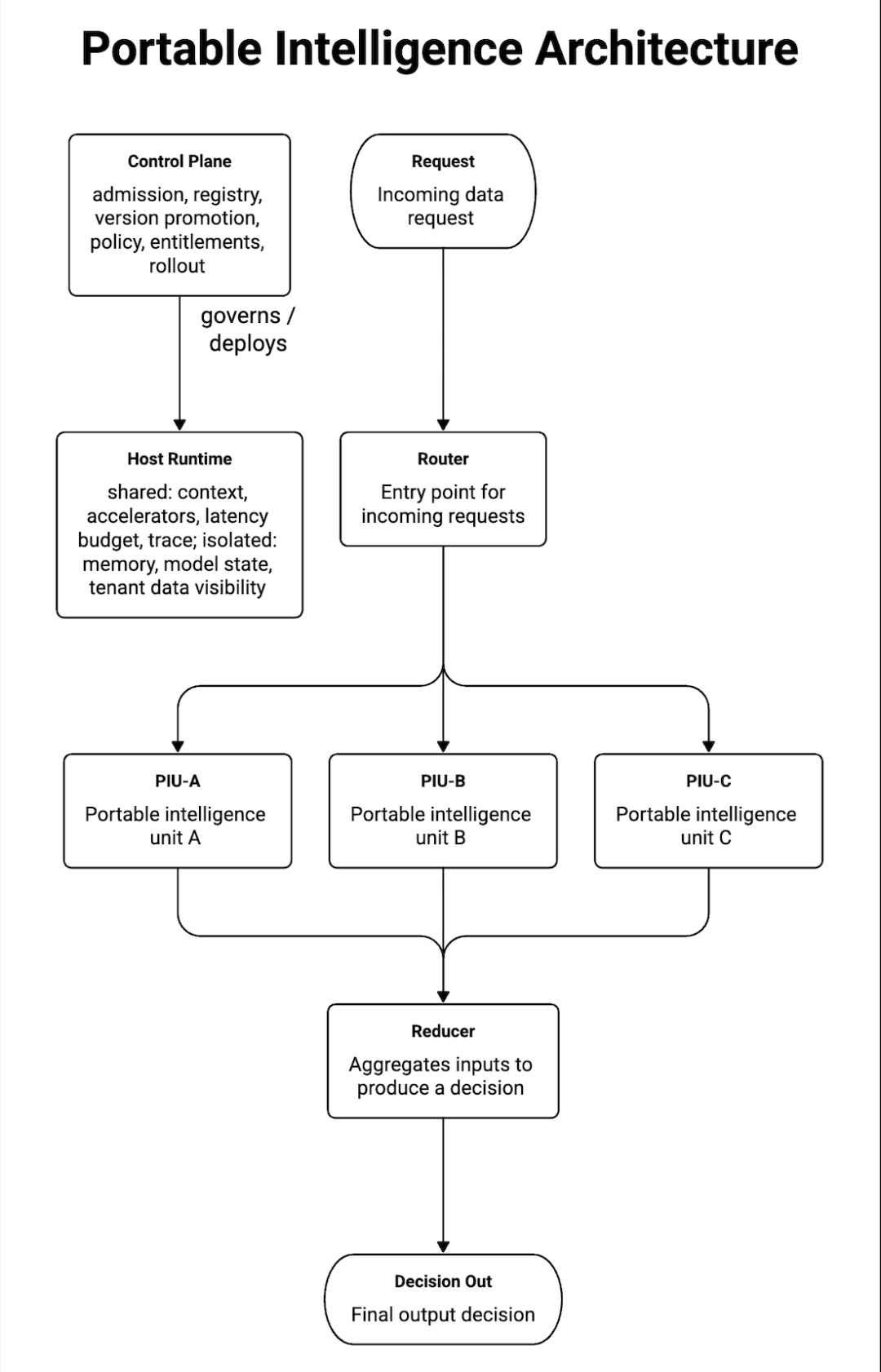
In simple terms, PIA is an architecture where you package inference into a portable, versioned unit and drop it into a host runtime that already owns the data.
It has three parts.
- A Portable Intelligence Unit, or PIU, is the deployable artifact: a model plus its preprocessing, its declared resource envelope, its data contract, its version identity, and its governance metadata. A PIU is not “a container with a model in it.” The container is packaging. The contract is the architecture.
- The host is the runtime that admits, schedules, routes to, isolates, meters, and observes PIUs. It owns the context that made deployment worthwhile in the first place.
- The decision plane is the hot path where PIUs execute against live context under a latency budget. It is deliberately separated from the control plane, which handles admission, versioning, policy, and rollout on a different time scale.
Running a model near data isn't new; we've been doing that with embedded code for decades. The real innovation here is the multi-tenant, contract-governed host. We're talking about units from different teams, on different release cycles, all sharing one runtime to make one decision.
That’s a runtime problem, plain and simple. And luckily, operating systems have already given us the blueprint.
The Five Principles
- Move the smaller thing. The architectural question is never “should intelligence be central or distributed.” It is “which artifact is cheaper to move in bytes, in fidelity, and in legal exposure? Is it the model or the context?” Answer that honestly per workload, and the topology falls out. It will not be the same answer for every workload in the same system.
- The host is an operating system, not a gateway. A gateway routes requests. An operating system admits programs, isolates them, schedules them against finite resources, accounts for what they consume, mediates access to privileged state, and defines the interface through which they ask for more. Once you have multiple third-party units sharing accelerators under a shared latency budget, you are building the second thing whether you intended to or not. Building it deliberately is cheaper.
- Optimize the composition, not the component. This is the principle I would have argued against a year ago. Marginal model quality is usually not the binding constraint. Routing, admission, fallback, and sequencing of specialized units produce more end-to-end improvement than another point of accuracy on any single unit. The system-level win comes from composition, and composition is an orchestration property.
- Operational properties are the contract. Latency, versioning, governance, and cost are not things you tune after the design. They are the declared interface of a unit. A PIU that does not declare a p99 budget, a data-class permission set, and a resource envelope cannot be safely admitted, because the host has no basis for scheduling it. Treat these as first-class contract fields, or you will enforce them later with incident reviews.
- Assume re-entry. Single-shot inference is the easy case and increasingly the minority case. Design the interface between a unit and the host assuming that intelligence will call back into the runtime mid-reasoning for a lookup, a tool, or another unit. This is the hardest principle to satisfy, and I will be honest about the fact that we have not fully solved it.
Composition Is Where the Value Is
The single most consequential thing we learned was not that one sophisticated model could be deployed at the decision point. It was that several specialized units working together were worth substantially more than one general unit.
The reasons are structural, not empirical:
- Specialized units are small, which makes them cheap to schedule and fast to load.
- They can be owned by different teams, or different companies, and released independently.
- They can be versioned independently, which means a regression is contained.
- The routing decision between them is itself cheap, so composition costs less than you would guess.
The router is where the architecture actually lives. It decides which units see a request, whether they run in parallel or in sequence, what happens when one exceeds its budget, and what the fallback path is. Every hard question in this pattern eventually becomes a router question.
The Host Becomes an Operating System
The analogy is not decorative. It is predictive: it tells you which problem you will hit next.
|
Operating system concept |
PIA equivalent |
|---|---|
|
Process |
Portable Intelligence Unit |
|
Scheduler |
Router and admission controller |
|
Memory protection |
Tenant and data-class isolation |
|
Resource accounting |
Per-unit compute metering and attribution |
|
System calls |
Callback interface from unit into host |
|
Package management |
Partner onboarding and unit registry |
|
Permissions |
Governance policy on data classes |
|
Device drivers |
Accelerator abstraction |
If you take one thing away, let it be this: keep your control plane and decision plane strictly separate. It’s the highest-leverage move you can make.
The control plane handles admission, registry, version promotion, policy, entitlements, cost models, rollout, and rollback. The decision plane handles request context, routing, inference, composition, fallback, and emitting the decision.
When you let control-plane junk leak into the decision path, like a registry call during routing, you’re coupling a minutes-scale system to a milliseconds-scale one. Your tail latency will let you know exactly why that was a mistake.
The Contract
Look at the manifest below. These fields aren't just metadata; they're everything the host needs to schedule, isolate, and govern a unit without ever needing to call the owner.
Figure 1: PIU Manifest JSON
{
  "piu": {
    "id": "risk-scorer",
    "version": "4.2.1",
    "owner": "partner:northwind",
    "artifact": {
      "image": "registry.internal/piu/risk-scorer@sha256:9f2c...",
      "signature": "cosign:...",
      "format": "onnx"
    },
    "resources": {
      "accelerator": { "class": "gpu.small", "count": 1 },
      "memory_mb": 6144,
      "max_concurrency": 32
    },
    "budget": {
      "p50_ms": 4,
      "p99_ms": 18,
      "timeout_ms": 25,
      "on_exceed": "fallback:[email protected]"
    },
    "data_contract": {
      "input_schema": "schemas/[email protected]",
      "compat": "backward",
      "required_fields": ["entity_id", "signal_vector", "channel"],
      "null_policy": "reject"
    },
    "governance": {
      "data_classes": ["pseudonymous", "aggregate"],
      "prohibited_classes": ["pii", "cross_tenant"],
      "residency": ["eu"],
      "audit": "sampled:0.01"
    },
    "economics": {
      "billing_unit": "accelerator_ms",
      "attribution": "tenant"
    },
    "capabilities": {
      "reentrant": false,
      "max_callbacks": 0
    }
  }
}
Two fields in that manifest are doing far more work than the rest.
data_contract.compat is where partner integrations actually succeed or fail.
capabilities.reentrant is where the open problem lives.
Getting this onto Kubernetes is the easy part once you have the contract. The substrate is just plumbing; the contract is the architecture.
Figure 2: Kubernetes Deployment Manifest
apiVersion: apps/v1
kind: Deployment
metadata:
  name: piu-risk-scorer
  labels:
    piu.host/id: risk-scorer
    piu.host/version: "4.2.1"
    piu.host/tenant-class: partner
spec:
  replicas: 6
  selector:
    matchLabels:
      piu.host/id: risk-scorer
  template:
    metadata:
      labels:
        piu.host/id: risk-scorer
        piu.host/version: "4.2.1"
    spec:
      nodeSelector:
        accelerator.class: gpu.small
      containers:
        - name: unit
          image: registry.internal/piu/risk-scorer@sha256:9f2c...
          env:
            - name: PIU_MANIFEST
              value: /etc/piu/manifest.json
            - name: HOST_CALLBACK_SOCKET
              value: /var/run/piu/host.sock
          resources:
            limits:
              nvidia.com/gpu: 1
              memory: 6Gi
            requests:
              memory: 6Gi
          readinessProbe:
            httpGet:
              path: /healthz/warm
              port: 8080
            initialDelaySeconds: 20
          volumeMounts:
            - name: host-socket
              mountPath: /var/run/piu
      volumes:
        - name: host-socket
          hostPath:
            path: /var/run/piu
            type: Directory
Pay attention to the readiness probe. If a unit says it's ready before the accelerator memory is loaded, it'll start taking traffic it can't handle. That’s how you would end up exceeding your p99.
Operational Lessons, Ranked By Cost
- Partner onboarding is the hardest problem, and it is not a packaging problem. I expected packaging friction. What we actually hit was data compatibility. Two teams agree on a schema, ship against it, and still fail because one side’s “session” means something subtly different from the other’s, or a field is nullable in practice but not in contract, or the feature distribution the unit was trained on does not match the distribution the host produces. Schema compatibility is necessary and nowhere near sufficient. What moved the needle was a developer protocol: an SDK, a conformance test suite, and golden datasets that a partner could run before ever touching our environment.
- Versioning models is easy. Testing across versions is not. Tagging a version takes an afternoon. Knowing whether version 4.2.1 behaves acceptably across every tenant, every context distribution, and every composition path it participates in is a combinatorial problem. Shadow traffic and production replay are the only honest tests I know of. Unit tests on models are theater.
- Multi-tenancy on accelerators is harsher than on CPU. Noisy-neighbor effects that are annoying on CPU are structural on shared accelerators, particularly once batching enters the picture. Batching couples tenants’ latency profiles: one tenant’s traffic shape now determines another tenant’s tail. Either isolate hard and pay for it, or accept the coupling explicitly and model it.
- Design the cost model before deploying sophisticated inference. This should be a boring statement, but it isn't. If you deploy first, you learn your unit economics from a bill, in arrears, after the architecture has ossified. Decide early what the billing unit is, whether it's accelerator-milliseconds, admitted requests, or allocated capacity, because that choice propagates into routing policy and eventually into what you can sell.
- Average latency is a vanity metric. p99 is the product. Dean and Barroso made this point over a decade ago, and it applies with extra force here because composition fans out. If a decision touches four units and each has a well-behaved tail, the composed tail is worse than any individual one. Budget the composition, not the components. Enforce timeouts at the router with a defined fallback, and treat fallback as a normal outcome rather than an error.
Tradeoffs, Stated Plainly
PIA buys latency, governance topology, and cost predictability at high volume. It costs the following:
- Operational surface area. You now operate a runtime. That is a permanent staffing commitment, not a project.
- Debugging across trust boundaries. When a composed decision is wrong, and three of the units belong to other organizations, root cause becomes a negotiation.
- Supply chain risk. Admitting third-party inference into your runtime is admitting third-party code into your runtime. Signing, scanning, and resource limits are table stakes, not maturity.
- Freshness. Centralized models update on one cadence. Distributed units update on many. Some drift is now a design parameter rather than an accident.
- Capacity planning. Accelerator capacity is lumpy, and lumpy capacity plus strict latency budgets means paying for headroom you do not use.
When Not to Use PIA
Do not build this if:
- Your volume is low. Per-call pricing is a gift at low volume; take it.
- Your latency budget is loose. If 200 ms is fine, call the API.
- There is one model, one owner, one release cadence. You have a deployment, not a runtime.
- Your context is small and legally exportable. Then the context is the smaller thing to move, and principle 1 tells you to move it.
- Your models are iterating weekly. Central deployment has a much shorter feedback loop, and early-stage model velocity beats architectural elegance every time.
The pattern earns its complexity at the intersection of high volume, tight budgets, multiple owners, and immovable context. Outside that intersection, it is overhead with a nice diagram.
The Future Is Agents Orchestrating Units
The direction this is heading is not one enormous model at the decision point. It is an agent orchestrating many specialized Portable Intelligence Units, selecting and sequencing them dynamically based on the decision at hand.
That future is architecturally coherent right up until it hits the problem we have not solved.
Iterative workflows break the budget model. Single-shot inference has a clean contract: the host gives a unit context, the unit returns a result inside a declared budget. Re-entrant reasoning does not work that way. A unit pauses mid-reasoning, calls back into the runtime for a lookup or another unit’s output, and resumes. Now the budget is not a duration; it is a session with an unknown number of stages, holding accelerator memory the whole time.
Every mechanism the host relies on gets harder: admission control cannot know the cost of admitting a request, scheduling has to handle units that are resident but idle, fair-sharing has to prevent one long chain from starving short ones, and tracing has to reconstruct a call graph that did not exist at admission time.
Operating systems solved the analogous problems with preemption, quotas, and priority scheduling over roughly thirty years. I do not think we get a shortcut. But I do think naming the problem correctly is most of the work, and the correct name is scheduling, not prompting.
Conclusion
Portable Intelligence Architecture does not replace APIs. It complements them. Most systems will run both planes, and the interesting design work is deciding which decisions belong on which plane.
What has changed is where the difficulty sits. For most of the last decade, the limiting factor in enterprise AI was model quality, and the industry organized itself accordingly. That is no longer where the constraint binds. The models are good enough for a large and growing set of enterprise decisions.
The new bottleneck is the runtime. We need a layer that lets portable intelligence run safely and at scale across different owners and tight budgets.
We stumbled into our runtime one whiteboard at a time. Trust me, it’s much cheaper to build it on purpose. This isn't an implementation detail; it’s a first-class architectural concern.
References
- Gray, J. Distributed Computing Economics. Microsoft Research, 2003.
- Dean, J. and Barroso, L. A. The Tail at Scale. Communications of the ACM, 2013.
- Barroso, L. A., Clidaras, J., Hölzle, U. The Datacenter as a Computer. Morgan & Claypool.
- Sculley, D. et al. Hidden Technical Debt in Machine Learning Systems. NeurIPS, 2015.
- Dehghani, Z. Data Mesh: Delivering Data-Driven Value at Scale. O’Reilly, 2022.
- Kubernetes documentation: Device Plugins and Dynamic Resource Allocation.
- ONNX: Open Neural Network Exchange specification.
Opinions expressed by DZone contributors are their own.
Comments