

Prompting AI for Analytics: The Missing Optimization Layer Between Your Question and the Model
A practical blueprint for cutting AI token costs in analytics — clean up the question before it reaches the model, then learn from what worked.
Join the DZone community and get the full member experience.
Join For FreeThe answer was right. The question cost four times what it needed to.
Every analytics team using AI models runs into the same quiet cost: wasted tokens from messy prompts. An analyst types a vague question, the model gives back a long, hedge-y answer, the analyst rewrites the question, asks again, and the loop repeats. Multiply that across hundreds of analysts asking questions every day, and it's not just money burned on tokens — it's time lost and answers that don't line up with each other.
The usual fix is to train people to write better prompts. That doesn't really work in an analytics team, where people range from SQL experts to product managers who've never heard the term "system prompt." You can't expect everyone to become a prompting expert, and you shouldn't have to.
What's actually missing is a layer that sits between the person and the model — something that takes a rough, real-world question, cleans it up into a tight, clear prompt, and only then sends it to the AI. Not a smarter model. A cleanup step in front of the one you already have.
The Idea, in Practice
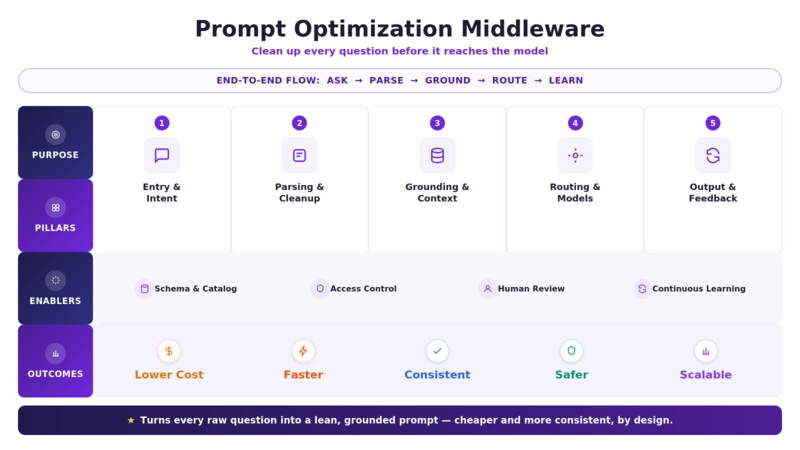
Think of it as a quick check before takeoff. Before a question ever reaches the main AI model, it passes through a smaller, cheaper step that does four things: it strips out repeated context and filler words that burn tokens without adding anything useful; it clears up what's actually being asked, tightening a vague question like "show me the numbers" automatically or flagging it with one quick clarifying question; it reshapes the request into a consistent structure — goal, scope, filters, output format — that the model can act on faster; and it pulls in only the slice of a dashboard, schema, or past query history that's actually relevant, instead of attaching everything on hand.
The result is that the expensive model only ever sees a short, clear prompt — not the rough, rambling way people actually type when they're thinking out loud. And because this happens in a small, cheap step before the real model call, the overhead of doing it is trivial next to what it saves downstream.
This matters more in analytics than almost anywhere else AI gets used. Analysts tend to ask the same kind of question over and over — "compare Q2 vs Q3 revenue by region," "why did churn spike in March" — which means there's rarely a reason to reinvent the prompt from scratch each time. Volume is high and prompting skill is intentionally not the point: analysts want the answer, not a lesson in context engineering. And because business reporting depends on repeatable numbers, a standard prompt shape produces more consistent answers than everyone phrasing the same question their own way.
Here's roughly what that looks like end to end — a request comes in, gets cleaned up by a small router model, gets grounded in real schema and glossary data, gets routed to the right model, and the outcome gets logged so the system can improve next time:
A Heavier Example: The Quarterly Business Review
The savings are easiest to see with a request that's genuinely heavy — the kind that piles up context fast in a normal BI workflow. Picture an analyst asking:
"can you pull together everything on how we did this quarter — revenue, churn, top segments, regional breakdown, how we compare to the last few quarters, and check if the new pricing tier is helping or hurting. need the full picture for the board deck"
Handled the way most people actually work, that request gets answered by attaching whatever's on hand — a few dashboard exports, several quarters of raw table data, the full schema documentation, maybe last quarter's board deck for reference. To be clear, the numbers below are an illustrative estimate, not a benchmark run against a real system — but if you've ever watched someone paste four exports and a glossary into a chat window before asking a question, the shape of it should feel familiar: that's easily thousands of tokens of attached context before the model has done any actual reasoning, covering five different metrics with no explicit scope.
A cleanup layer instead decomposes the request into five clear sub-questions, resolves the comparison window (this quarter vs. the trailing four), pulls only the specific tables those five metrics actually touch, keeps aggregates instead of raw rows, and fixes the output shape up front — something like:
Objective: quarterly business review, current quarter vs. trailing four. Metrics: revenue, churn, segment mix, regional mix, pricing-tier impact. Data: five named tables, summary level only. Output: a five-part board-ready summary.
Same request, same five topics, but a small fraction of the original context — in a setup like this, you'd plausibly see a reduction in the range of 80–90%, since the naive version is mostly redundant attachments rather than information the model actually needs. The exact number depends entirely on how much got over-attached in the first place, which is precisely the point: the waste is rarely in the question; it's in what gets bolted onto it.
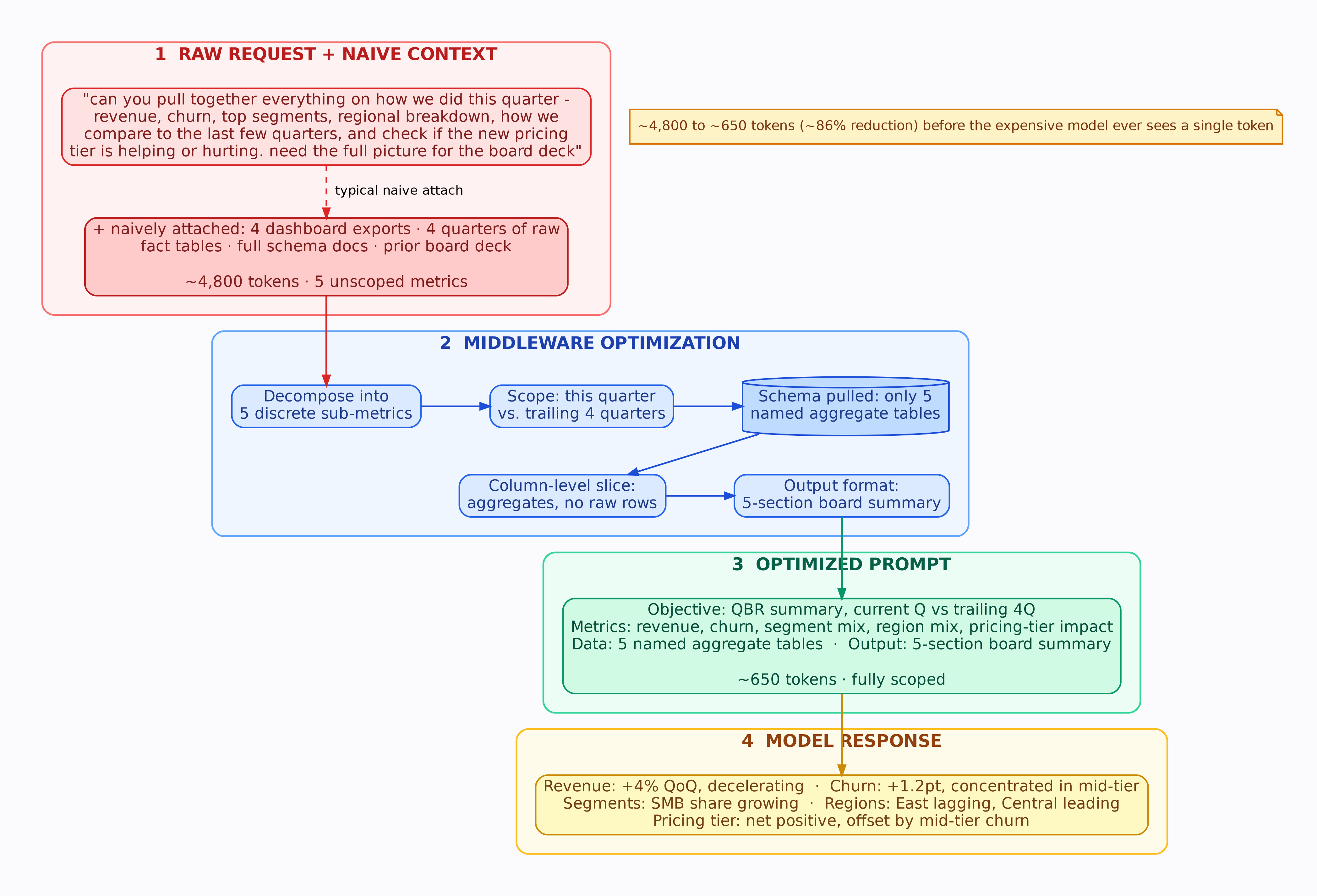
The mechanism that makes this affordable is using a small, cheap model to do the cleanup, and reserving the expensive model for the actual reasoning. The cleanup pass costs a sliver of the token budget it saves.
Memory, Guardrails, and the Cold-Start Problem
A cleanup layer that only ever looks at one prompt at a time is leaving something on the table. Most analysts across a company end up asking structurally similar questions, just worded differently — and if the system re-derives the same structure from scratch every time, it never gets any smarter from what the organization has already asked.
The natural extension is a shared memory of good prompt patterns: when a pattern is used, and the outcome is accepted without correction, it's a candidate for reuse. If a second analyst — on a different team, weeks later — asks for essentially the same kind of summary with different filters, the system can retrieve that pattern and adapt it instead of starting cold. This is also where the mechanism keeps learning: every outcome (accepted as-is, corrected, or manually edited before sending) gets logged, and that signal is what tells the system whether a pattern is worth keeping, needs review, or was actually a miss in the cleanup logic itself.
That memory only works if it doesn't turn into a liability, so it needs three guardrails from day one, not bolted on later. First, access has to be inherited, not invented — a stored pattern only surfaces for someone who could already see the underlying data, and sensitive domains (HR, legal, anything under investigation) stay out of shared memory by default. Second, nothing gets trusted just because it was used once — a new pattern sits in a probationary state until it's been reused successfully by more than one person with no corrections, and only then graduates to something the system will actively suggest. Third, patterns expire — each one is tagged to the schema and glossary version it was built against, so when a business definition changes (what counts as an "active user," say), the pattern gets flagged for re-validation instead of quietly giving a stale answer with total confidence.
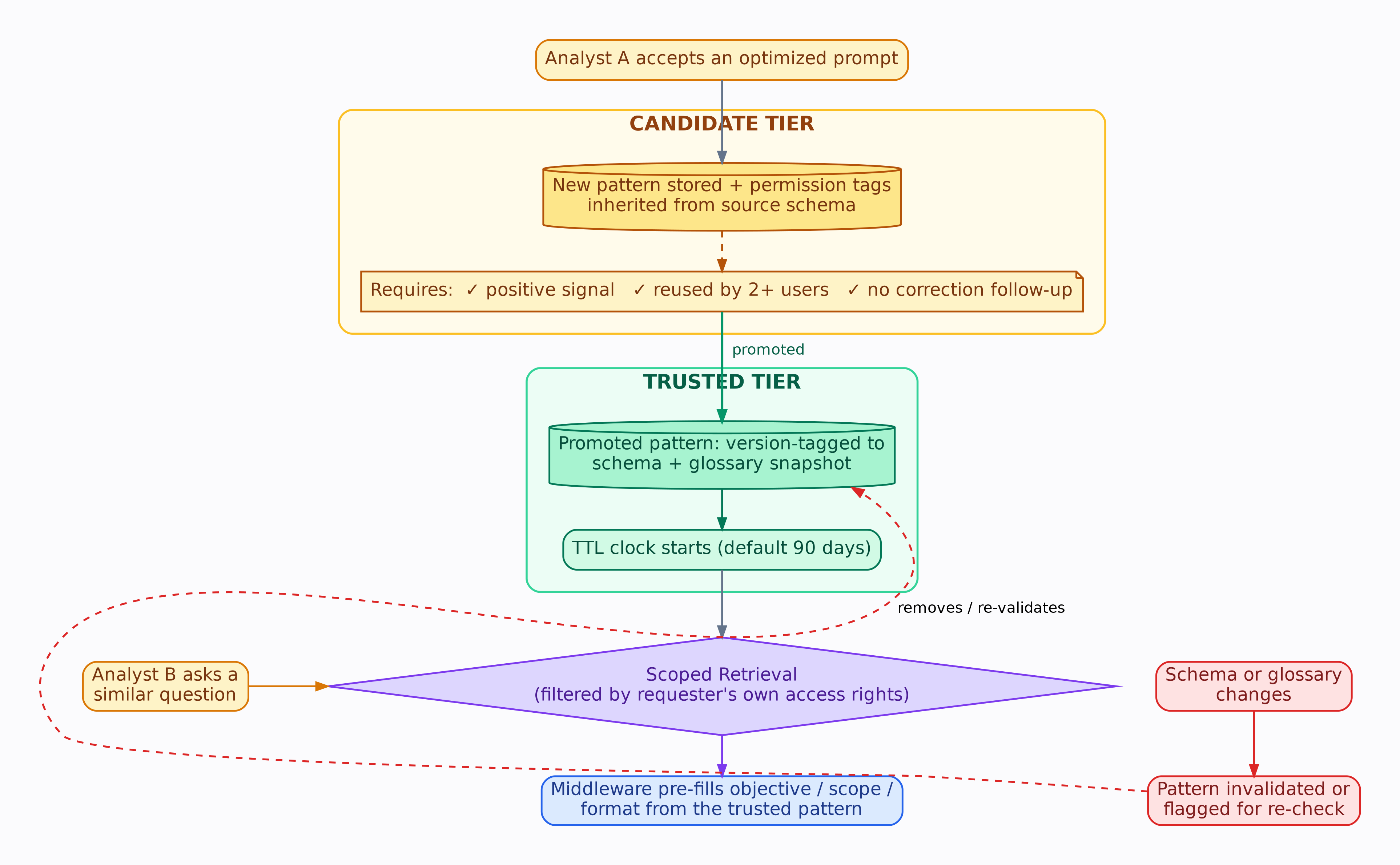
This also answers the obvious objection: what happens on a genuinely new question, with no pattern to draw on? Nothing breaks — the system still has the business glossary, the schema, and a generic template for the type of question being asked (root-cause, comparison, trend, forecast), so a first-of-its-kind question still gets meaningfully cleaned up. It just doesn't get the extra head start that a repeat question gets once a pattern exists. Cold or warm, the request ends up in the same place; only the source of the structure differs.
Where This Breaks Down
None of this is free, and it's worth being upfront about the costs. There's a small amount of added latency from the cleanup step itself — for most analytics workloads that's a fair trade, but it's a real one, and it's not the right call for anything latency-sensitive. There's also a real risk of over-simplifying a question: an aggressive cleanup pass can strip out something the analyst actually meant, which is why the rewritten prompt should always be visible and editable before it's sent, not applied silently. And the system needs a clear owner — someone reviewing what gets promoted into shared memory, someone keeping the schema and access rules in sync — because a black box that nobody can inspect is worse than the problem it's solving.
Worth noting too: this idea isn't limited to analytics questions. The same pattern — cleaning up an underspecified request before it becomes expensive — shows up in "vibe coding," where a developer describes a data pipeline in plain English and lets a model write it. The failure mode is nearly identical: the model guesses at table names, error handling, and whether a job is safe to re-run, because nobody specified it. A cleanup layer that injects the real schema and fills in the unstated technical spec solves the same problem there that it solves for an analyst's question here.
The core claim is a modest one: most of what AI costs in an analytics team isn't the reasoning; it's the raw material we hand the model before it starts reasoning. Clean that up first, and the model you already have gets meaningfully cheaper and more consistent — no upgrade required.
Further Reading
- Jiang et al., LLMLingua (Microsoft Research, EMNLP 2023) — prompt compression by pruning low-information tokens.
- Lewis et al., Retrieval-Augmented Generation for Knowledge-Intensive NLP Tasks (NeurIPS 2020) — the original RAG paper, the root idea behind grounding a prompt in real schema and glossary data before answering (RAG means the model's answer is grounded in retrieved data rather than pulled from its own training memory).
- Dekoninck et al., A Unified Approach to Routing and Cascading for LLMs — routing simple requests to a cheap model and reserving an expensive one for harder cases.
- AI Automation Essentials, Tuhin Chattopadhyay, DZone Refcard — broader background on AI automation architecture and governance.
Opinions expressed by DZone contributors are their own.
Comments