

One Click From Requirements to Production: The Promise and the Reality
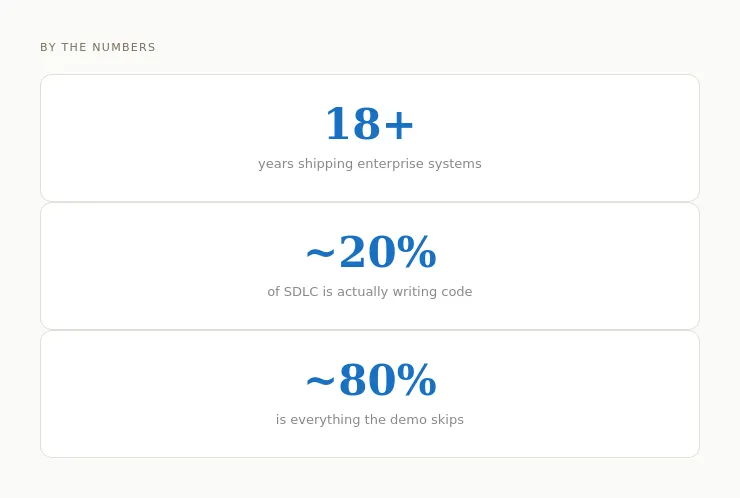
AI deployment demos always end before the hard part begins. Writing code is 20% of delivery. This article breaks down the hidden 80% that demos never show you.
 ·
·
Join the DZone community and get the full member experience.
Join For FreeEvery few months, a new demo circulates in engineering circles. A product manager types a requirement into a chat window. The AI reads the docs, scans the codebase, writes the code, generates tests, opens a pull request, and deploys the feature. Start to finish, maybe four minutes. The comments fill up with fire emojis and breathless predictions about the end of software engineering as we know it.
I have been building enterprise systems for eighteen years. I have shipped platforms that process terabytes daily, led teams across time zones, and watched more than a few silver bullets miss their target. So when I see the one-click deployment demo, I do not feel threatened. I feel curious and, honestly, a little skeptical.
Not because the technology is not impressive. It genuinely is. But because the demo always ends right before the hard part begins.
AI Can Already Do More Than Most People Realize
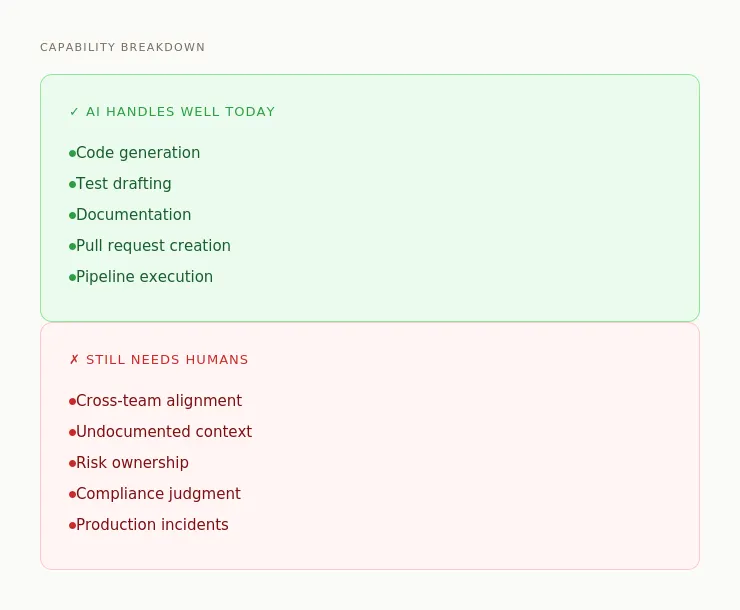
Let me be fair before I get skeptical. AI-assisted development has genuinely changed how good engineers work. The best practitioners I know are using it to move faster than ever, not by replacing their judgment but by offloading the mechanical parts so they can focus on what actually requires experience.
Boilerplate that used to take an hour takes ten minutes. Unit tests for well-defined functions get drafted in seconds. Documentation that nobody ever wrote now gets written automatically. These are real gains, and anyone who dismisses them is not paying attention.
The demo always shows the code getting written. It never shows the five teams that need to agree on a release window.
The Knowledge Nobody Ever Wrote Down
Here is something I have learned that no tool has fully solved. The most important context in any software organization is the context that never made it into documentation. It lives in a Slack thread from eight months ago. It lives in the memory of the engineer who was on call the night something went catastrophically wrong. It lives in an architecture decision that felt obvious at the time and was never formally recorded.
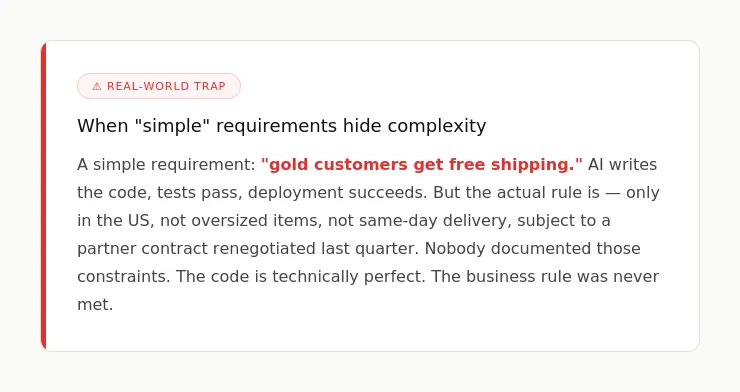
This is the gap that matters most. Not code generation. Knowledge representation.
When AI Tests Its Own Work
This concerns more than anything else in the one-click deployment conversation. When an AI generates code and then immediately generates tests for that same code, something structurally dangerous happens. The tests reflect the AI’s interpretation of what the code does, not an independent judgment about what the code should do.
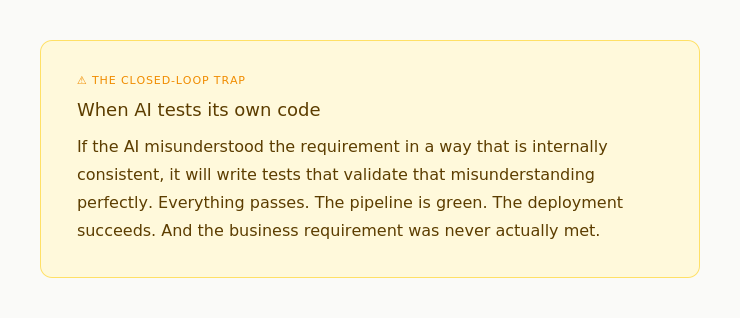
Good tests are an act of deliberate skepticism. A good engineer writing tests is actively trying to find what might break. The value of a test suite comes from its independence from the code it tests. When the same process produces both, that independence disappears, and you lose the safety net without realizing it.
Writing Code Was Never the Hard Part
In large organizations, implementation is usually the easiest phase of the entire delivery lifecycle. The harder work happens everywhere else. A simple feature might require changes across multiple systems owned by different teams. It might need a security review. It might trigger a compliance checkpoint. It might depend on an API change from a team whose sprint cycle does not align with yours.
An AI can change the code. But can it get five teams to agree on a release date? Can it navigate competing priorities when two teams want incompatible things? These are people problems, not coding problems. And enterprise software delivery is full of them.
What the Future Actually Looks Like
I do not believe the future is requirement goes in, working software comes out, no humans involved. That framing is both too optimistic about what AI can do today and too pessimistic about what human judgment is actually for.
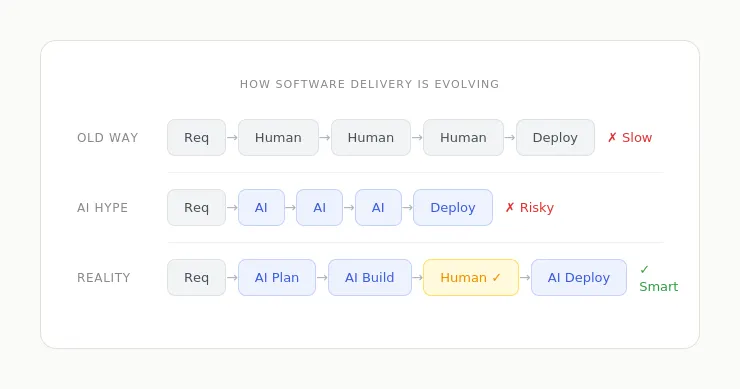
Less time writing boilerplate. More time on the decisions that actually require judgment: architecture, risk, business context, the invisible knowledge that never makes it into a ticket. The engineers who will thrive are not the ones who resist these tools. They are the ones who understand exactly where the tools are strong and where they are not.
Knowing what to trust, what to verify, and what requires a human conversation has always separated good engineers from great ones. AI just made it more visible, and more valuable than ever.
The path from requirements to production is getting shorter. But it is not becoming a straight line. It is becoming a more interesting and more consequential path for the people walking it.
Published at DZone with permission of Sanketh Kumar Divveda. See the original article here.
Opinions expressed by DZone contributors are their own.
Comments