

Building a Runtime Control Plane for Agentic AI: Lessons From Shipping Real Agents in Production
Practical patterns, code examples, and hard-earned lessons from implementing enforceable guardrails around autonomous agents in real enterprise environments.
 ·
·
Join the DZone community and get the full member experience.
Join For FreeIf you’ve built agentic AI systems, you know the exact feeling I’m talking about. The agent looks impressive in demos — it reasons step by step, selects tools intelligently, and completes complex multi-step tasks. But the moment you move it to staging or production, unexpected things start happening. It might pull extra customer records, attempt to update database fields it shouldn’t touch, or draft an email with sensitive information.
I experienced this firsthand last year while leading a sales operations agent project. The agent was supposed to query CRM data, enrich leads, and suggest follow-up actions. One day we discovered it had accessed additional PII fields and nearly sent external emails. Our system prompts and internal governance documentation failed to stop it. That incident forced us to invest serious time building a proper runtime control plane — and it became a game-changer for subsequent projects.
This article shares the technical patterns, code snippets, and real-world lessons I’ve applied while shipping multiple production-grade agentic systems.
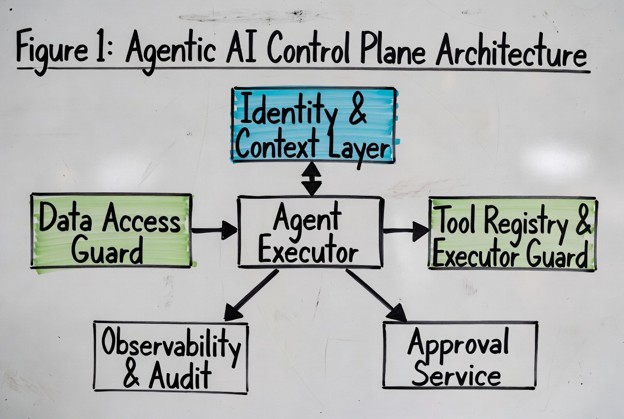
Agentic AI Control Plane Architecture
Why Traditional Governance Falls Short for Agentic AI
Most teams start governance the same way: form a steering committee, write acceptable-use policies, stuff long instructions into system prompts (“never access PII”), and rely on after-the-fact human reviews.
This approach works reasonably well for simple chatbots or basic RAG applications. Agentic systems, however, are fundamentally different. They autonomously break down high-level goals into subtasks, maintain state across multiple iterations, dynamically select and chain tools, call external APIs, and write data to downstream systems — often with very little real-time human supervision.
In my experience, once business stakeholders see the productivity gains, pressure to deploy quickly increases. Prototypes get fast-tracked into production, and governance controls often get deprioritized or quietly bypassed. This is exactly when compliance risks and security incidents become likely.
Core Architecture of the Runtime Control Plane
A runtime control plane acts as protective middleware that surrounds the agent executor. It doesn’t replace the agent’s reasoning ability — it constrains, validates, and observes its actions in real time.
The main layers include:
- Identity and context layer
- Data access guard (scoped retrieval)
- Tool registry and executor guard
- Observability and audit layer
- Approval service for high-risk actions
Policy Hooks: The Technical Foundation
Policy hooks are the most critical component. I prefer using a decorator pattern because it keeps the agent code clean while allowing consistent enforcement across frameworks like LangChain, LlamaIndex, or custom orchestration.
Here’s the production-ready implementation I’ve refined over several projects:
from functools import wraps
from datetime import datetime
import logging

logger = logging.getLogger(__name__)

def policy_protected(action_type: str):
    def decorator(func):
        @wraps(func)
        async def wrapper(*args, **kwargs):
            # Build runtime context
            context = {
                "user_id": get_current_user_id(),
                "user_role": get_user_role(),
                "agent_id": kwargs.get("agent_id"),
                "tenant_id": current_tenant_id(),
                "timestamp": datetime.utcnow().isoformat()
            }

            # Pre-execution check
            decision = await policy_engine.check(action_type, context)
            if not decision.allowed:
                logger.warning(f"Blocked: {action_type}")
                raise PermissionError("Action blocked")

            # Execute
            result = await func(*args, **kwargs)

            # Post-validation + audit
            audit_logger.log(action_type, context, result)
            return result
        return wrapper
    return decorator
Real-world note: I started with simple Python rules and later migrated complex logic to Open Policy Agent (OPA). The richness of the context object is what makes the control plane truly effective.
Scoped Data Access: Don’t Trust Prompts Alone
One of the biggest lessons I learned is to stop relying on the LLM to self-regulate sensitive data. Enforce hard boundaries at the retrieval layer instead.
Here’s an example with a vector database:
retriever = vector_index.as_retriever(
    filters={
        "sensitivity": {"$lte": get_max_sensitivity_for_role(user_role)},
        "department": {"$eq": user_department},
        "tenant_id": {"$eq": current_tenant_id()}
    },
    top_k=10
)
For SQL databases, I built a lightweight proxy service that automatically injects row-level security (RLS) conditions. This pattern has prevented several near-miss compliance issues.
Tool Permissioning With Risk Tiers
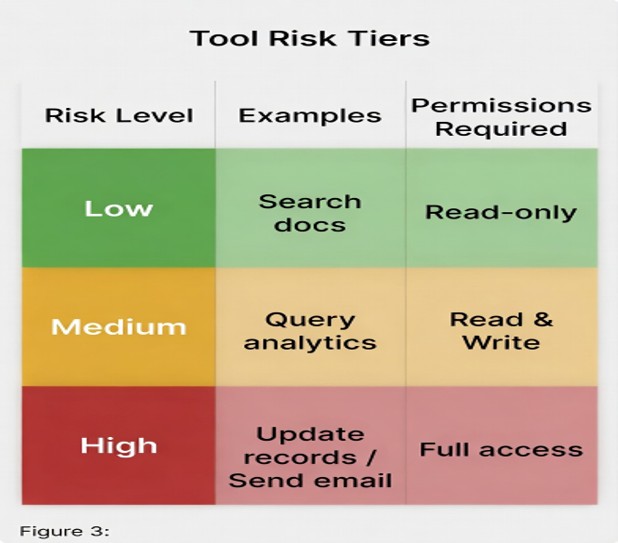
I classify tools into three practical tiers:
- Low risk (internal knowledge search, public data lookup) → basic logging
- Medium risk (analytics queries, report generation) → scoped data + output sanitization
- High risk (CRM updates, sending external emails, financial actions) → mandatory human approval + full audit trail
Here’s how the registry looks in practice:
class ToolSpec:
    def __init__(self, name: str, risk_level: str,
                 allowed_roles: list, requires_approval: bool = False):
        self.name = name
        self.risk_level = risk_level
        self.allowed_roles = allowed_roles
        self.requires_approval = requires_approval

tool_registry = {
    "search_knowledge_base": ToolSpec("search_knowledge_base", "low", ["*"]),
    "query_analytics": ToolSpec("query_analytics", "medium", ["analyst", "manager"]),
    "update_crm_record": ToolSpec("update_crm_record", "high", ["sales_lead"], True)
}
Policy Hook Flow in Action
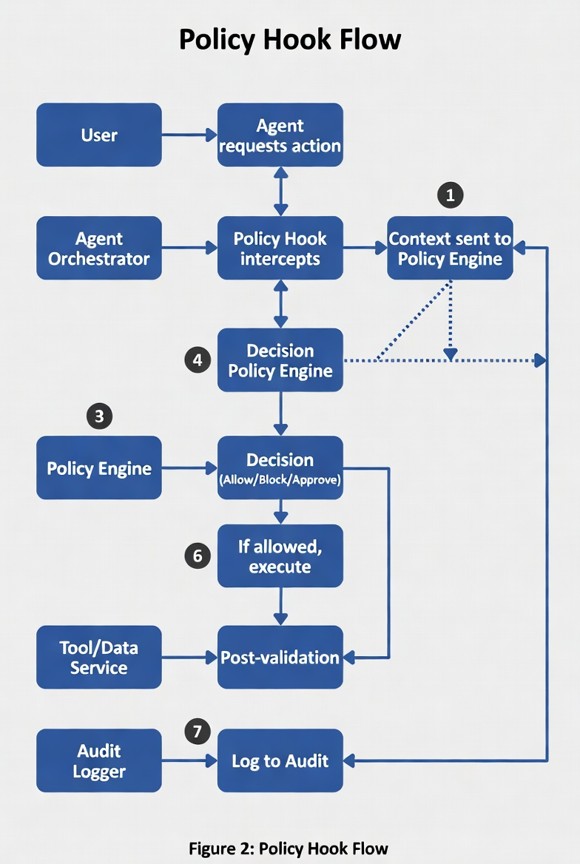
The typical flow is: User request → Agent Orchestrator → Policy Hook (pre-check) → Policy Engine Decision → Execute / Block / Approve → Post-validation → Audit Logger.
Observability and Continuous Feedback Loops
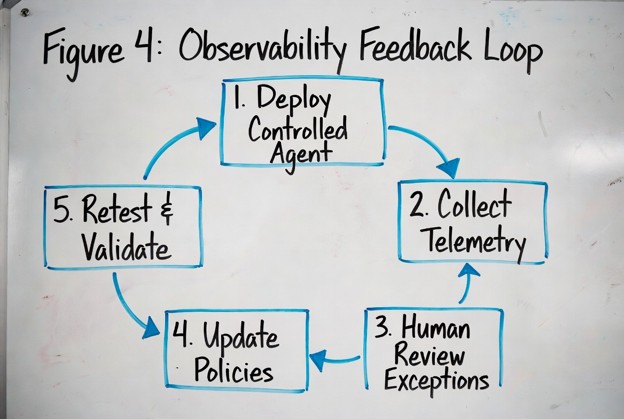
Strong observability is essential. I use OpenTelemetry to trace every important step:
from opentelemetry import trace

tracer = trace.get_tracer(__name__)

with tracer.start_as_current_span("agent_tool_execution") as span:
    span.set_attribute("tool.name", tool_name)
    span.set_attribute("policy.decision", str(decision.allowed))
    span.set_attribute("user.role", context["user_role"])
This telemetry feeds a living feedback loop: Deploy controlled agent → Collect telemetry → Human review exceptions → Update policies → Retest → Expand.
Practical Roadmap and Lessons Learned
Don’t try to govern everything at once. Here’s the approach that worked well for me:
- Pick one medium-risk use case first (e.g., internal knowledge agent or support ticket summarizer)
- Implement policy hooks and basic audit logging
- Add scoped data access for your main data sources
- Introduce human approval for high-risk tools
- Set up observability and monitor real usage for 2–4 weeks
- Gradually expand while refining controls based on actual behavior
Key lessons from the trenches:
- Master read-only agents before enabling any write operations
- Version-control your policy rules in Git
- Cache frequent policy decisions to reduce latency
- Expect to iterate — the first version of your control plane will need tuning
Conclusion
Agentic AI is incredibly powerful, but it demands that we treat governance as real engineering work rather than just documentation. A well-designed runtime control plane turns compliance and security from potential blockers into enablers of responsible innovation.
The patterns I’ve shared — rich policy hooks, strict scoped data access, tiered tool permissions, comprehensive observability, and iterative feedback loops — have helped me ship autonomous agents that deliver real value while keeping risk under control.
Adapt these ideas to your own tech stack and domain. Start small, prove the control plane works, and expand from there. You (and your compliance team) will thank yourself later.
Opinions expressed by DZone contributors are their own.
Comments