

Designing Scalable Containerized Backend Services
Learn to build high-concurrency relational microservices using Python and Docker, focusing on async connection pooling and state management.
Join the DZone community and get the full member experience.
Join For FreeModern enterprise software design has fundamentally shifted away from monolithic, single-threaded runtimes toward decoupled, containerized architectures. When building systems that handle high throughput — such as fintech services, automated reporting pipelines, or real-time distributed platforms — engineers must address two core infrastructure vectors: high-concurrency connection management and deterministic relational state execution.
A common anti-pattern in backend systems engineering is assuming that containerization automatically scales an application. In reality, wrapping a poorly optimized, blocking database service inside a Docker container simply shifts the performance bottleneck from local computing hardware to network sockets and thread pools.
This technical guide breaks down the implementation of a decoupled, high-concurrency microservice engine built on an asynchronous Python core, using localized relational persistence layer mechanics, automated connection pooling, and multi-tier containerized deployment.
The Concurrency Bottleneck in State Management
In traditional synchronous web gateways, each incoming network transaction is mapped directly to an operating system (OS) thread. If an application needs to process a complex relational query, generate a structural file, or compute algorithmic abstractions, that thread remains blocked until the underlying process returns a code sequence.
Under heavy enterprise concurrency patterns, thread starvation occurs. The OS spends more execution cycles executing thread context switches than processing actual transaction payloads.
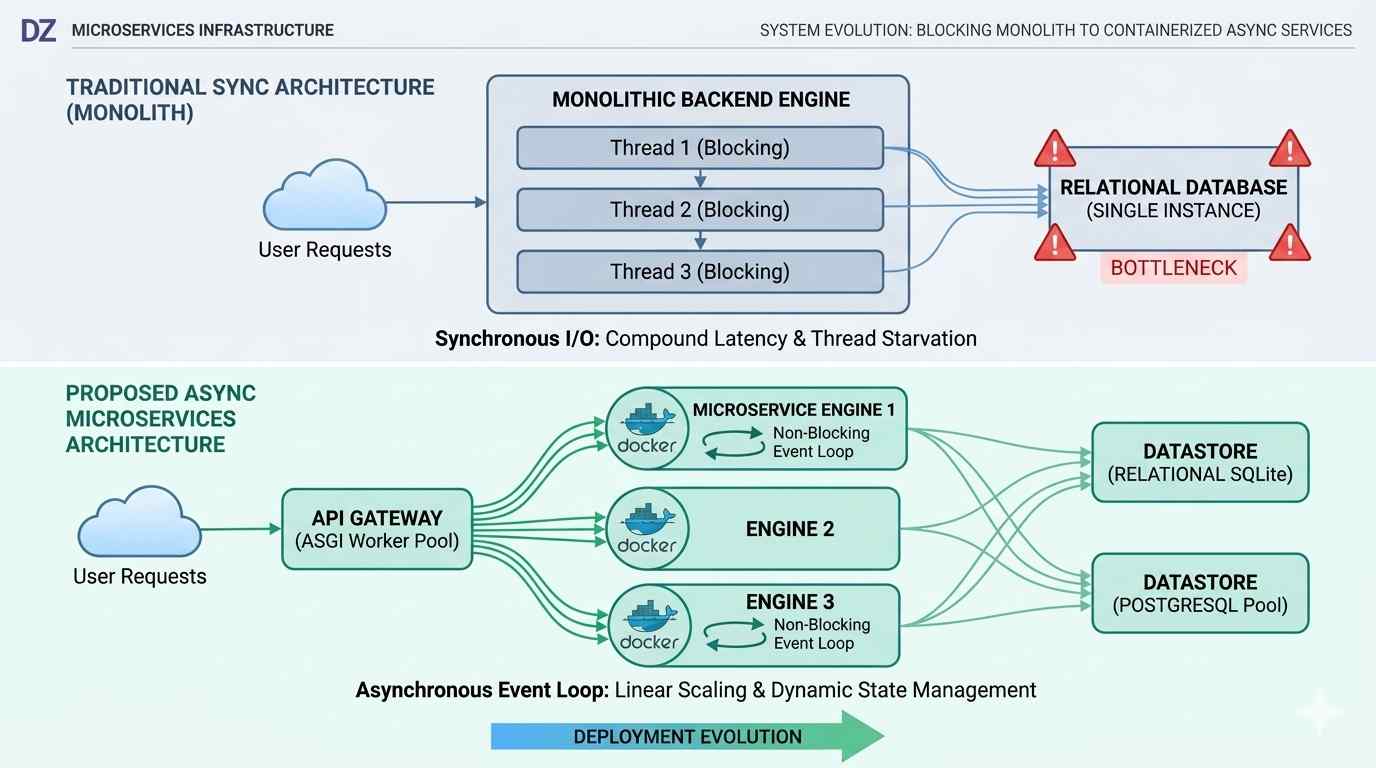
[Blocking Monolith] ───► Thread 1 ───► [DB Read / Long IO Block] ───► (Thread Starvation)

[Asynchronous ASGI] ───► Async Worker ───► Loop Delegation ───► (Thread Free to Serve Next Connection)
To achieve true horizontal scaling within a decoupled microservices architecture, we must exploit non-blocking Asynchronous Server Gateway Interface (ASGI) frameworks combined with explicit, non-blocking asynchronous drivers for relational storage layers. This structural change ensures that database connection limits do not become a systemic point of failure.
Architectural Blueprint: The Asynchronous Core Engine
The following implementation showcases an advanced, high-performance transactional microservice core engine. The software structure uses asynchronous runtime loops to manage localized transactional persistence dynamically without blocking the main worker loop.
import asyncio
import logging
import uuid
from typing import AsyncGenerator
from pydantic import BaseModel, Field
from contextlib import asynccontextmanager

# Setup structured system tracking logs
logging.basicConfig(level=logging.INFO, format="[%(asctime)s] %(levelname)s: %(message)s")
logger = logging.getLogger("MicroserviceCore")

# Define strict, type-validated data transmission contracts
class FinancialPayload(BaseModel):
    transaction_id: str = Field(default_factory=lambda: str(uuid.uuid4()))
    account_source: str
    amount_tokens: float = Field(gt=0.0)
    system_metadata: dict = Field(default_factory=dict)

class ServiceInfrastructureEngine:
    """
    Manages isolated transactional operations, simulating high-performance
    relational database pool connections under non-blocking event loops.
    """
    def __init__(self, database_connection_string: str, max_pool_size: int = 20):
        self.connection_string = database_connection_string
        self.max_pool_size = max_pool_size
        self._execution_semaphore = asyncio.Semaphore(max_pool_size)

    async def initialize_state_store(self) -> None:
        """Simulates automated schema migration and table validation."""
        logger.info(f"Connecting to data storage system: {self.connection_string}")
        await asyncio.sleep(0.5)  # Simulate non-blocking I/O connection handshake
        logger.info("Relational schemas and operational metadata verified successfully.")

    @asynccontextmanager
    async def acquire_pooled_session(self) -> AsyncGenerator[str, None]:
        """Context manager enforcing connection pooling constraints asynchronously."""
        await self._execution_semaphore.acquire()
        session_id = f"DB_SESSION_{uuid.uuid4().hex[:8].upper()}"
        try:
            yield session_id
        finally:
            self._execution_semaphore.release()

    async def execute_isolated_transaction(self, payload: FinancialPayload) -> bool:
        """Executes a strict transaction block simulating multi-stage persistence loops."""
        async with self.acquire_pooled_session() as session:
            logger.info(f"[{session}] Opening isolated database transaction context for ID: {payload.transaction_id}")

            # Simulate a continuous analytical lookup pattern or sub-query sequence
            await asyncio.sleep(0.2)

            # Verify pseudo ledger balances
            if payload.amount_tokens > 50000.0:
                logger.warning(f"[{session}] Risk flags raised. Transaction {payload.transaction_id} requires multi-signature validation.")
                return False

            await asyncio.sleep(0.1) # Simulate final commit state save
            logger.info(f"[{session}] Transaction successfully written and finalized in relational engine.")
            return True

# Entry point simulation for a highly distributed parallel transaction load
async def main():
    # Instantiating our microservice engine layer
    infra_engine = ServiceInfrastructureEngine(database_connection_string="sqlite+aiosqlite:///production_ledger.db")
    await infra_engine.initialize_state_store()

    # Generate an explicit array of simultaneous simulated client event payloads
    mock_requests = [
        FinancialPayload(account_source=f"ACC_USR_{i:03d}", amount_tokens=150.0 * i)
        for i in range(1, 15)
    ]

    # Map requests into non-blocking concurrent tasks
    execution_tasks = [infra_engine.execute_isolated_transaction(req) for req in mock_requests]

    # Execute all database loops concurrently across the async thread gateway
    results = await asyncio.gather(*execution_tasks)
    logger.info(f"Engine batch processing sequence finished. Successful operations: {results.count(True)}/{len(results)}")

if __name__ == "__main__":
    asyncio.run(main())
Containerization Strategy: Engineering Production Docker Environments
To guarantee predictable horizontal execution layers across hybrid cloud network topologies, we deploy the engine utilizing highly optimized multi-stage containerization blueprints.
A common operational failure is building bulky production images that include build tools (compilers, development headers, package managers) in the final image. This significantly expands the system's attack surface and increases cold-start image download latency over orchestrated node servers.
Below is the optimized, multi-stage Dockerfile blueprint designed to ensure image portability and minimal security overhead:
# Stage 1: The Build/Compilation Environment
FROM python:3.11-slim AS build-compiler
WORKDIR /app

RUN apt-get update && apt-get install -y --no-install-recommends \    build-essential \    libpq-dev \    && rm -rf /var/lib/apt/lists/*

COPY requirements.txt .

# Compile and dump dependencies natively into a local virtual deployment tree
RUN python -m venv /opt/venv
ENV PATH="/opt/venv/bin:$PATH"
RUN pip install --no-cache-dir -r requirements.txt

# Stage 2: The Final Operational Secure Runtime
FROM python:3.11-slim AS runtime-layer
WORKDIR /app

# Install localized system runtime libraries required by standard database interfaces
RUN apt-get update && apt-get install -y --no-install-recommends \    libpq5 \    && rm -rf /var/lib/apt/lists/*

# Pull exclusively compiled executable components from the isolated build stack
COPY --from=build-compiler /opt/venv /opt/venv
COPY . .

# Set immutable system paths and configuration markers
ENV PATH="/opt/venv/bin:$PATH"
ENV PYTHONUNBUFFERED=1
ENV ENVIRONMENT=production
EXPOSE 8000

# Enforce secure operational constraints by bypassing root execution privileges
USER 1001

CMD ["python", "main.py"]
Key Takeaways for Production Systems
- Explicit resource bound manipulation: As seen in the asynchronous script implementation, utilizing
asyncio.Semaphoreallows developers to hard-code a strict ceiling over concurrent processing paths, mitigating database exhaustion errors. - Deterministic data contracts: Leveraging schema wrappers (like Pydantic or native object-relational models) ensures invalid or corrupted objects fail at the interface boundary before hitting core internal relational storage pipelines.
- Multi-stage build standards: Decoupling the development environment from the final execution layer results in production-ready, low-footprint containers, making the backend infinitely more resilient and ready for automated container management layers.
Building enterprise-grade web backends requires careful alignment between non-blocking application loops and resource constraints. By implementing asynchronous architectures and optimized container multi-staging, software engineers can design resilient systems capable of sustaining high-throughput data pipelines efficiently.
Opinions expressed by DZone contributors are their own.
Comments