

Evolving Spring Boot APIs to an Event-Driven Mesh
Learn to transform Spring Boot REST APIs into an event-driven architecture by utilizing Kafka, RabbitMQ, or NATS to enhance scalability, resilience, and responsiveness.
 ·
·
Join the DZone community and get the full member experience.
Join For FreeOverview
As modern applications require greater scalability, resilience, and responsiveness, traditional REST-based architectures are hitting their limits. This article looks into how Spring Boot developers can upgrade their APIs from synchronous REST calls to asynchronous, event-driven communication through an event mesh that utilizes technologies like Kafka, RabbitMQ, or NATS.
It emphasizes important architectural differences, design patterns for decoupling services, and practical implementation strategies in Spring Boot. Readers will discover how to integrate event streams, manage eventual consistency, and achieve real-time responsiveness while ensuring observability and fault tolerance. The article also covers trade-offs, performance improvements, and best practices for moving enterprise APIs towards event-driven systems.
This article provides a practical guide for transforming Spring Boot services from synchronous REST to an event-driven architecture using an event mesh. It explains the reasons for this transition by highlighting the limitations of REST in terms of scaling and resilience — such as latency chains, tight runtime coupling, and failure propagation—and compares these issues with the benefits of the mesh’s asynchronous pub/sub structure that can handle bursts, separates producers from consumers, and enables real-time experiences.
Utilizing Java 21, Spring Boot 3, Gradle, and Kafka for clarity (with additional notes for RabbitMQ and NATS), the article outlines a working example: a REST endpoint that sends out OrderCreated events; independent consumers (Payment, Notification) that respond idempotently; retries and dead-letter topics that manage failures; and Micrometer/OpenTelemetry that offer tracing across producer/consumer boundaries.
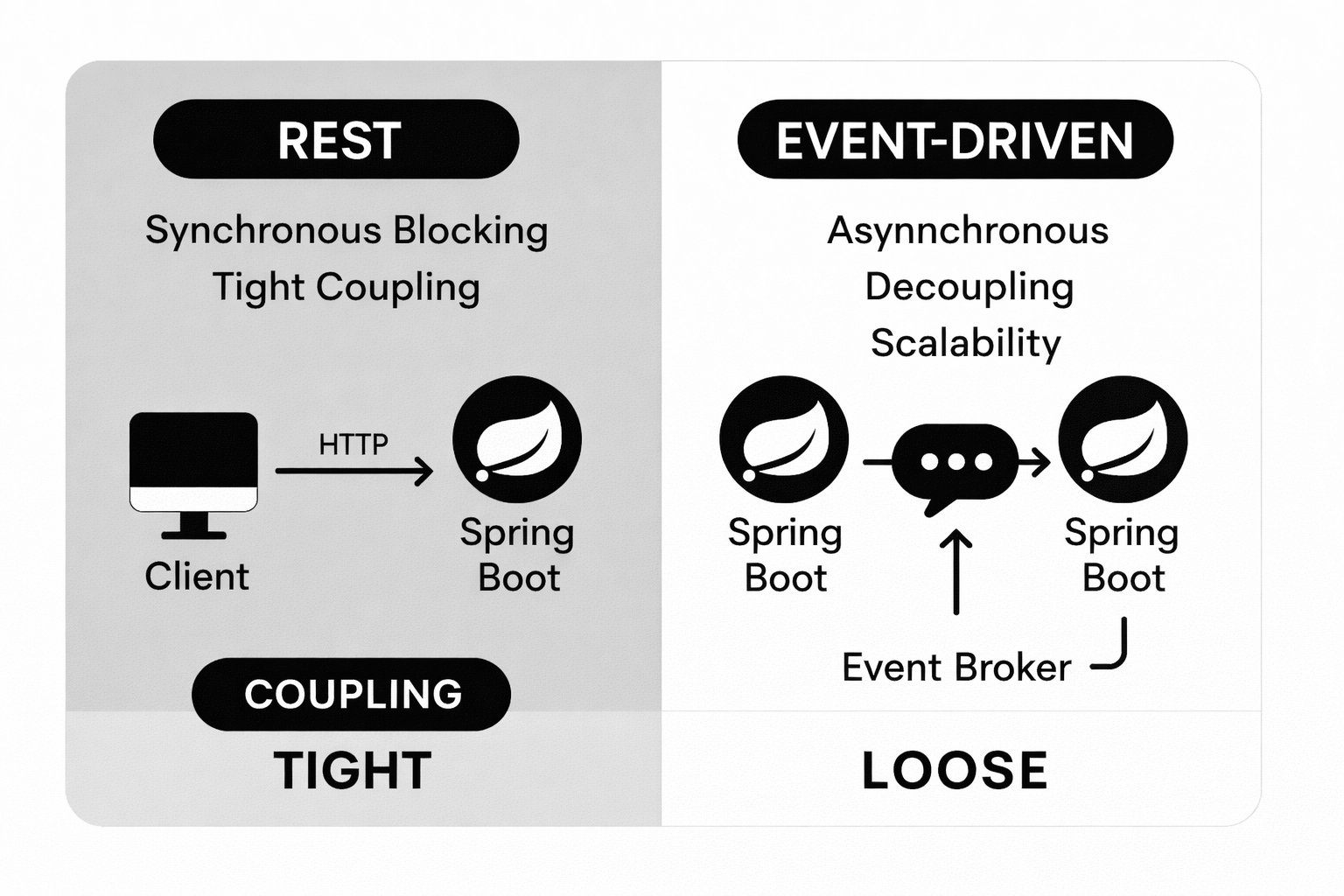
It covers schema governance (transitioning from JSON to Avro/Protobuf with a registry), choices regarding partitioning and ordering, and the trade-offs involved with exactly-once semantics. A migration playbook (starting with publish-first, using the strangle pattern, reinforcing with DLT/metrics, and then scaling while phasing out fan-out REST calls) allows for gradual adoption without needing a complete rewrite. Docker/Tescontainers snippets facilitate local execution and testing.
The outcome is a practical guide for modernizing APIs: maintain REST where it is suitable, emit domain events as the core integration mechanism, and develop a governed, observable event mesh to enhance scalability, resilience, and responsiveness.
Introduction: Moving Beyond REST
REST is straightforward, widely used, and excellent for handling request/response interactions. However, as systems grow, synchronous connections can create issues:
- Latency chains (a single slow dependency can delay the entire request)
- Tight runtime coupling (all services need to be operational at the same time)
- Sudden spikes in load and cascading failures
Event-driven architectures (EDAs) and event meshes help separate producers from consumers and promote asynchronous, streaming communication, which enhances scalability, resilience, and real-time user experience.
This article will demonstrate how to transform a Spring Boot service from REST to an event-driven model using an event mesh (with a Kafka demo; notes on RabbitMQ/NATS are also included). We will discuss design patterns, schema/versioning, retries/idempotency, observability, and tips for migration, along with runnable code.
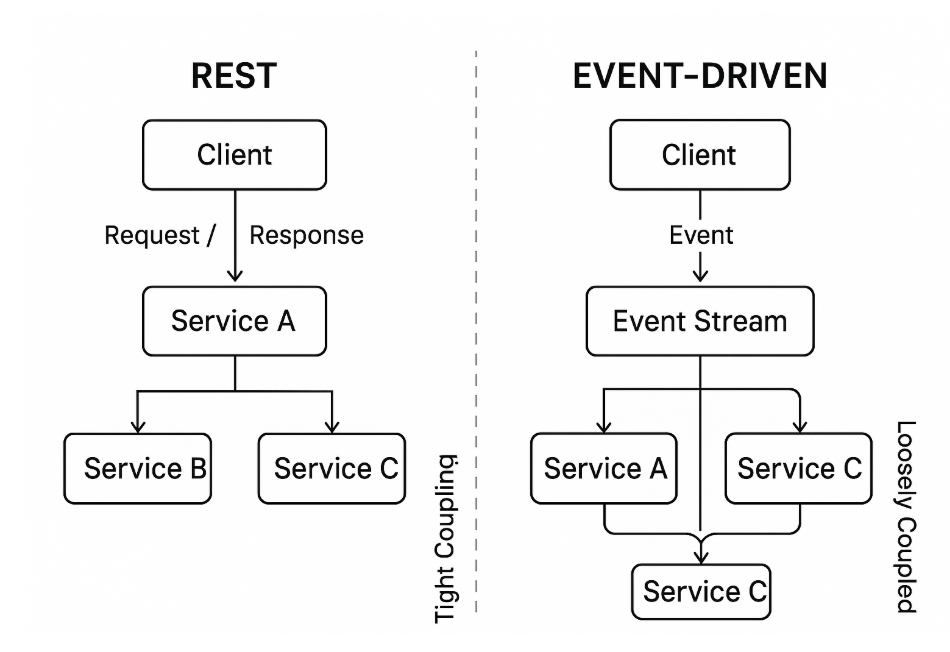
What Is an Event Mesh?
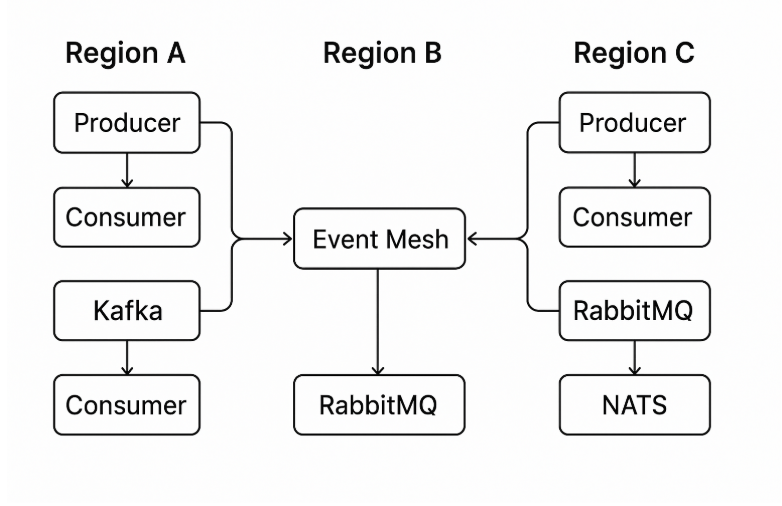
An event mesh is a distributed system that links event producers and consumers across different services, regions, and runtimes. Rather than depending on fixed endpoints, an event mesh routes events dynamically using topics, subjects, or keys, which enables services to communicate without being tightly connected.
An event mesh offers:
- Smart routing across boundaries (topics/subjects, not URLs)
- Horizontal scalability with built-in buffering for handling traffic spikes
- Pub/sub and stream processing that separates producers from consumers
- Global reach, allowing events to move across clusters, clouds, and geographical areas
How it differs from a single broker:
A traditional broker is usually local — limited to one cluster, one region, one namespace. An event mesh covers multiple brokers or clusters, providing unified discovery, routing, replication, and governance. You can think of it as a global data bus instead of just a single local queue or topic.
Event-Driven APIs in Spring Boot
Spring Boot offers excellent support for creating event-driven APIs:
- Kafka: using spring-kafka for producers, consumers, and listener containers
- RabbitMQ: utilizing spring-amqp with RabbitTemplate and @RabbitListener
- NATS: through community starters or the official io.nats:jnats client
Example flow:
- OrderService manages a REST POST and publishes an OrderCreated event.
- PaymentService takes in the event and processes payments in an asynchronous manner.
- NotificationService listens for the same event to send out emails or alerts.
REST and events work well together — your HTTP endpoint can give an immediate response while the more complex tasks are handled asynchronously in the background.
Advantages: Why Transition From REST to Events?
Switching from REST to an event-driven architecture significantly enhances system performance during high loads and failures. REST relies on synchronous, direct communication, which can lead to bottlenecks and tight interdependencies.
In contrast, events facilitate asynchronous flow control, enabling services to scale independently and manage traffic surges through queues and streams. Failures are no longer interconnected — if a consumer is slow or offline, messages can be safely stored with retry and backoff strategies. This architecture also supports real-time functionalities: as soon as an event happens, downstream systems, analytics processes, and user interfaces get updates instantly. In summary, events foster a more efficient, responsive, and robust ecosystem that adapts smoothly to business needs.
- Scalability and performance: Asynchronous buffering, horizontal consumers, built-in back-pressure.
- Resilience: Loose coupling; failures are contained; retries, DLQ, and parked messages enhance stability.
- Real-time delivery: Send updates to clients through WebSockets/SSE, directly powered by event streams.
Key Points of Implementation (Code)
We will utilize a single Spring Boot application to demonstrate the main patterns from start to finish:
REST → Event:
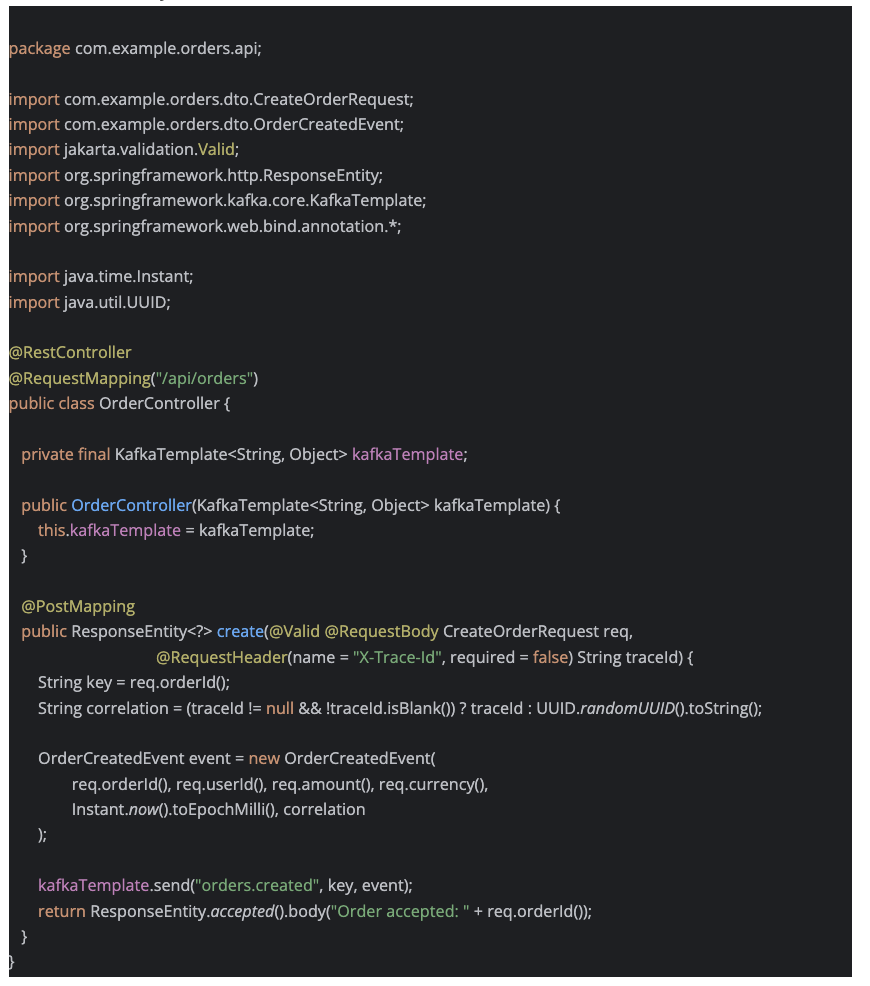
- A straightforward POST /orders endpoint checks the input, saves the order, and sends an OrderCreated event to Kafka using KafkaTemplate.
Kafka listeners (Payment and notification):
- Two logical consumers (like PaymentListener and NotificationListener) listen to the order-created topic and respond asynchronously — charging the customer, updating the status, sending emails, and more.
Reliability: Retries, DLT, idempotency, tracing:
- Spring Kafka error handlers for retries and dead-letter topics (DLT)
- Idempotent consumers using a processed-event table or business keys
- Tracing through trace IDs in headers and Spring Observability / OTEL
RabbitMQ/NATS notes:
- The same process can be carried out with RabbitMQ (using spring-amqp, exchanges, and DLX for dead letters) or NATS/JetStream (subjects plus durable consumers) by changing the messaging layer while maintaining the same domain events and handler structure.
Project Setup (Gradle, Java 21)
settings.gradle
rootProject.name = "orders-event-mesh"

build.gradle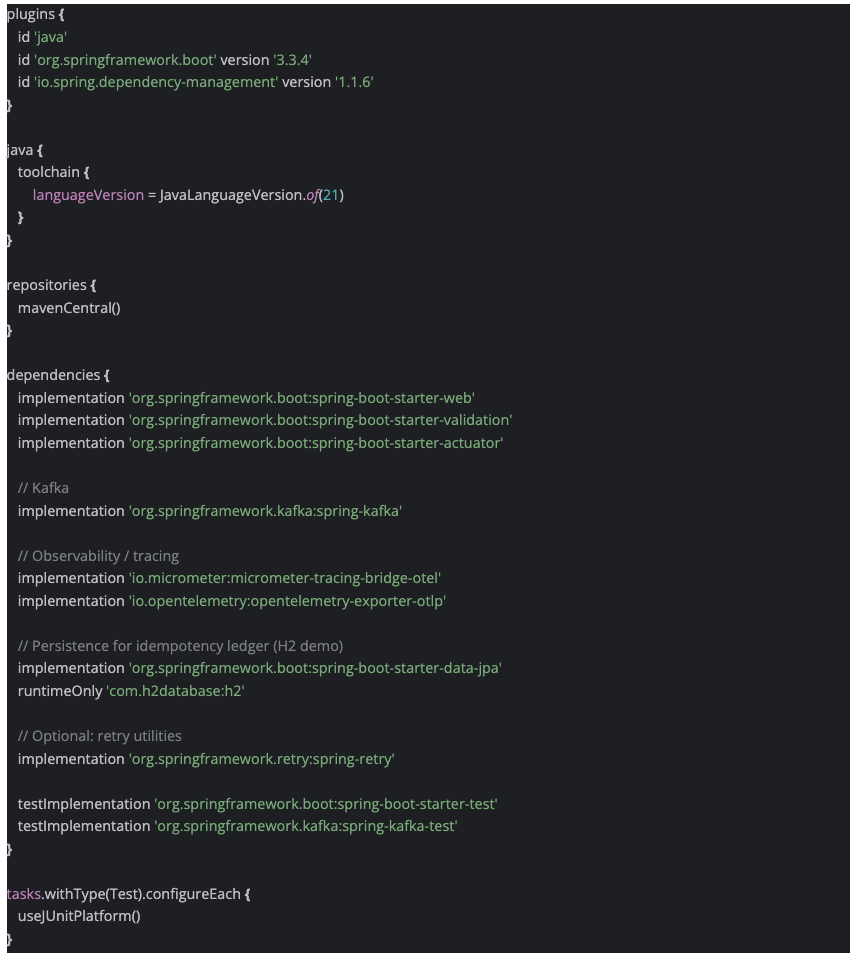
RabbitMQ note: Replace spring.kafka.* with spring.rabbitmq.* and use spring-boot-starter-amqp plus @RabbitListener/RabbitTemplate.
NATS note: Use io.nats:jnats, configure a Connection bean, and publish/subscribe with subjects. Spring wrappers are community-provided.
REST → Event Producer
OrderController.java
PaymentListener.java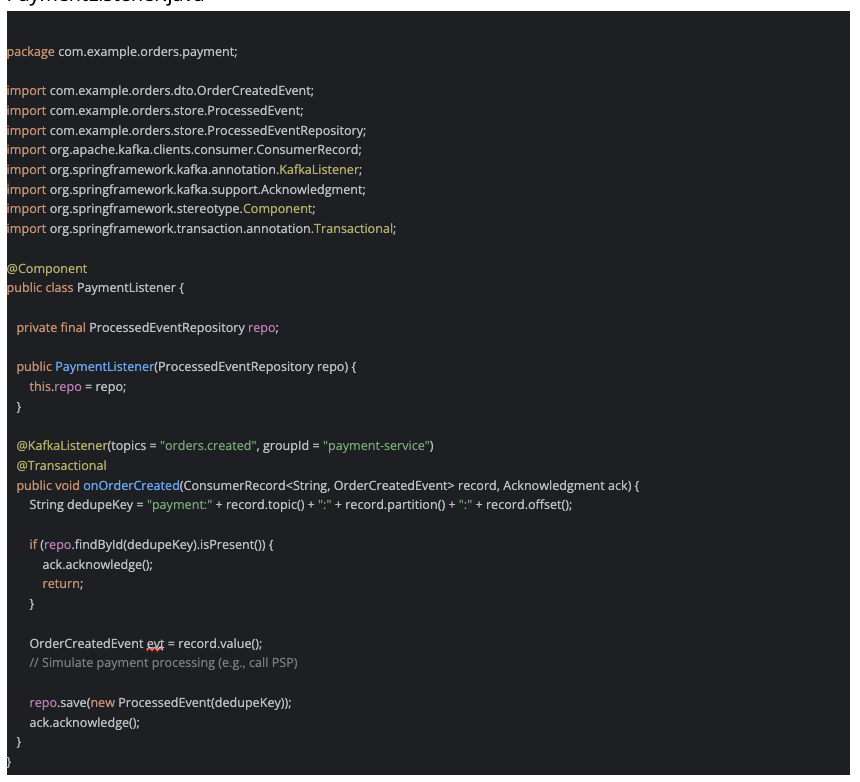
NotificationListener.java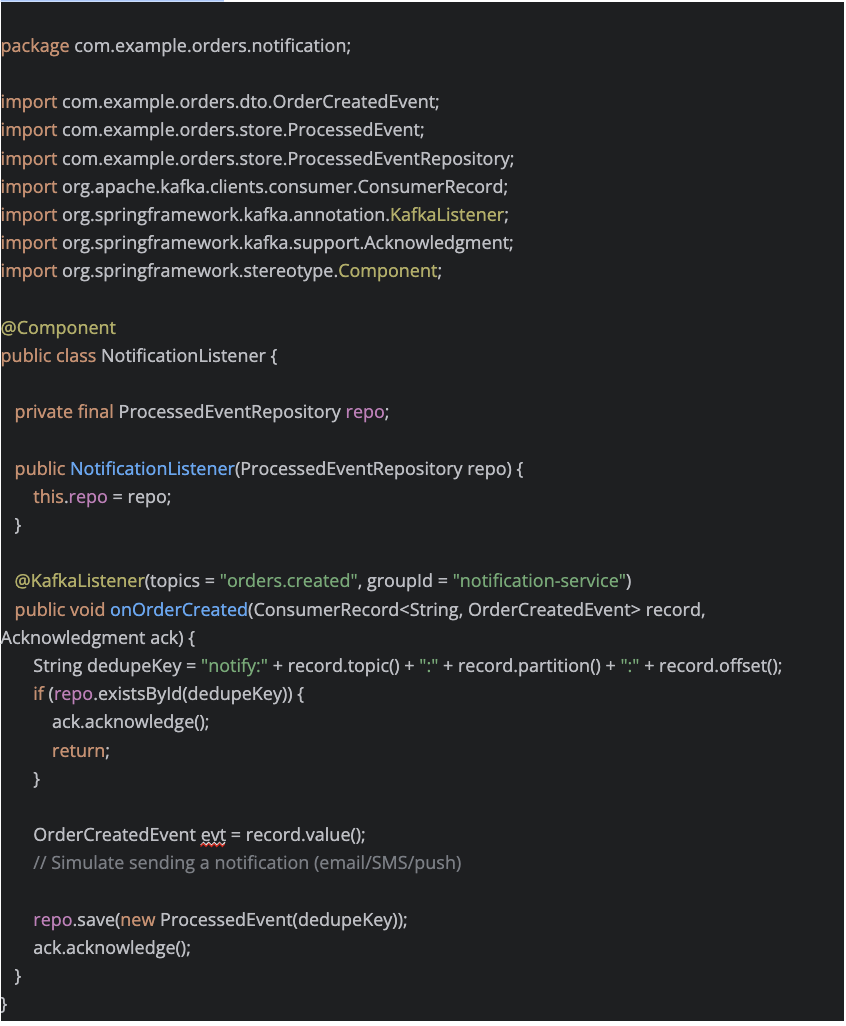
Local Run (Kafka)
Use Docker for Kafka (or Testcontainers in tests).
Run:
docker compose up -d

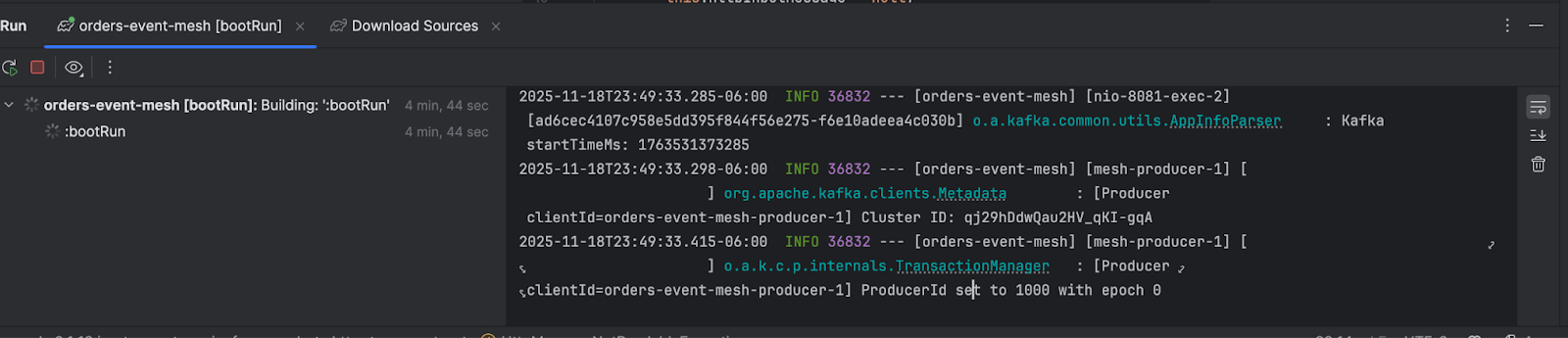
./gradlew bootRun
Test the flow:
curl -X POST http://localhost:8080/api/orders \
  -H "Content-Type: application/json" \
  -d '{"orderId":"o-123","userId":"u-9","amount":42.35,"currency":"USD"}'
You should see consumer logs for payment/notification. Check DLT behavior by throwing a controlled exception in a listener.

Key Takeaways
- REST alone restricts scalability and resilience: REST is effective for straightforward request/response interactions, but synchronous calls introduce latency, create tight runtime dependencies, and cause cascading failures under high load. As applications grow, REST can become a limiting factor since every service needs to reply instantly, which results in slowdowns and instability during peak times or outages.
- Event mesh enables distributed and decoupled communication: An event mesh directs events between services, regions, and clusters by utilizing topics rather than fixed endpoints. It offers a worldwide pub/sub framework that can handle spikes, scale horizontally, and separate producers from consumers, allowing for robust, location-independent, real-time communication that goes beyond just one broker or local queue.
- REST and events can work together: Embrace a publish-first approach; you don’t have to completely rewrite modern Spring Boot systems. You can maintain your current REST endpoints while also publishing domain events for important processes (like OrderCreated). This way, consumers can handle tasks asynchronously. It helps to lessen REST fan-out, boosts responsiveness, and allows for gradual migration using the Strangler pattern, all without causing issues for current clients.
- Reliability needs idempotency, retries, and DLT: Event delivery happens at least once, which means consumers have to manage duplicates carefully. Systems that are ready for production require idempotent operations, backoff retries, dead-letter topics/queues (DLT), and tracing to see failures. These features help avoid duplicate charges, inconsistent states, and lost messages when there are outages or errors in consumer processing.
- Schema evolution and observability support scalability: To scale events effectively, you need solid governance, not just messaging middleware. Schema registries like Avro and Protobuf ensure backward compatibility, while OpenTelemetry monitors asynchronous flows between services. Partitioning strategies help maintain order when necessary and allow for horizontal scaling, which makes event systems easier to manage, track, and secure for business expansion.
Conclusion
Transitioning from synchronous REST to an event mesh brings major benefits in scalability, resilience, and real-time responsiveness. With tools like Spring Boot and message brokers such as Kafka, RabbitMQ, or NATS, teams can publish domain events from their current REST workflows, handle tasks asynchronously with idempotency and retries, and ensure strong observability through tracing and metrics. Schema registries help ensure safe evolution as services develop. Implement the model gradually, track the performance and user experience enhancements, and grow the event mesh as your platform and organization mature.
References
GitHub Codebase: https://github.com/lavi2088/orders-event-mesh
Opinions expressed by DZone contributors are their own.
Comments