

Don't Adopt Anything Announced at re:Invent for 90 Days
An architect's five-gate filter for the annual AWS firehose, plus the short list of exceptions where waiting costs you more than moving.
 CORE
·
If you built an agent on AWS in 2024, there's a decent chance you built it on Bedrock Agents. It was the obvious choice. Managed, native, announced with a keynote and a dozen launch-week blog posts. Then, on June 30, 2026, AWS gave it a new name: Bedrock Agents Classic. New customers were cut off on July 30. The recommended path forward is AgentCore.
Nothing broke. Nothing paged. Existing agents kept answering questions the next morning. That's the part that should worry you. "Classic" is the quietest word in cloud computing, and it means the roadmap has moved somewhere you aren't.
re:Invent 2026 runs November 30 to December 4 in Las Vegas. Within a week, your Slack will fill with "should we be using this?" threads. My answer, for almost everything: not yet. Put it on a 90-day clock, run it through five gates, and make the decision in March with real information instead of in December with keynote adrenaline.
Here's the filter, the math behind the 90 days, and the exceptions where I'd move on day one.
The Firehose Is the Product
Start with the volume. The AWS community re:Cap for re:Invent 2025 counted 530 updates across the event window. Only 116 of them landed during conference week. The other 414 shipped before the first keynote, starting in late October (AWS re:Cap 2025).
That's roughly 78% of the year's biggest launch wave arriving before anyone in Vegas has picked up a badge. Nobody reads 530 announcements. Not you, not your platform team, not the AWS account team. What actually happens is that two or three announcements get picked up by whoever happened to be in the room, and they show up as tickets in January with no scoring, no exit plan, and a senior engineer who is already emotionally invested.
Your inbox isn't the problem. Your adoption reflex is.
An Announcement Is the Start of a Lifecycle, Not a Product
The thing announced on stage and the thing you'll run in production a year later are often different products. Same name, different price, different regions, different API surface. AgentCore is the cleanest recent example because the whole arc happened in public.
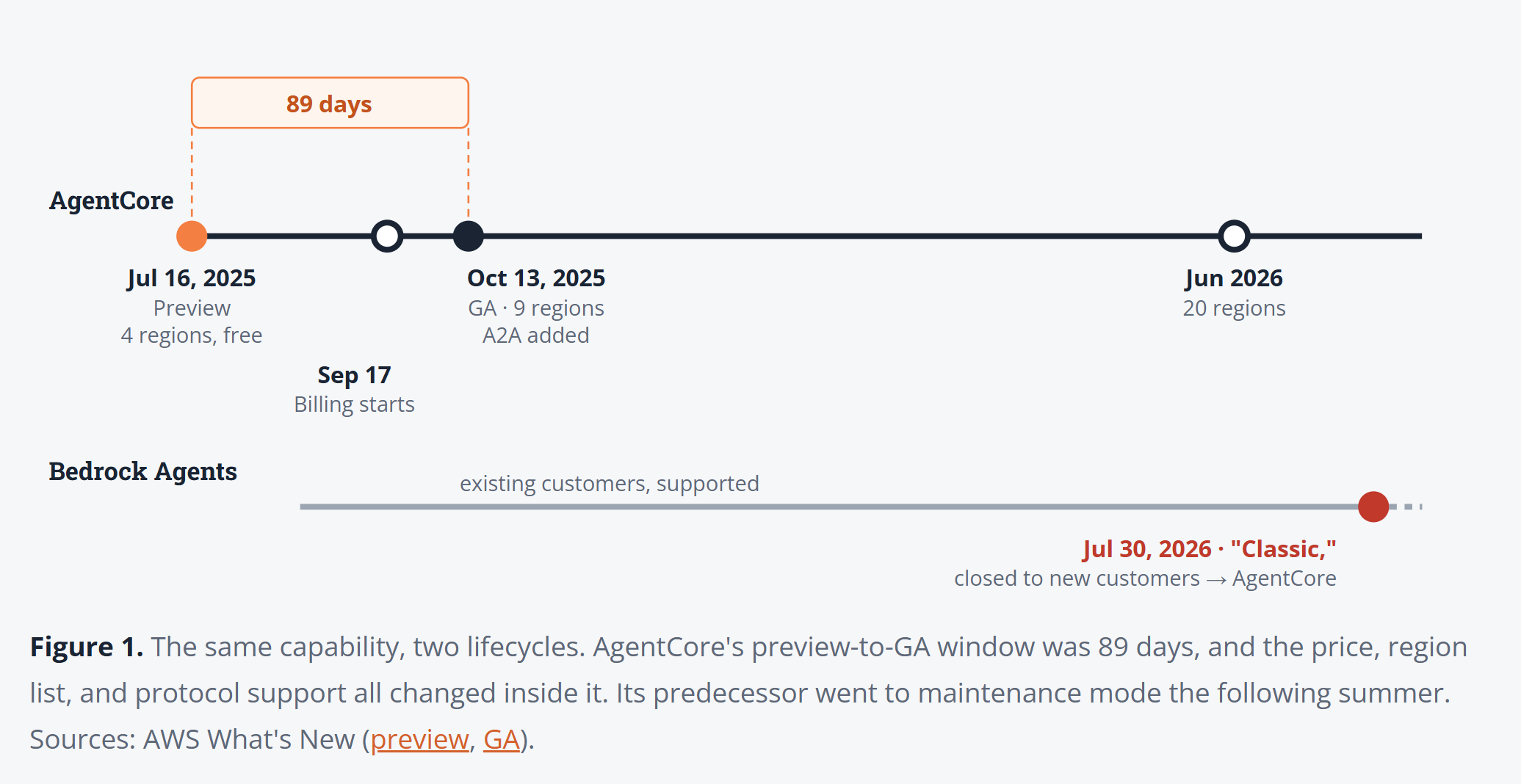
Look at what moved in those 89 days. The preview launched in four regions and was free until September 16. Billing started on September 17. GA arrived on October 13 in nine regions, and it shipped Agent-to-Agent protocol support that the preview didn't have. By June 2026, the region list was at 20.
A team that committed in July was committing to a moving target. Nothing wrong with the product. The problem is that "adopt" in July meant making architecture decisions against a price sheet that didn't exist yet, in a region that might not have been on the list.
And lifecycles run in both directions. Here are four worth keeping on a sticky note.
Table 1. Four AWS lifecycles that early adopters lived through
| Service | What happened | Lesson for early adopters |
|---|---|---|
| Bedrock AgentCore | Preview Jul 16, 2025 → GA Oct 13, 2025 | Pricing, regions, and protocol support all changed during the window. The GA product is the one you should evaluate. |
| Bedrock Agents | Renamed "Classic," closed to new customers Jul 30, 2026; successor is AgentCore | A launch-week favorite can become the legacy option inside about two years. Your migration clock starts when the successor ships, not when the banner appears. |
| CodeCommit | Closed to new customers in mid-2024; returned to GA on Nov 24, 2025 | Teams that panic-migrated paid for a move that later turned out to be optional. Deprecation signals deserve the same 90-day patience as launches. |
| AWS Proton | Sunset announced Oct 7, 2025; support ended Oct 7, 2026 | Sunset means a fixed 12-month window. There's no extended-support market for a service someone else operates. |
CodeCommit is my favorite example, because it cuts against lazy cynicism. AWS stopped onboarding new customers in 2024, took a lot of heat, and then, in the week before re:Invent 2025, put it back into general availability. If you'd migrated off it in a panic during the summer of 2024, you burned a quarter on a move nobody ultimately required. Patience applies to bad news, too.
"Classic" is the quietest word in cloud computing. It means the roadmap has moved somewhere you aren't.
Why 90 Days, Specifically
Ninety isn't magic. It's three things that tend to happen inside a quarter, and they're all information you can't get on announcement day.
- Previews convert or stall. The headline launches that are going to reach GA usually show you their trajectory within a quarter. AgentCore did it in 89 days. If a preview hasn't moved by March, that's a signal too.
- The first real bill arrives. Pricing pages are a model. Your Cost Explorer after 60 days of a sandbox pilot is the truth. Agentic and inference services in particular have usage curves that look nothing like the calculator once retries and context windows are involved.
- The ecosystem catches up, or doesn't. Terraform provider support, CDK constructs, CloudTrail events, IAM condition keys, the first re:Post threads and GitHub issues from people who hit the edges. Ninety days is enough to know whether a service is a platform or a demo.
There's a fourth, more boring reason. December 4 plus 90 days lands you in early March. That's after budget season and before most teams lock Q2 roadmaps. Decisions made then actually get funded.
The 90 days aren't a vacation, though. The clock only works if you spend it scoring.
The Five Gates
Every announcement that someone on the team wants gets scored against five gates. Each gate is worth 0 to 2 points. It takes about 15 minutes per announcement once you've done a few.
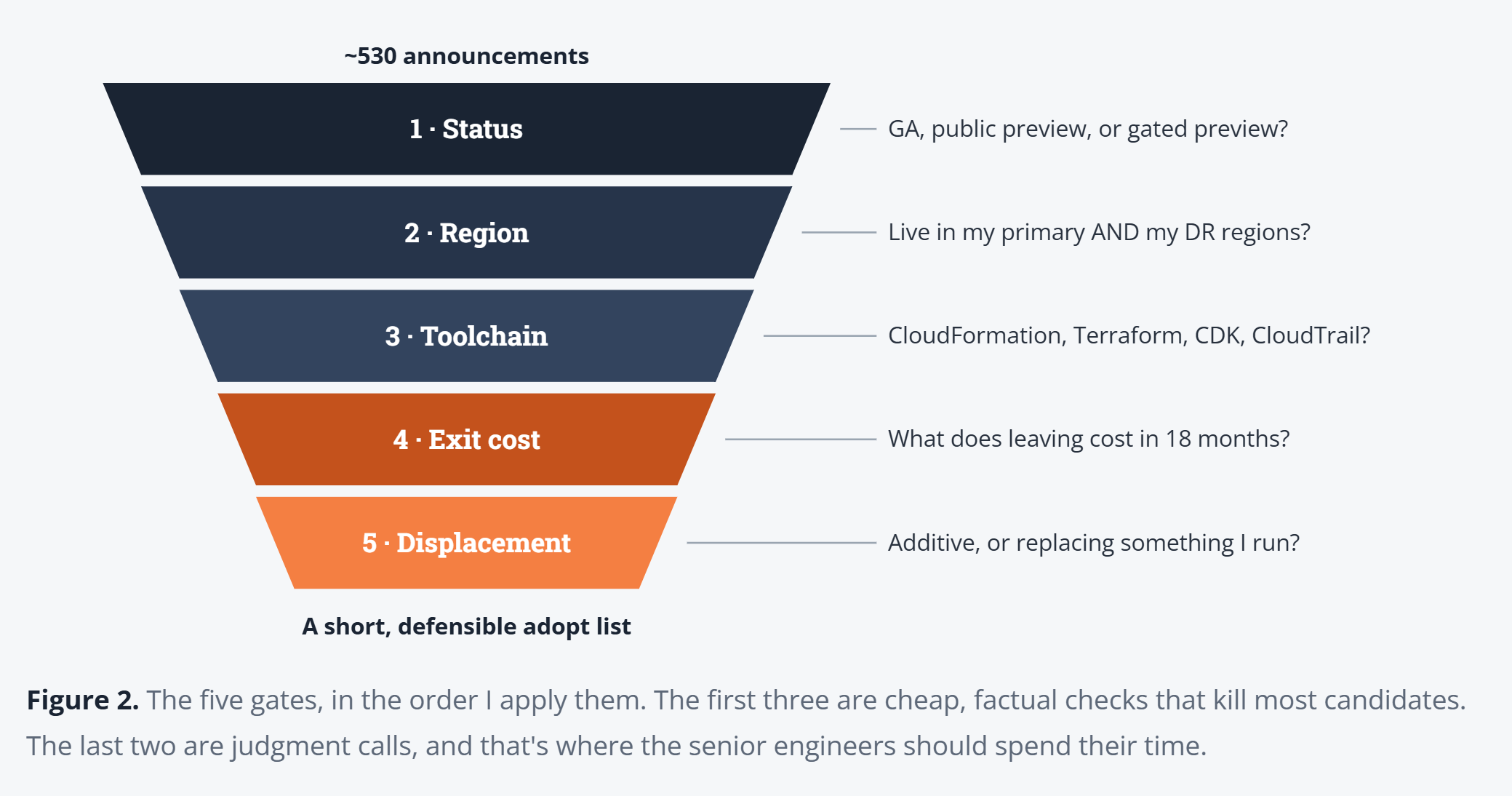
Gate 1: Status
GA scores 2. Public preview scores 1. Gated preview scores 0, and a zero here caps the whole announcement at "watch," no matter how good the other gates look. A gated preview has no SLA you can hold anyone to, and its API can change under you. Fine for a lab account. Not fine for anything with a pager attached.
Gate 2: Region
Is it available in every region your workload runs in, including your disaster recovery region? Launch-day region lists are short, and DR regions are almost never on them. If a service exists in us-east-1 but not in your failover region, you haven't adopted a service. You've adopted a single point of failure. Don't trust the blog post; AWS publishes regional availability as public SSM parameters you can query:
# Regions where a given service is available (AWS public SSM parameters)
aws ssm get-parameters-by-path \  --path /aws/service/global-infrastructure/services/<service-code>/regions \  --query 'Parameters[].Value' --output text
# Don't know the service code? List them all first
aws ssm get-parameters-by-path \  --path /aws/service/global-infrastructure/services \  --query 'Parameters[].Value' --output text
Two points if it's in all your regions. Zero otherwise. There's no partial credit, because there's no partial failover.
Gate 3: Toolchain
Can you express it in infrastructure as code, and can you audit it? I look for CloudFormation resource support, the Terraform AWS provider (or CDK constructs, if that's your stack), CloudTrail events, and IAM condition keys tight enough to scope least privilege. Two points if it's all there, one if it's CloudFormation only, zero if it's console-and-CLI. If you can't put it in a pull request and you can't see it in CloudTrail, it's a console demo.
Gate 4: Exit Cost
This is the gate people skip, and the one that the Bedrock Agents Classic story is really about. Ask: if this goes to maintenance mode in 18 months, what does leaving look like? Low exit cost (2 points) means open formats, standard protocols, and your state stays in your own stores. High exit cost (0) means proprietary data formats, a bespoke API that your business logic wraps around, or state that lives inside the service. The question isn't whether AWS will deprecate it. The question is whether you've made it cheap to find out.
Gate 5: Displacement
Is this additive, or does it replace something you already run? Additive capability scores 2. Replacing a minor component scores 1. Replacing something critical, whether that's your own system or an older AWS service, scores 0. That's not because replacements are bad. It's because a replacement is a migration project, and migration projects need a plan and a budget line, not a launch-week ticket. While you're here, check the AWS Product Lifecycle page to see whether the thing being replaced has quietly moved to maintenance.
Table 2. Scoring rubric and what each total means
| Total (0–10) | Verdict | What you actually do |
|---|---|---|
| 9–10 | Adopt | Pilot now, plan a production rollout, write the exit plan in the same doc. |
| 6–8 | Pilot | Start the 90-day clock. Sandbox account, budget alarm, a named owner, and a decision date. |
| 3–5 | Watch | Re-score in March. No tickets, no side projects. |
| 0–2 | Ignore | Say so out loud, in the channel, so nobody quietly starts building on it. |
| Status = 0 | Watch (cap) | A gated preview never leaves the lab, whatever the other gates say. |
I keep the scoring in code rather than a spreadsheet, mostly so the rules can't drift between whoever happens to fill it in. It's deliberately tiny:
from dataclasses import dataclass

STATUS = {"ga": 2, "public_preview": 1, "gated_preview": 0}

@dataclass
class Announcement:
    name: str
    status: str               # ga | public_preview | gated_preview
    in_all_my_regions: bool   # primary AND DR regions
    iac_support: int          # 0 console only, 1 CFN only, 2 CFN + Terraform/CDK + CloudTrail
    exit_cost: int            # 0 high, 1 medium, 2 low
    displacement: int         # 0 replaces something critical, 1 minor, 2 additive

def score(a: Announcement) -> tuple[int, str]:
    total = (STATUS[a.status]
             + (2 if a.in_all_my_regions else 0)
             + a.iac_support + a.exit_cost + a.displacement)
    if STATUS[a.status] == 0:
        return total, "WATCH"        # gated preview never leaves the lab
    if total >= 9:
        return total, "ADOPT"
    if total >= 6:
        return total, "PILOT (start 90-day clock)"
    if total >= 3:
        return total, "WATCH"
    return total, "IGNORE"

if __name__ == "__main__":
    backlog = [
        Announcement("new-agent-runtime-feature", "public_preview", False, 0, 1, 2),
        Announcement("next-gen-graviton-instances", "ga", True, 2, 2, 2),
        Announcement("managed-replacement-for-x", "ga", True, 1, 0, 0),
    ]
    for a in backlog:
        print(f"{a.name:30} {score(a)}")

# new-agent-runtime-feature      (4, 'WATCH')
# next-gen-graviton-instances    (10, 'ADOPT')
# managed-replacement-for-x      (5, 'WATCH')
Notice the third row. GA, available everywhere, and it still lands on "watch," because it replaces something critical and leaving it would be expensive. That's the case the keynote never prepares you for. A great product can still be a bad adoption decision this quarter.
The Exceptions: When Waiting Costs More
A rule with no exceptions is a slogan. Some announcements should be adopted the week they ship, and waiting 90 days is leaving money or security on the table. The way I separate them is two questions: how reversible is it, and how big is the blast radius if it goes wrong?
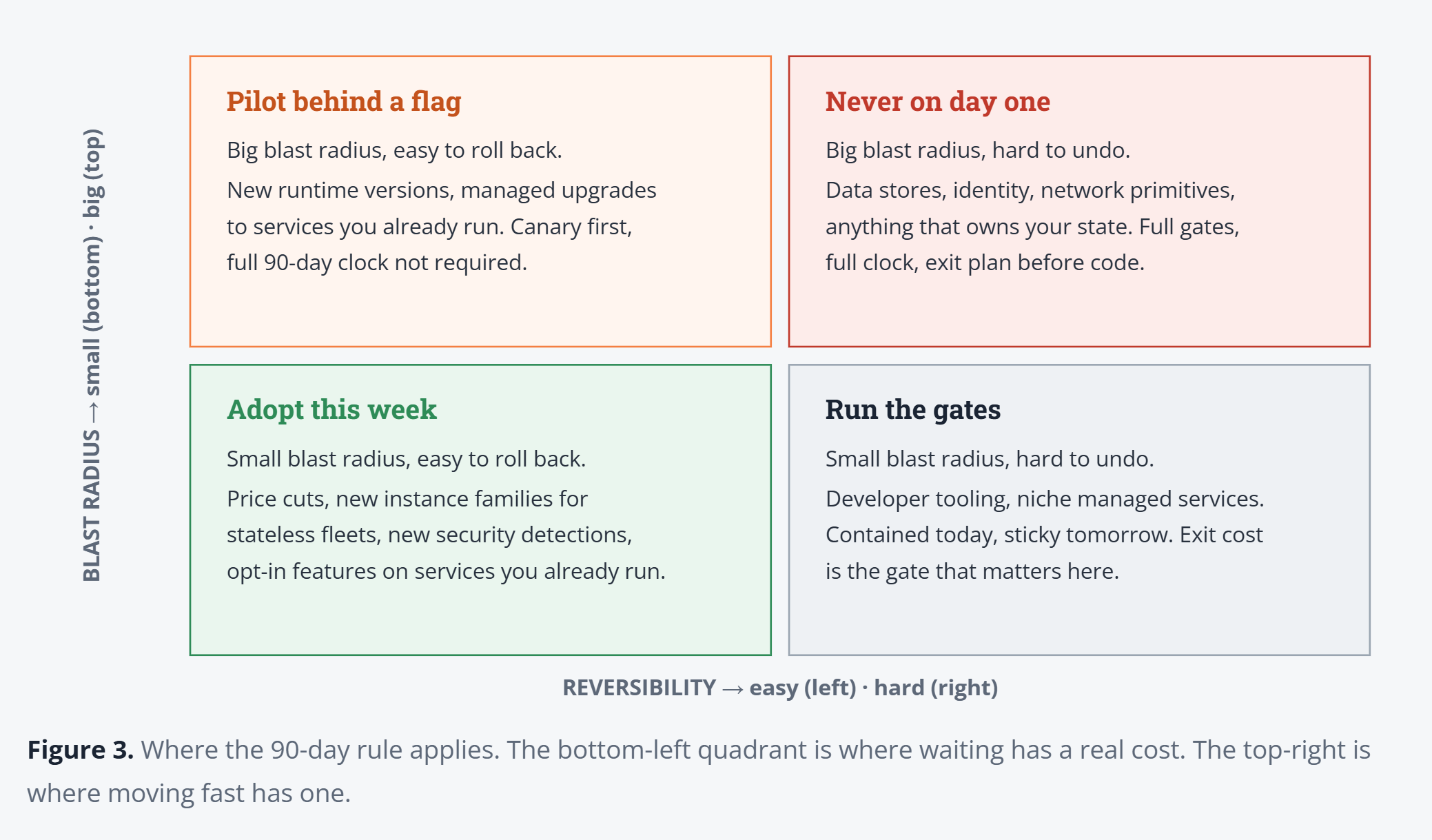
The bottom-left quadrant deserves a closer look, because that's where teams lose money by being too cautious. A price reduction needs no approval process. A new instance family behind an Auto Scaling group with stateless workloads is a launch template change you can revert in an afternoon. A new GuardDuty detection type is pure upside. Holding those for a quarter is caution for its own sake, and it'll make the rule look silly to the people you need to follow it.
The 90-Day Calendar
Here's what the clock actually looks like. The whole point is that every week has a job, so "waiting" never turns into "forgetting."
Table 3. From re:Invent week to a funded decision
| When | Job | Output |
|---|---|---|
| Week 0 (Nov 30–Dec 4) |
Triage. Log every announcement anyone on the team cares about. No tickets, no spikes. | One shared list, with who raised what |
| Weeks 1–2 | Score each item against the five gates. Publish the "ignore" list. | Scored list; ignores announced in the channel |
| Weeks 3–6 | Sandbox pilots for anything scoring 6+. Isolated account, budget alarm, named owner. | Working pilot, first real cost data |
| Weeks 7–10 | Re-check status, pricing page, region list, Terraform provider changelog, re:Post and GitHub issues. | Re-scored list; anything that slipped gets demoted |
| Weeks 11–13 (early March) |
One-page decision memo per candidate: adopt, extend the watch, or drop. | Decision, budget line, and an exit plan for every adopt |
The exit plan in the last row isn't optional. If someone can't write half a page on how they'd leave, they don't understand the service well enough to adopt it yet.
When Not to Use This Rule
I'd be lying if I said this fits every team. Skip it, or shorten it, if:
- Your differentiation is the new capability. If you're a startup whose pitch depends on being first to something AWS just shipped, 90 days might be your whole runway. Keep the gates. Shrink the clock to 30 days.
- You were a design partner. If you've been in the private beta for six months with a named AWS team, you already have the information the clock is meant to collect.
- It's bottom-left. Price cuts, reversible performance wins, and security detections don't need a quarter of deliberation.
- You're evaluating, not committing. Reading docs and running a tutorial in a sandbox is not adoption. Nobody needs permission to learn.
The rule exists to stop one specific failure: production architecture decisions made on announcement-day information. If that's not the risk you're facing, use something lighter.
Back to "Classic"
Bedrock Agents wasn't a bad service, and the teams that adopted it weren't wrong. They just made a decision with a two-year consequence on the information available in launch week, and most of them never wrote down what leaving would cost. That's the habit this filter is built to break.
The teams that will be calm next July, when the next batch of services quietly picks up a suffix, aren't the ones who adopted the least. They're the ones who wrote the exit plan before they wrote the first line of code.
After re:Invent wraps, I'll run this year's headline announcements through these five gates and publish the scores, including the ones I expect to get wrong. Come back in March and hold me to it.
Opinions expressed by DZone contributors are their own.