

Six Patterns for Building Production-Grade AI Quality Systems
AI quality engineering platform should be built on 6 patterns. It is a unique PTAO cognitive loop (Perceive → Think → Act → Observe) that quality-gates.
 ·
·
Join the DZone community and get the full member experience.
Join For Free1. Why Most AI QA Tools Fail in Production
The pattern is now familiar: a team integrates an LLM into their QA workflow, the demo impresses stakeholders, and three months later the tool is quietly deprecated. Tests it generated needed manual cleanup. Root cause analyses were generic enough to apply to any failure. Data provisioning left environments in inconsistent states. The on-call engineer stops trusting it and goes back to doing things by hand.
The problem is rarely the model. It is the engineering around the model. Production-grade AI systems require the same rigor as any other software: quality gates, bounded failure modes, auditable outputs, and clear contracts about what the system will and will not do autonomously. Most AI QA integrations skip all of this, ship a thin wrapper around a prompt, and wonder why adoption stalls.
The Core Gap
An LLM that returns plausible text is not the same as a system that produces reliably structured, quality-gated, auditable output. Bridging that gap is a software engineering problem, not a prompt engineering problem. The six patterns in this article address it directly.
Each pattern is described independently so you can adopt any subset into an existing system. A reference implementation that applies all six is described in Section 8.
2. Pattern 1 — Cognitive Loops, Not API Calls
The Problem
A single LLM call with a try/except block around it is not a production system. It has no concept of output quality, no recovery strategy, and no visibility into what happened between the prompt and the response. When it fails, it fails silently and completely.
The Pattern
Replace the raw API call with a Perceive-Think-Act-Observe (PTAO) cognitive loop. Each phase is a discrete, inspectable step with its own inputs and outputs:
|
P Perceive Detect intent, classify the request, tokenise the input, surface context signals |
T Think Select output strategy, build the enriched prompt, set the quality threshold |
A Act Stream the LLM call, accumulate raw output, emit progress events to consumers |
O Observe Score output against rubrics, emit telemetry, decide PASS / RETRY / WEAK |
The Quality Gate
The OBSERVE phase is the critical addition most systems omit. It runs a rubric-based quality score on the raw output. A rubric is simply a list of (label, regex_pattern) pairs that check for required structural elements. If the ratio of passing checks falls below a threshold, the loop injects a correction instruction and retries — at most once, keeping worst-case cost to two LLM calls.
# Quality gate logic — fast-pass for long structured responses,

# rubric scoring for everything else.

if len(output) >= FAST_PASS_CHARS and output.startswith("#"):

     quality = "PASS"           # long markdown output — skip rubric

else:

     passed = sum(1 for label, pattern in rubric

                  if re.search(pattern, output))

     ratio   = passed / len(rubric)

     quality = "PASS" if ratio >= THRESHOLD else "RETRY"


if quality == "RETRY" and attempt <= MAX_RETRIES:

     prompt += "\n\n[RETRY] Prior attempt was incomplete. Include all required sections."
Why This Matters
The loop turns each LLM interaction into an inspectable, telemetry-emitting pipeline stage. Every phase transition can be streamed to the UI as a named SSE event, giving engineers real-time visibility into what the model is doing — not a spinner followed by a blob of text.
Key Insight: Cap MAX_RETRIES at 1. Two LLM calls are an acceptable worst-case cost. Three or more and you are not fixing a quality problem — you have the wrong prompt strategy. The fast-pass threshold prevents retry storms on large, well-structured responses that happen to miss an optional rubric keyword.
3. Pattern 2 — The 96% Token Problem
The Problem
Every AI agent framework loads its full context on every call: skill definitions, tool schemas, system prompts, few-shot examples. For a typical agent setup, this adds 8,000 or more tokens of overhead to every request — before a single character of user input is included. At scale, this is a latency and cost problem that compounds with every invocation.
|
COMPONENT |
TOKENS |
REQUIRED FOR THIS TASK? |
|
Full skill definition (SKILL.md) |
4,741 |
No — the task is already routed |
|
Tool JSON schemas |
2,800 |
No — tool use is not required |
|
Agent boot system prompt |
600 |
No — a task-scoped prompt replaces this |
|
Total naïve overhead |
8,141 |
None of it |
The Pattern: Context Slicing
Inject only what the model needs for the specific task at hand. A task-scoped system prompt — typically 100-200 tokens — frames the domain context without loading the full agent boot sequence. The result: the total payload for a typical request collapses from 8,000+ tokens to under 300.
Naive (8,300+) 8,300 tokens
Sliced (~250) 250
Context slicing is not about removing context — it is about matching context to the task. A test generation task needs the output schema and the requirement document. It does not need the data provisioning protocol, the dedup algorithm, or the report format spec. Load only what is relevant to the current intent.
Implementation
Build a lightweight context slicer that measures the actual payload sent on each call and computes the reduction against a measured naïve baseline. Surface this as telemetry:
def compute_report(user_prompt, raw_output, output_tokens) -> SlicerReport:

     raw_user  = estimate_tokens(user_prompt)

     optimized = raw_user + TASK_SYSTEM_PROMPT_TOKENS   # e.g. 148

     naive     = optimized + NAIVE_OVERHEAD_TOKENS       # e.g. + 8,141

     return SlicerReport(

         optimized_payload = optimized,

         naive_payload     = naive,

         reduction_pct     = (naive - optimized) / naive * 100,

        # latency_saved, cost_saved_pct derived from reduction_pct

    )
Measured Result: A context slicer measuring 148-token task prompts against an 8,141-token naïve baseline yields a 96.4% payload reduction on every call. At high invocation rates, this translates directly to lower API costs and meaningfully faster end-to-end response times.
4. Pattern 3 — Align Capabilities to the Lifecycle
The Problem
AI tooling that presents itself as a feature menu forces engineers to make a meta-decision before every task: which tool applies here? That decision is cognitive overhead that does not produce test coverage or defect insight. It also produces inconsistent usage — different engineers reach for different tools at the same lifecycle stage.
The Pattern
Map each AI capability to a specific SDLC phase. The engineer's current phase determines which capability is active — not a dropdown, not a search box, not a knowledge of which prompt to write.
|
1 Requirement Analysis [DESIGN] |
2 Data Provisioning [SETUP] |
3 Failure Analysis [EXECUTE] |
4 Suite Maintenance [MAINTAIN] |
5 Reporting [REPORT] |
Each phase boundary is also a data handoff point. The outputs of earlier phases feed naturally into later ones: requirement analysis produces test cases that populate the execution suite; failure analysis produces confirmed defects that feed the triage report; data provisioning produces entity IDs that feed the prep report. The lifecycle ordering is not cosmetic — it is an architectural constraint that prevents accidental coupling.
Capability Detection
Intent detection at the PERCEIVE phase routes each request to the correct capability automatically, without requiring the user to navigate a menu:
# Keyword-based capability routing at the PERCEIVE phase

CAPABILITY_SIGNALS = {

     "prd":     ["requirement", "user story", "acceptance criteria", "jira"],

     "data":    ["provision", "fixture", "seller", "stage env"],

     "rca":     ["timeouterror", "stack trace", "nosuchelement", "failing test"],

     "dedup":   ["duplicate", "scan", "redundant", "similar tests"],

     "triage": ["defect", "sla", "severity", "priority", "breach"],

}
Design Principle: Phase-ordering also makes it easy to answer "what should I do next?" at any point in the cycle. An engineer finishing a requirement analysis session is automatically positioned at the data provisioning step — no context-switching required.
5. Pattern 4 — The Self-Heal Safety Contract
The Problem
Self-healing test automation is compelling on paper. In practice, systems that apply fixes unconditionally — without confidence scoring, without bounding the blast radius, without a rollback guarantee — make things worse. An engineer who discovers that an automated system silently modified their test suite loses trust in the entire platform, not just the healing feature.
The Pattern: A Formal Safety Contract
Define a self-heal contract before writing any auto-remediation code. The contract specifies exactly when the system may act, how many times it may retry, and what it must do if all attempts fail:
|
CONTRACT CLAUSE |
RULE |
RATIONALE |
|
Confidence gate |
Confidence score ≥ 85% required to auto-apply |
Low-confidence fixes have a higher chance of masking real defects |
|
Effort classification |
Only LOW-effort fixes auto-apply |
HIGH-effort changes carry architectural risk; require human review |
|
Retry budget |
Maximum 3 fix attempts per failure |
Bounded failure prevents cascading mutations to the test file |
|
Scope constraint |
Re-run only the failing test, not the full suite |
Avoids surfacing unrelated failures that pollute the signal |
|
Rollback guarantee |
Restore original file if all fixes fail |
The system must always leave the codebase in a known-good state |
|
Commit prohibition |
Never commit or push changes autonomously |
Human approval required before any change enters version control |
# Self-heal contract enforced at prompt construction time

if self_heal_enabled:

     prompt += (

         "\n[SELF-HEAL CONTRACT]"

         "\n- Apply fix only if confidence >= 85% AND effort = LOW"

         "\n- Re-run the failing test only — not the full suite"

         "\n- Retry up to 3 different fixes if the first does not pass"

         "\n- Restore original file if all fixes fail"

         "\n- Never commit, push, or stage any file change"

    )
Key Insight: Encoding the contract in the prompt rather than only in application code means the model itself is aware of the constraints. This improves adherence on borderline cases — the model learns to self-qualify its confidence before acting, rather than always proposing a fix and letting the application layer decide.
The Triage Pipeline
Self-healing and defect triage should be connected, not siloed. When a failure survives the healing contract — meaning the model classified it as a real defect rather than a selector issue or environment flake — it should automatically feed into the defect queue with its classification metadata intact. This eliminates the manual step of copying failure information from a test run into a defect tracker.
6. Pattern 5 — Analysis Is AI's Lane; Action Is Human's
The Problem
The instinct when building AI tooling is to make it do as much as possible. For irreversible operations — deleting files, merging test cases, modifying production data — this instinct is wrong. An AI that deletes what it classifies as a duplicate test may be deleting a regression anchor or a platform-specific edge case that looks identical at the semantic level but covers different runtime behaviour.
The Pattern
Hard-code read-only analysis as the default for any operation that cannot be trivially undone. The AI identifies, scores, and recommends. The engineer decides and acts. This is not a limitation of the system — it is a deliberate trust boundary that makes the AI's recommendations credible.
# Read-only constraint enforced at prompt construction time.

# The AI cannot override this in its output — the constraint

# is architectural, not a suggestion.

DEDUP_PROMPT = """

Scan the test repository at `{repo_path}` for duplicates.

Similarity threshold: {threshold}%.


Do NOT delete, modify, or rename any files — read-only analysis only.

Return: JSON with summary + groups[], each with a recommended action

(DELETE | MERGE | REVIEW), confidence score, and rationale.

"""
The Recommendation Schema
A strong read-only analysis output is not just a list of duplicates. It provides enough context for the engineer to act confidently without re-examining every file:
|
FIELD |
PURPOSE |
|
group_id |
Stable identifier for the duplicate cluster |
|
similarity_pct |
Semantic similarity score across the group |
|
action |
DELETE / MERGE / REVIEW — the AI's recommendation |
|
rationale |
Plain-English explanation of why this action was chosen |
|
risk |
NONE / LOW / MEDIUM — estimated blast radius if the action is taken |
|
keep_file |
Which file to preserve if the group is merged or deleted |
Why This Builds Trust: Practitioners adopt AI tools faster when the tool is honest about what it knows it cannot safely decide. A system that says "here are 7 groups; I recommend deleting 2, merging 2, and reviewing 3 — here is my reasoning" is far more credible than one that silently performs deletions and reports a summary. Trust is built through transparency, not through autonomy.
7. Pattern 6 — The Execution Store
The Problem
Most AI integrations produce output and discard it. The next run has no memory of the last one. Reports have to be regenerated from scratch. Debugging a bad output requires re-running the entire pipeline. There is no audit trail for compliance, no replayability for debugging, and no shared source of truth for downstream consumers.
The Pattern
Persist every AI interaction to a typed execution store — a key-value structure indexed by capability type, containing the prompt, raw output, rendered output, and a timestamp. Reports, dashboards, and downstream capabilities read directly from this store. Nothing regenerates data it could reuse.
# Execution store: typed entries, one per capability.

# Persisted after every OBSERVE phase regardless of quality outcome.

STORE_SCHEMA = {

     "capability": str,      # "prd" | "data" | "rca" | "dedup" | "triage"

     "prompt":     str,      # the enriched prompt sent to the model

     "raw":        str,      # raw LLM output (unparsed)

     "rendered":   str,      # rendered HTML or structured format

     "ts":         str,      # ISO 8601 timestamp

     "telemetry":  dict,     # PTAO phase metadata, token counts, quality score

}
Cross-Capability Data Flow
The execution store enables a pattern where capability outputs compose naturally without explicit integration code. A defect confirmed by the failure analysis capability is written to the store under the "triage" key. The defect triage report reads from that key on every page load — no webhook, no event bus, no manual copy-paste required.
Design Note: Start with a flat JSON file. It is human-readable, zero-dependency, and sufficient for dozens of daily invocations. Migrate to a database only when audit retention, concurrent writes, or query complexity actually demand it — not before. YAGNI applies to persistence layers too.
What the Store Enables
|
CONSUMER |
WHAT IT READS |
VALUE DELIVERED |
|
Defect Triage Report |
triage key |
Live defect matrix without re-running analysis |
|
Dedup Viewer |
dedup key |
Latest duplicate groups without re-scanning the repo |
|
Data Prep Report |
data key |
Entity IDs and session state from last provisioning run |
|
Unified Dashboard |
All keys |
Cross-capability health in one view |
|
Compliance audit |
All keys + timestamps |
Full history of what the AI was asked, what it produced, and when |
8. Reference Implementation and Results
All six patterns were implemented together in a quality engineering platform for a high-volume e-commerce fulfillment operation. The platform — built over a single weekend as an internal hackathon project using FastAPI, HTMX, and Playwright MCP — applies the patterns across five SDLC-ordered capabilities: PRD-to-Suite, Agent-Driven Data Provisioning, Failure RCA with Self-Heal, Test Deduplication, and a live Reporting layer backed by the execution store.
Architecture in One Diagram
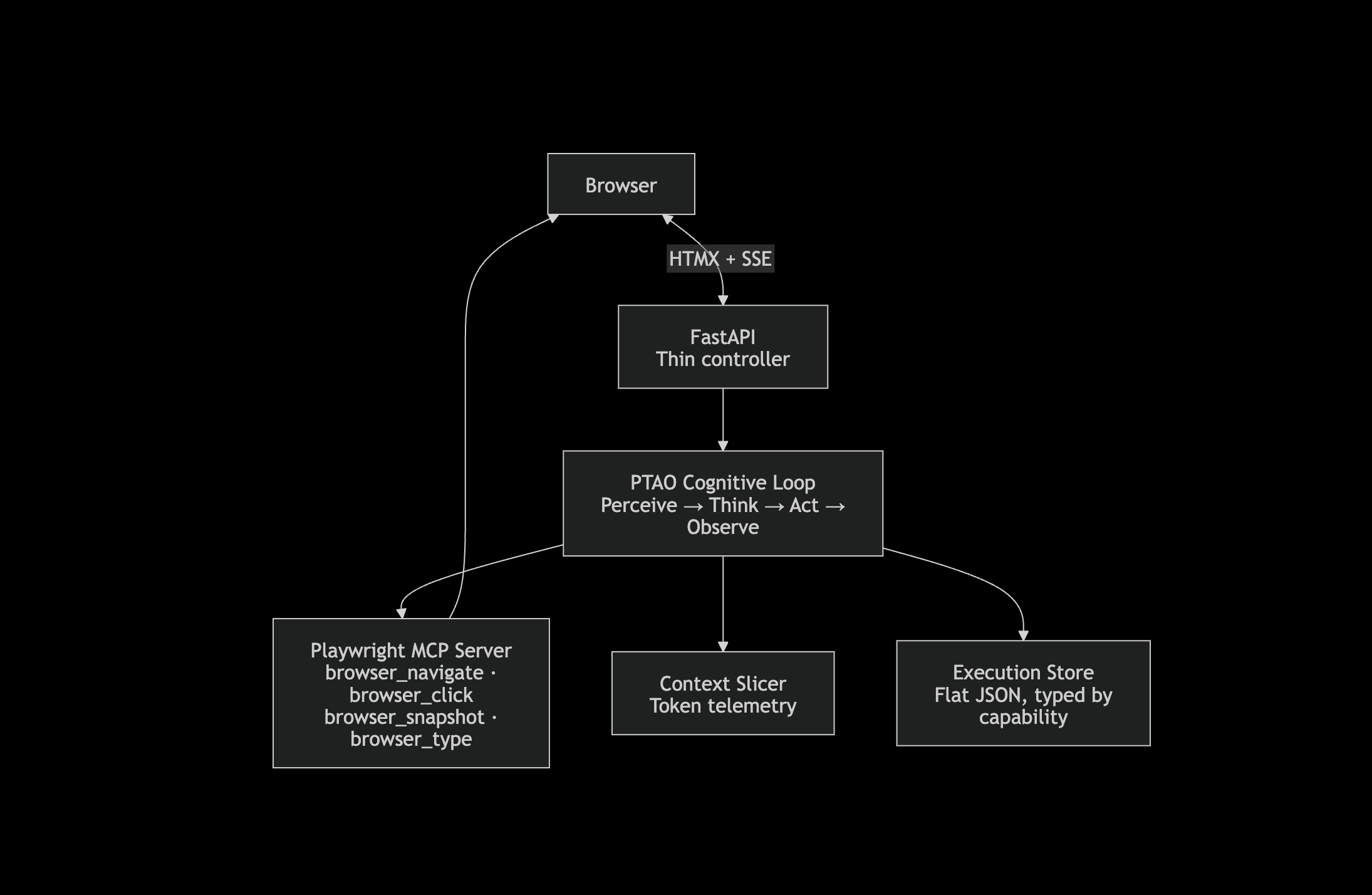
Measured Outcomes
|
70-80% QA Cycle Time Reduction |
96%+ Token Payload Reduction |
93% Duplicate Detection Rate |
|
85% Test Coverage Achieved |
<45s PRD to Test Suite Time |
0 Autonomous Commits Made |
Most Important Metric: The zero autonomous commits figure is not a limitation — it is the point. The self-heal contract, read-only analysis, and human-gated action patterns kept the system in an advisory role throughout. Engineers adopted it because it did not try to make decisions that were theirs to make.
Technology Stack
|
LAYER |
TECHNOLOGY |
ROLE IN THE PATTERNS |
|
API layer |
FastAPI (Python) |
Async-native; SSE via StreamingResponse for PTAO phase events |
|
Frontend |
HTMX + Jinja2 |
HTML-over-the-wire; zero JS framework; server-side report rendering from execution store |
|
Browser automation |
Playwright MCP |
LLM calls browser_navigate, browser_snapshot as MCP tools — no custom runner code |
|
AI runtime |
Internal AI platform |
Network-gated; no external API keys; task-scoped prompts via context slicing |
|
Persistence |
Flat JSON file |
Execution store — typed by capability, read by all report consumers |
|
Test framework |
Playwright + TypeScript |
Target of self-heal patches; isolated per feature; config checked in |
9. What to Take Back to Your Codebase
None of the six patterns require a new framework, a large model budget, or a multi-sprint migration. Each can be adopted incrementally into an existing AI integration:
|
PATTERN |
MINIMUM VIABLE ADOPTION |
|
Cognitive Loop |
Add an OBSERVE step after your existing LLM call. Check for one required structural element. Retry once if absent. |
|
Context Slicing |
Measure your current prompt token count. Remove everything not needed for the specific task type. Track the reduction. |
|
Lifecycle Alignment |
Group your AI features by the SDLC phase they serve. Surface the right one based on the engineer's current context. |
|
Self-Heal Contract |
Add confidence and effort fields to your fix output schema. Gate autonomous application on both. Hardcode the rollback path. |
|
Read-Only Default |
For any irreversible operation, make the AI return a recommendation with a rationale. Remove the execution path entirely from the model's output. |
|
Execution Store |
Write each AI response to a keyed file alongside its prompt and timestamp. Point your next report at the file instead of re-running the analysis. |
The broader lesson is that AI quality engineering earns adoption through predictability, not capability. A system that reliably produces structured output, never silently modifies files, and leaves a full audit trail will be used every day. A system that occasionally produces brilliant results but fails unpredictably and leaves no trace will be abandoned.
Final Thought
The Zen of Python applies here: explicit is better than implicit, errors should never pass silently, and in the face of ambiguity, refuse the temptation to guess. Every one of these six patterns is a direct application of that philosophy to AI system design. The model is not magic — it is a component. Treat it like one.
Opinions expressed by DZone contributors are their own.
Comments