

A Developer-Centric Cloud Architecture Framework (DCAF) for Enterprise Platforms
Developer-Centric Cloud Architecture Framework (DCAF) introduces a platform architecture framework that codifies architectural intent through meaningful invariants.
Join the DZone community and get the full member experience.
Join For FreeEnterprise-class cloud systems seldom fail because of infrastructure constraints; rather, problems arise when architectural vision cannot scale to match the scale of the business.
With the increasing use of the cloud by various teams, geographic locations, and business units, certain recurring scenarios emerge:
- Platform behavior diverges across environments
- Application code absorbs operational workarounds
- Security and governance rely on procedural controls
- Observability data lacks causal clarity
- Cost signals appear only after deployment decisions
- AI workloads introduce additional governance and operational uncertainty
These are not issues of tooling. They arise when architectural intention is tacit rather than explicit, and when the platform layer is unstructured, unrestrained, and inherently unreasoned about.
Typically, platforms in the enterprise world develop in an incremental manner. Initial architectural choices made for speedy delivery often remain unchanged even as systems scale. As a result, design decisions optimized for early velocity persist well beyond their intended context.
Developer-Centric Cloud Architecture Framework (DCAF) — This proposed framework for cloud platform architecture directly addresses this problem space. Instead of recommending tools, reference architectures, or implementation patterns, DCAF establishes a formal approach for stating architectural intent in terms of platform-level invariants and clear ownership boundaries across architecture, platform engineering, and applications.
The Core Architectural Failure
At enterprise scale, a consistent structural condition emerges:
- Infrastructure capabilities expand faster than architectural intent
- When architectural intent is implicit, enforcement becomes inconsistent
- When enforcement is inconsistent, complexity accumulates
This accumulation manifests as behavioral divergence, operational fragility, and escalating coordination costs.
To reason about this condition, architectural intent must be:
- Explicit — formally defined
- Enforceable — structurally represented through the platform
- Verifiable — observable through system behavior
DCAF introduces architectural invariants as a mechanism for expressing architectural intent — conditions intended to remain stable regardless of cloud provider, tooling choices, or organizational structure.
Where Well-Architected Framework Guidance Ends
Well-architected frameworks evaluate individual workloads across reliability, security, cost, and operational dimensions. They answer a narrow question:
Is this workload designed and operated correctly?
They do not define how architectural intent is expressed, preserved, and enforced consistently across a growing platform. As organizations scale, several limitations become evident:
- Responsibility boundaries between platform and application teams remain implicit
- Best practices function as guidance rather than architectural constraints
- Governance relies on process rather than structural enforcement
- Observability depends on tooling configuration rather than platform guarantees
- AI is treated as a workload concern rather than a platform capability
DCAF proposes a platform architecture operating model that formalizes architectural intent as a first-class concern, complementing existing well-architected guidance rather than replacing it.
How DCAF Differs from Common Cloud Architecture Articles
Most cloud architecture articles focus on workload design: service selection, deployment patterns, reliability strategies, and cost optimization.
DCAF operates at a different layer.
Rather than prescribing how workloads should be implemented, DCAF defines how enterprise cloud platforms can be architecturally reasoned about so that workloads do not absorb platform complexity as scale increases. In short, traditional cloud architecture guidance evaluates workload outcomes, while DCAF defines platform-level architectural constraints and frames compliance as a platform responsibility rather than a developer concern.
The Six Pillars of DCAF
Each pillar represents a proposed architectural invariant intended to prevent platform complexity from propagating into application code.
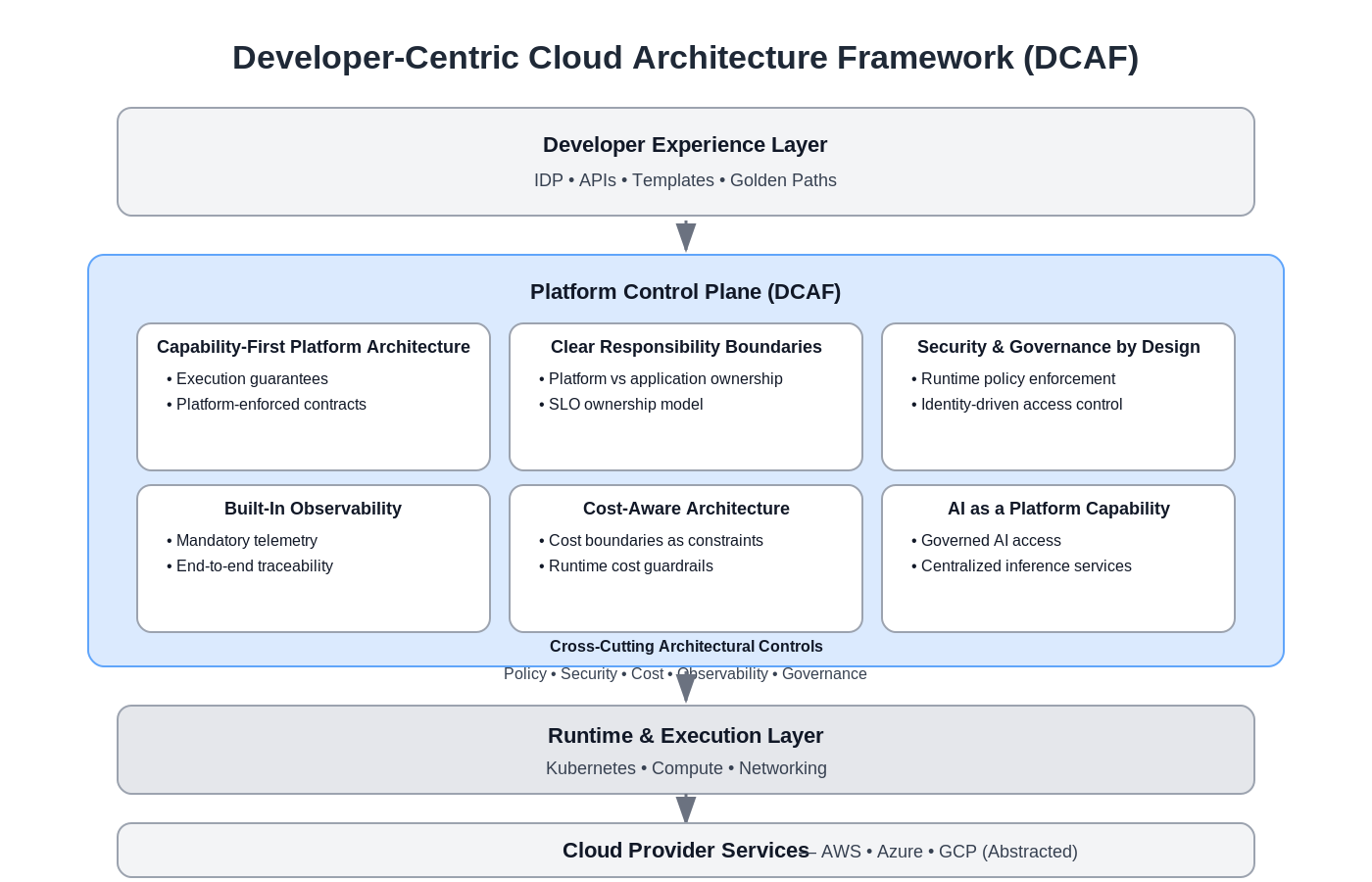
Pillar 1: Capability-First Platform Architecture
Problem: Execution semantics vary across environments, requiring applications to implement compensating logic.
Architectural invariant: Application behavior is defined independently of platform evolution.
Key actions:
- Architecture specifies execution semantics as platform guarantees
- Platform engineering implements these semantics at shared control points
Design signals:
- Consistent retry and timeout behavior
- No application-specific fallback logic
Pillar 2: Clear Responsibility Boundaries
Problem: Operational responsibilities migrate into application teams when platform behavior is inconsistent.
Architectural invariant: Applications are not responsible for platform operational concerns.
Key actions:
- Architecture assigns scaling and resilience to the platform
- Platform engineering centralizes operational mechanisms
Design signals:
- Uniform scaling and recovery behavior
- No application-level resilience mechanisms
Pillar 3: Security and Governance by Design
Problem: Security enforcement depends on manual review and static controls.
Architectural invariant: Security enforcement is expressed structurally at runtime.
Key actions:
- Architecture requires runtime evaluation of security decisions
- Platform engineering embeds identity and policy enforcement
Design signals:
- No static credentials in application code
- Runtime-verifiable audit data
Pillar 4: Built-In Observability
Problem: Telemetry exists but does not consistently support causal reconstruction.
Architectural invariant: System behavior is traceable end to end.
Key actions:
- Architecture defines causal traceability as a platform property
- Platform engineering enforces telemetry standards
Design signals:
- End-to-end request traces
- Correlated logs and metrics
Pillar 5: Cost-Aware Architecture
Problem: Cost considerations surface only after deployment.
Architectural invariant: Cost constraints are treated as architectural inputs.
Key actions:
- Architecture defines cost boundaries
- Platform engineering implements runtime guardrails
Design signals:
- Automatic cost enforcement
- Predictable cost-related failure modes
Pillar 6: AI as a Platform Capability
Problem: AI integrations introduce coupling and governance gaps.
Architectural invariant: AI usage is treated as a centrally governed platform capability.
Key actions:
- Architecture defines AI access as a platform concern
- Platform engineering centralizes access and auditability
Design signals:
- Uniform AI access interfaces
- Centralized visibility into AI usage
Architectural Tradeoffs Introduced by DCAF
DCAF prioritizes architectural consistency and enforceability over localized optimization.
As a result:
- Application teams operate within defined architectural constraints
- Platform teams assume greater responsibility for runtime guarantees
- Architectural decisions move earlier in the lifecycle
These tradeoffs are intentional and reflect a preference for system-level stability at scale.
Architectural Contribution
The challenges DCAF seeks to address are widely observed in large-scale cloud environments. As platforms grow, execution behavior diverges, responsibility boundaries blur, governance becomes procedural, and applications increasingly compensate for platform inconsistency.
DCAF introduces a structured architectural framing for these conditions at the platform level.
Rather than proposing new tooling or prescriptive best practices, DCAF defines a platform architecture operating model based on enforceable architectural invariants. These invariants formalize responsibility boundaries between architecture, platform engineering, and application teams, making architectural intent explicit and verifiable as platforms evolve.
By treating complexity accumulation as an architectural property rather than an implementation artifact, DCAF provides a principled way to reason about enterprise cloud platform design in terms of platform behavior rather than workload-level optimization.
Opinions expressed by DZone contributors are their own.
Comments