

The Reasoning Control Plane: The Missing Architectural Layer in Multi-Agent Systems
Multi-agent systems lack a governance layer for reasoning. The Reasoning Control Plane addresses this with shared context, A2A access controls, observability, guardrails.
Join the DZone community and get the full member experience.
Join For FreeWe have spent the last two years learning how to ground a single AI agent in enterprise data. That was the easy part. Coordinating a fleet of them turns out to be a different problem entirely.
Multi-agent systems ask questions our current platforms weren't built to answer. How do two agents share state without contradicting each other? Whose credentials are used when Agent A calls Agent B? What audits the decision when an agent triggers another based on a probabilistic inference? Most enterprise architectures shrug at all of these. They were built for humans reading dashboards, not autonomous consumers acting on inference.
The result is a quiet architectural crisis. I see multi-agent pilots pass demo review and then fall over the moment they meet real production traffic. It's rarely the model. It's that the system has nowhere to govern reasoning itself.
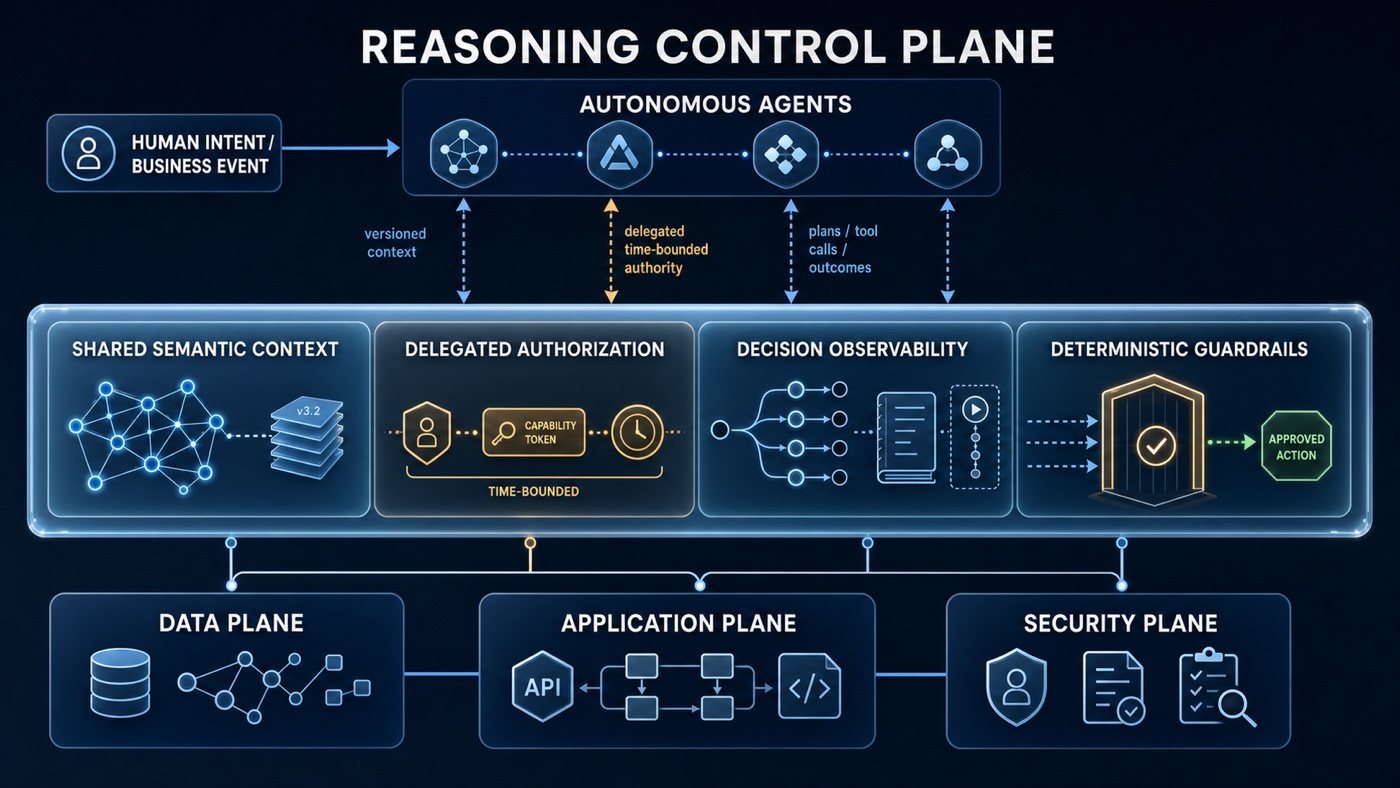
I've come to believe a new architectural layer is emerging as the answer. I call it the Reasoning Control Plane. It sits alongside the data, application, and security planes every enterprise architect already knows. It governs how autonomous agents share context, authenticate to each other, expose their decisions to observation, and behave when the stakes are high.
Every previous era of enterprise architecture eventually produced a new plane when a new class of consumer showed up. Agents are that new class, and the plane hasn't been named yet.
The Planes We Already Know
All mature system architectures that have shipped in the last thirty years are organized into control planes and data planes. A control plane governs. A data plane executes. The pattern is so ubiquitous by now that architects reach for it reflexively when a new domain needs structure.
Zoom out, and enterprise architecture runs on three planes:
- The Data Plane governs how information is stored, moved, and queried. Data warehouses, Lakehouses, Streaming Data.
- The Application Plane governs how code executes and services communicate. APIs, Orchestrators, Workflow engines.
- The Security plane governs identity, access, and audit trail. IdPs, Policy engines, SIEMs.
Each of these assumes a specific kind of consumer. A human as the end-user. An application making deterministic calls. A user authenticating to a resource. Autonomous agents fit none of those assumptions cleanly.
An agent needs to consume the data plane for grounding, invoke the application plane for effects, and satisfy the security plane's policies. Fine, we can wire that up. But the reasoning that an agent does across those three planes has no home. When one agent triggers another based on a probabilistic decision, what governs that? When two agents share a "customer" concept, what enforces that they mean the same thing? When an agent takes a regulated action, what audits the rationale? There's no plane for that. Not yet.
Introducing the Reasoning Control Plane
The Reasoning Control Plane is the architectural layer that governs how autonomous reasoning gets coordinated, constrained, and observed across an enterprise's agentic systems. It's not about where the inference happens. Models can be anywhere. It's where the enterprise expresses what reasoning is permitted, how it's grounded, how it's audited, and what happens when it fails.
Position it above the traditional three planes. It consumes services from all of them: the data plane for grounding, the application plane for effectors, the security plane for identity. But it exposes new primitives that none of the older planes provided on their own.
Those primitives are what agents actually need to work together:
- A shared semantic context so agents mean the same thing when they say "customer" or "at risk"
- Agent-to-agent access controls so one agent's actions stay bounded when it delegates to another
- Observability of non-deterministic workflows so decisions can be reconstructed after the fact
- Deterministic guardrails on actions that must never be free-planned
If you've built a multi-agent pilot that worked once and then failed inconsistently on a second run, one of these four is missing. The Reasoning Control Plane is where they belong together.
Dimension 1: Shared Semantic Context
Multi-agent systems break down first at the level of shared meaning. Agent A's understanding of "the customer" isn't Agent B's. Agent A's definition of "at risk" was trained against the churn model. Agent B's was defined against the credit model. When they collaborate, they compound the ambiguity, and nobody notices until an action lands in the wrong place.
Structured semantic layers have existed for years in the analytics world. They exposed shared metrics and dimensions to BI tools, so "revenue" meant the same thing across every dashboard. The Reasoning Control Plane needs the same thing, but built for agents instead of humans. Machine-first, so it returns schemas and structured concepts, not charts. Composable, so agents can assemble context on the fly. Versioned, so an agent can tell which definition of "at risk" it's operating against.
If your multi-agent design has no shared semantic surface, every agent redefines the world for itself. That works for one agent. It doesn't survive the second.
Dimension 2: Agent-to-Agent Access Controls
Traditional identity and access management assumed one human authenticating to one system. Agent-to-agent access breaks that model. When Agent A delegates to Agent B, whose credentials are used? Whose scope? What happens when Agent B invokes Agent C on the same request?
Most current implementations answer this the wrong way. They give every agent a service account with broad permissions and hope for the best. That works until an agent hallucinates a request outside its intended scope. Then it works catastrophically well, because the service account executes the mistake with full authority.
The Reasoning Control Plane needs a different primitive. Scoped, delegable, time-bounded authorization that follows the reasoning chain. When Agent A delegates to Agent B, the token B receives should be narrower than A's own. Bounded to the specific task. Expiring quickly. Auditable back to the originating human intent.
None of this is new in identity engineering. OAuth's scoped tokens and step-up authentication are close analogs. What's new is applying the same rigor at the agent boundary, treating every delegation as a potential blast-radius event and constraining it accordingly.
I keep asking why we don't have this yet in mainstream agent frameworks. The honest answer, I think, is that the frameworks were built by ML engineers, not identity engineers. The two worlds haven't merged. They will, but it's going to take another year of production incidents to force the marriage.
Dimension 3: Observability for Non-Deterministic Workflows
Traditional application performance monitoring made an assumption that's dead for agentic systems. Same input, same code path. Two runs of the same agent against the same input can now produce different plans, different tool calls, different outcomes.
That doesn't mean the system is unobservable. It means observability itself has to be redesigned from the ground up.
The Reasoning Control Plane needs to capture what traditional APM never did. The plan the agent chose. The context it considered. The tools it invoked. The confidence it expressed at each step. The alternatives it rejected. This isn't a superset of tracing. It's a different discipline. It looks less like OpenTelemetry spans and more like a per-request, per-agent decision journal that lets an operator reconstruct what happened after the fact and, more importantly, generalize from patterns of failure.
Here's the thing I've learned from every incident review I've done in this space: your multi-agent system will act unexpectedly, and you'll want to know why. If you didn't build the plane's observability from day one, you can't answer the question. You can guess. You can't answer.
At one Enterprise I worked with, a sales agent drifted its discount recommendations 8% to 10% higher than policy over 2 weeks. Every discount had passed the workflow's guardrails individually. But because we had built decision-level observability from Day 1, we could replay everything the agent had reached for: the retrieved comparables, the sample deals, the confidence scores. Within few hours, we traced the drift to a promotional campaign from two Quarters back still in the retrieval index. The same instrumentation has since caught two other drifts before they reached revenue.
Bolting observability on after the first incident doesn't work either. The information you need was in the model's context at inference time. Once that request is done, the context is gone. If you didn't capture it, you can't recover it. The plane has to instrument this from day one.
Dimension 4: Deterministic Guardrails for High-Stakes Actions
The last dimension is the recognition that not every step of an agent's workflow should be reasoned about. Some steps have to be scripted. Bolted down. Refusing to change based on anything the model has to say.
Take an agent that helps close a sales deal. Recommending discount tiers? Fine, reason about it. Actually applying the discount to a signed contract? That has to be deterministic. Policy-bounded. Approval-gated. Executed by code that never asks a model what to do.
This is where many current agent frameworks fall short, and I'll be blunt about it. They give you the tools to let an agent do anything and expect you to constrain it in the prompt. That isn't architecture. That's hope. A real guardrail lives outside the model's context. As code. As a policy engine. As a circuit breaker. It is impervious to prompt injection and model drift. If the model can see it, the guardrail is negotiable, and negotiable guardrails aren't guardrails at all.
I've never seen a production multi-agent system survive without this discipline. Every one that tried to constrain behavior purely in the prompt ended up with an incident within six months. That may sound harsh, but the pattern is remarkably consistent.
Deterministic guardrails are the architectural expression of a simple principle: reasoning proposes, policy disposes. The Reasoning Control Plane declares up front which actions belong to reasoning and which belong to policy. The guardrail layer is where you enforce the split.
Where Multi-Agent Designs Break Down
Nearly every failed multi-agent pilot I've reviewed traces to one of these four dimensions being absent or half-built. No shared semantic context produces coherent-sounding but internally contradictory outputs. No scoped access controls produce security incidents. No decision observability produces mysteries that never get diagnosed. No deterministic guardrails produce compliance events.
The Reasoning Control Plane's diagnostic value is that each dimension can be scored independently. Ready, partial, or absent. The weakest dimension caps what the system can safely do. You inherit your worst dimension, not your average, and no amount of investment in the other three lifts the ceiling.
That's the single most important thing to internalize about multi-agent architecture.
What to Instrument First
Architects who buy this framing usually ask which dimension to build first. The right answer depends on where you are, but the sequence I've seen work is: semantic context, then observability, then access controls, then guardrails.
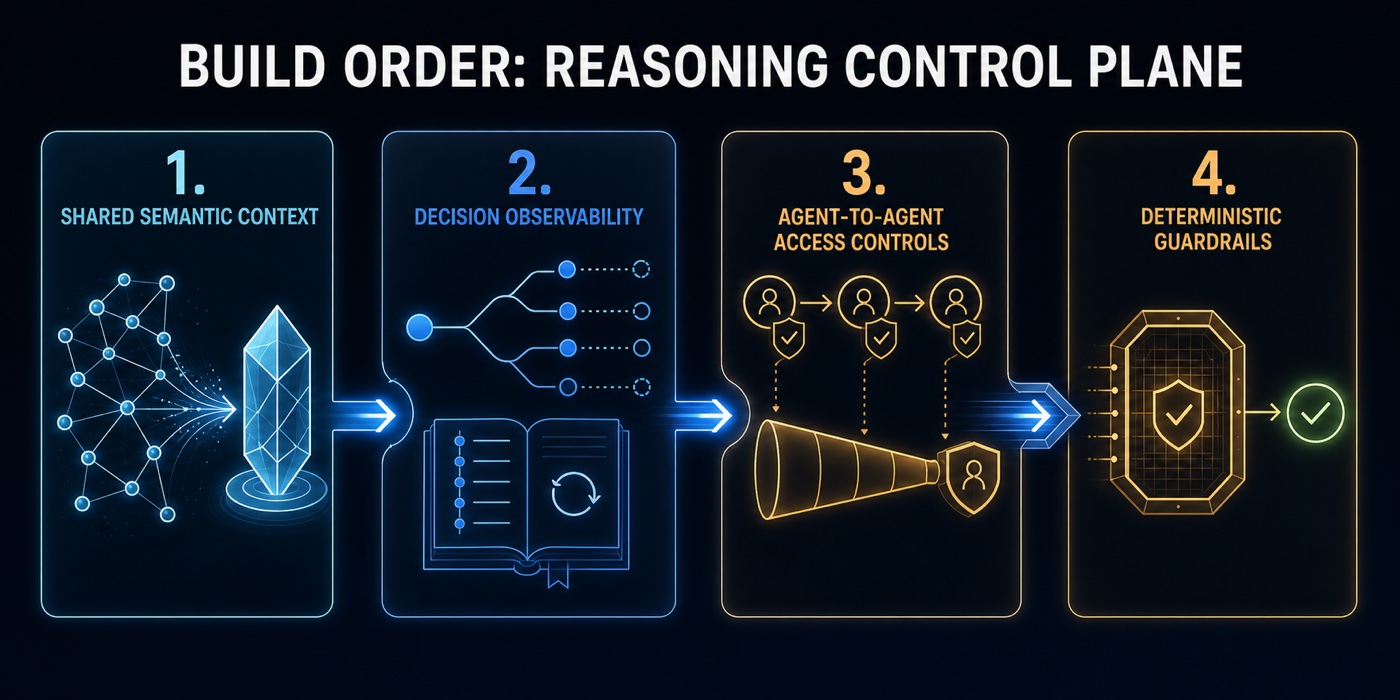
Semantic context is first because it unblocks everything else. Without it, no other layer has a stable substrate to reason about. Observability is second because you can't improve what you can't see. Every subsequent design decision gets easier when you can trace real behavior. Access controls come third because they contain blast radius as autonomy grows. Guardrails come fourth because they're the most application-specific. The right ones depend on knowing your regulated actions, and you rarely fully know those until you've shipped a pilot.
The Reasoning Control Plane isn't a product you buy. It's a discipline you adopt, layered across the data, application, and security planes you already run. No single vendor will market it as a coherent category for another year or two. But it's emerging as the architectural piece that separates multi-agent systems that survive from the ones that quietly break.
The organizations that recognize this now will build the infrastructure their agents actually need. The rest will keep debugging demos in production, wondering why the model is the problem when it never really was.
Opinions expressed by DZone contributors are their own.
Comments